[MOVIE]
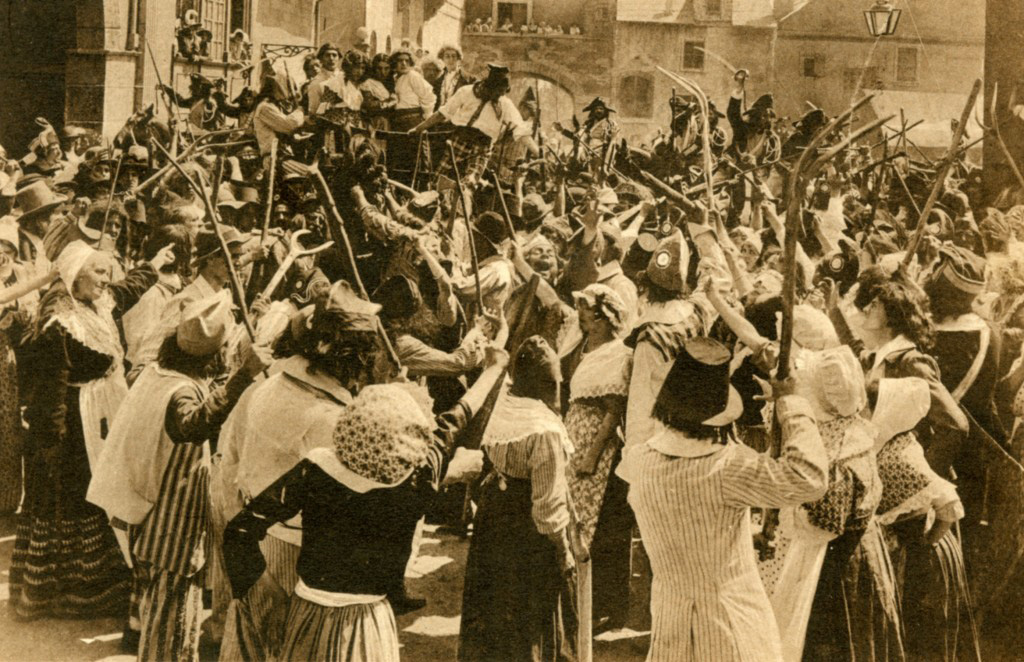
R.e Sc.: Enrico Guazzoni. S.: dall’omonimo dramma di Victorien Sardou. In.: Lyda Borelli (Madame Tallien), Amleto Novelli (tallien), Renzo Fabiani (Robespierre), Ruggero Barni (Guery), Ettore Baccani (Fontenay), Roberto Spiombi (un abatino), Orlando Ricci. P.: Cines. l.o.: 1855m. 16mm.
Edition History
Much celluloid has run through the gate in the seven years that have elapsed since this film, under the title of Robespierre, was acclaimed as the greatest production of the Cines studio, but it will still be admitted that, though the Cines producers have done much to raise the standard of artistic spectacle all over the world, there is still much in which they have never been excelled. Madame Guillotine, to call it by its new title, is still the most vivid and artistic picture of the French Revolution yet shown on the screen. The dramatic appeal of the earlier scenes is, perhaps, not so strong as it was when first shown, and the love affair between Thérèse and Jean Guery rather lacks interest and fervour, but the concluding scenes in which Robespierre becomes the centre of interest, the fête of the Goddess of Reason, the impressive settings in the Chamber of Deputies, and the climax when the corpse-like figure of the dying Robespierre is dragged to the guillotine have never been surpassed. The costumes and settings are superb, and no one can wear the clothes of the period with a better grace than the Italian actor. Some of the scenes at the Trade Show suffered by being out of focus, but as the same defect applied to the subtitles, it may be assumed that the fault was with the projector. The quality and lighting effects are of that artistic excellence which is a feature of the Italian studios, while the fine performances of Lyda Borelli as Thérèse, Amleto Novelli as Tallien, and particularly that of Renzo Fabiani as Robespierre, make this a revival of unusual interest.
Anon., “The Bioscope”, August 7, 1924

Restored in 1995 by Cineteca di Bologna, Cineteca Italiana and Cinémathèque française, with the contribution of Proyecto Lumière. The restoration used a nitrate camera negative without intertitles, found by Cineteca Italiana at the Pittaluga Archive, and a tinted and toned nitrate positive print with French intertitles kept at the Cinémathèque française. The colors were reproduced using the Desmet method
Lyda Borelli’s seventh film, the only one directed by Enrico Guazzoni, was already shown last year at Il Cinema Ritrovato. Therefore why are we showing it again? Simple – a print of the French version of the film has rediscovered in the inexhaustible archives of Cinémathèque Française. It is in colour and most importantly it has all the intertitles.
The copy presented last year was in 16mm and without titles. Collating the original negative saved by the Cineteca Italiana with the French version, it was possible to reconstruct a version of splendid photographic quality with sparkling colours (pink, orange, blue, yellow, and violet tintings, green, blue and sepia tonings, combinations of tinting and toning: pink on blue and pink on sepia).
Yet another element of interest: the film’s advertising material underlines the tragic ending of the story, when Teresia Cabarrus becomes Madame Tallien in order to save her lover Jean Guéry who dies, however, notwithstanding this sacrifice.
In both our versions (and one is the original negative), Guéry saves himself and so the film concludes with a happy ending, lightly veiled by a slight sadness. Evidently, at the moment of release of the film, when the advertising material had already been printed, those responsible for the film found the first ending too negative for the large audience which they wanted to attract.
A review from 1917
“Guazzoni, in putting on this sensational work must have encountered many difficulties. However, he overcame them brilliantly. He presents the episodes and vicissitudes which characterise the lives of Robespierre, Tallien, Teresa and the others around whom he revolved the plot of the film, with a wonderful sense of reality. The Convention scene is particularly beautiful and successful. The scenes of the masses are truly admirable as they give us an exact, rather than approximate, idea of memorable struggles and famous insurrections in those revolutionary times (the masses are laudably and magisterially disciplined and instructed when one takes into account the innumerable difficulties which cropped up).
Another particular which confers added value to Madame Tallien is the acting. The actors prove themselves to be perfectly in harmony with the action. I would say that they are absolutely informed about about the lives of the persons they depict.
Lyda Borelli plays a part which is not certainly suitable to assess her true value. However, she is natural, beautiful, enchanting and not worried (as I noted on previous occasions) about obtaining a plastic effect which often had a detrimental effect on her performances. Fabiani is very good, he is a perfect Robespierre, with his squinting glance, hard-set features and expression. Novelli is also excellent -an actor of beautiful physical presence and ingenuity, as also is Barni who made up the figure of Guéry with a rare nobility of attitude”. (Nino Maggi, La vita cinematografica, Turin, Jan. 7-15, 1917)