[MOVIE]
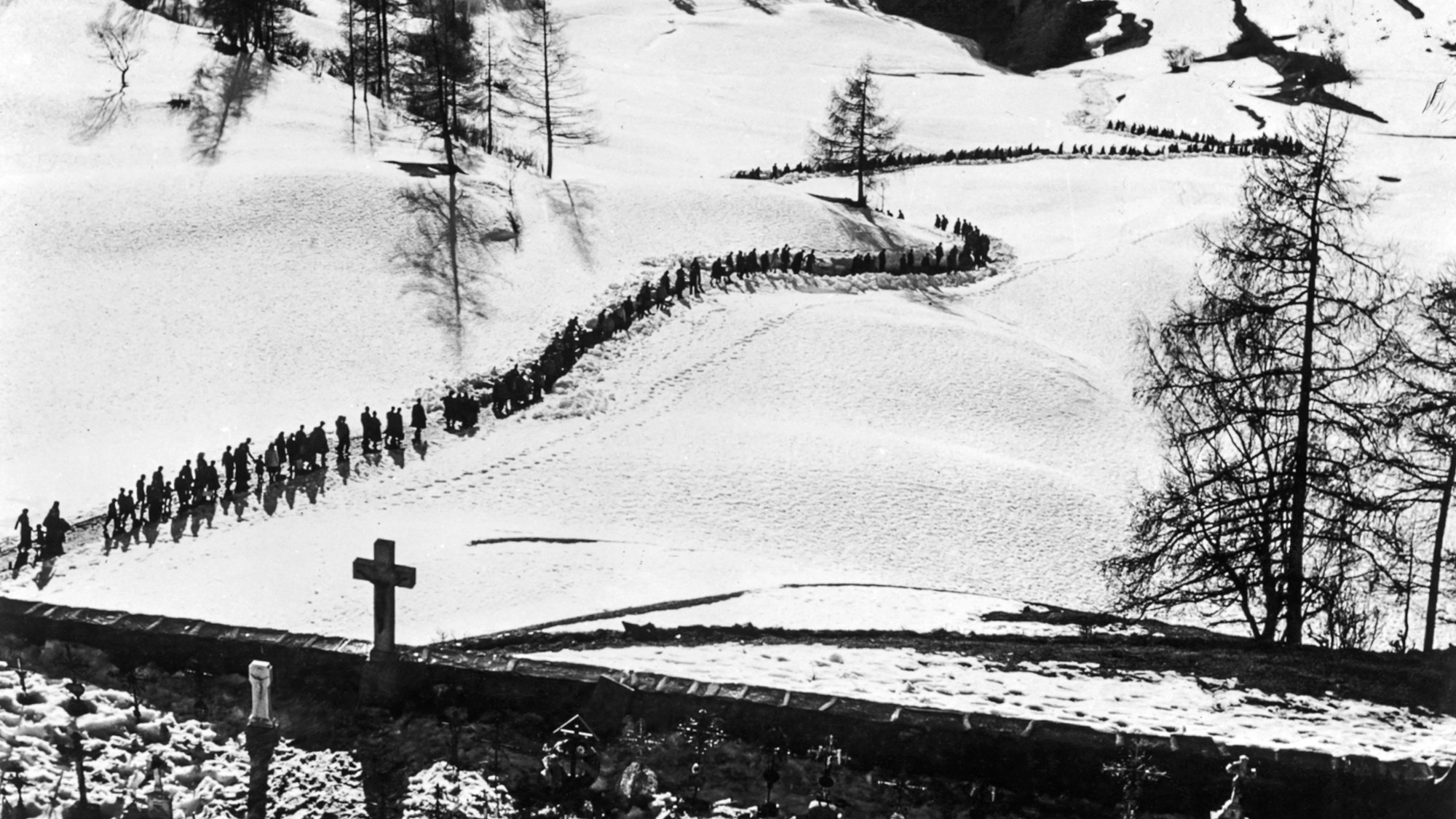
Sog., Scen.: Richard Schweizer. F.: Emil Berna. M.: Hermann Haller. Scgf.: Robert Furrer. Mus.: Robert Blum. Int.: Edward G. Morrison (maggiore inglese Telford), John Hoy (tenente inglese John Halliday), Ray Reagan (sergente U.S.A. James R. Braddock), Luisa Rossi (Tonina), Eduardo Masini (albergatore), Giuseppe Galeati (cocchiere), Romano Calo (prete), Tino Erler (Muzio). Prod.: Lazar Wechsler per Praesens-Film. DCP. D.: 102’. Bn.
Edition History
“Die letzte Chance deserves its place as a classic among prominent postwar films” (Hervé Dumont). One year after Marie-Louise, Leopold Lindtberg made a new deeply humanist film on the theme of war refugees in Switzerland.
When it decided to portray the situation of refugees, Praesens-Film immediately encountered numerous difficulties with the federal government, which was not really in favour of a work potentially critical of its position. The connections of the filmmakers – director Leopold Lindtberg and screenwriter Richard Schweizer in particular – with the Schauspielhaus, considered to be a ‘den of refugees’ with communist connections, encouraged the government to regard the project with utmost suspicion. On several occasions the army complicated the shoot, forbidding access to certain planned locations and refusing to grant authorisation for the shoot. Once the film was finished, every effort was made to delay its release, at least until the end of the war. Certain Germanophile members of the military even demanded the destruction of the negative. To obtain its release, the producers had to accept shortening a scene. Still, Richard Schweizer’s screenplay was the fruit of long conversations and investigations, even if, according to director Leopold Lindtberg: “The story of this film is a harmless fairytale compared to the real facts. […] It is not a film for those who have known misfortune, but for all the others – the happy, the spared that it might encourage them to think”. Die letzte Chance met with major international success. It won the Grand Prix at Cannes in 1946, where the jury of the National Union of Intellectuals, presided by Paul Éluard, awarded it the International Peace Award. Distributed by MGM in the United States, it won a Golden Globe. Georges Sadoul and Henri Langlois, and filmmakers Jean Grémillon, Alberto Lattuada, Luigi Comencini and Alfred Hitchcock in particular sang the praises of the film, which rigorously presents the vicissitudes of war and persecution.

courtesy of Praesens-Film and SRF. Restored in 4K in 2016 by courtesy of Cinémathèque suisse and Schweizer Radio und Fernsehen at Digimage from a combined interpositive copy from Cinémathèque suisse’s archives and a copy fragment from Toulouse. With funding provided by Memoriav
“Die letzte Chance deserves its place as a classic among prominent postwar films” (Hervé Dumont). Coming a year after Marie-Louise, it marks a new oeuvre for Leopold Lindtberg: a deeply humanist film on the theme of war refugees in Switzerland.
When it decided to portray the situation of refugees, Praesens Film immediately encountered numerous difficulties with the federal government, which was not really in favour of a work potentially critical of its position. The connections of the filmmakers – director Leopold Lindtberg and screenwriter Richard Schweizer in particular – with the Schauspielhaus, considered to be a ‘den of refugees’ with communist connections, encouraged the government to regard the project with utmost suspicion. On several occasions the army complicated the shoot, forbidding access to certain planned locations and refusing to grant authorisation to film. Once the film was finished, every effort was made to delay its release, at least until the end of the war. Certain Germanophile members of the military even demanded the destruction of the negative. To obtain its release, the producers had to accept that a scene be shortened. Still, Richard Schweizer’s screenplay was the fruit of long conversations and investigations, even if, according to director Leopold Lindtberg: “The story of this film is a harmless fairytale compared to the real facts. […] It is not a film for those who have known misfortune, but for all the others – the happy, the spared – that it might encourage them to think”.
Die letzte Chance met with major international success. It won a Grand Prix at Cannes in 1946, where the jury of the National Union of Intellectuals, presided by Paul Éluard, awarded it the International Peace Award. Distributed by MGM in the United States, it won a Golden Globe. Georges Sadoul and Henri Langlois, and filmmakers Jean Grémillon, Alberto Lattuada, Luigi Comencini and Alfred Hitchcock in particular sang the praises of the film, which rigorously presents the vicissitudes of war and persecution.
Restored by Cinémathèque suisse and Schweizer Radio und Fernsehen with the support of Memoriav at Hiventy laboratory, from a nitrate interpositive and from a fragment of a shot from an earlier internegative