[MOVIE]
Sog.: based on the novel (1921) by Booth Tarkington. Scen.: Dorothy Yost, Mortimer Offner, Jane Murfin. F.: Robert De Grasse. M.: Jane Loring. Scgf.: Van Nest Polglase. Mus.: Max Steiner, Roy Webb. Int.: Katharine Hepburn (Alice Adams), Fred MacMurray (Arthur Russell), Fred Stone (Virgil Adams), Evelyn Venable (Mildred Palmer), Frank Albertson (Walter Adams), Ann Shoemaker (Mrs. Adams), Charles Grapewin (Mr. Lamb), Grady Sutton (Frank Dowling). Prod.: Pandro S. Berman for RKO Radio Pictures. 35mm. D.: 99’. Bn.
Edition History
The film that made Hepburn a star features her as a cheerful-on-the-outsidesad- on-the-inside young woman living in a small town who has aspirations above her class and family. George Stevens directs this adaptation of a novel by Booth Tarkington (The Magnificent Ambersons), and somehow through his chemistry with Hepburn, makes the potentially odious figure of a social climber not only attractive but moving.
The head of the Adams family (Fred Stone) is something of a permanent invalid living on his boss’s kindness. The harpy mother berates him for not getting off his bottom and improving himself (and them) in the world. The turning point comes when Hepburn is going to a debutante party and can’t even afford a pretty dress or corsage. She plucks some flowers from a public garden to make a posy. At the party, Hepburn the wallflower is seated alone, when Fred MacMurray plucks her abandoned posy from the floor and gives it to her, to her mortification. Luckily he is undaunted by the wilted mess, and will woo the awkward Hepburn to everyone’s astonishment, not least her own. (Interestingly, they meet again as she is mounting the steps to take a secretarial course; love will intervene.)
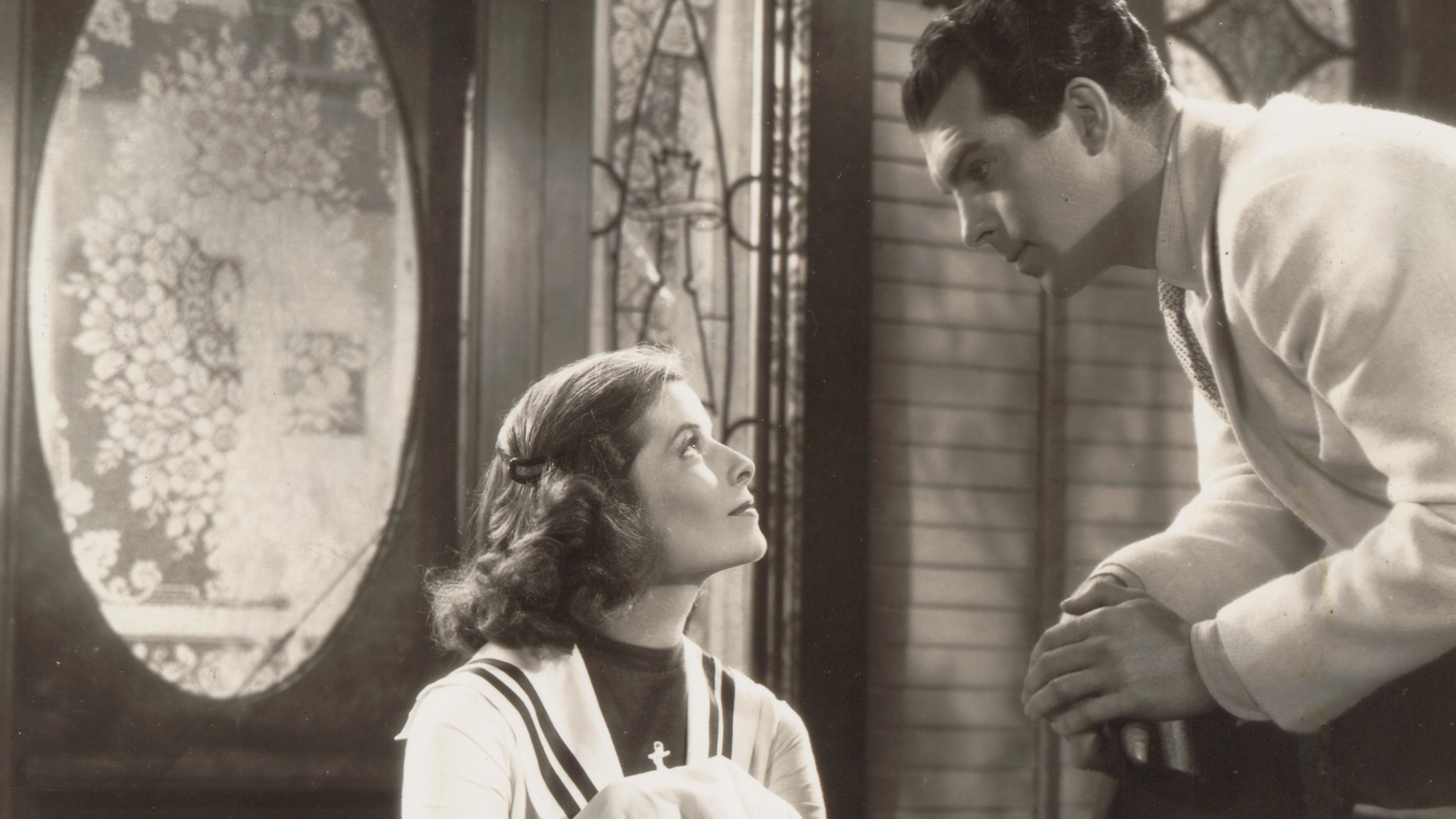
As she’s too embarrassed to have him see the shabby interior of her house, their courtship takes place on the porch on successive nights and it’s here we see in its most dramatic form the female identity crisis, the need not just for male approval but for self-definition.
In her desperate gaiety, she looks into his eyes, appeals to him to show her who she is. In the beginning, her posh accent seems out of place, but gradually we see it as a kind of histrionic artifice, one of the acting tools of a woman who wants desperately to be something else, but what? She glows with desirability under George Stevens’ sympathetic direction, her social climber becomes a parable about women’s search for their place in the world.
Molly Haskell

Restoration credits
Courtesy of Blackhawk Films
Perhaps there’s nothing more excruciating than pretending to be something one is not – and no humility greater than having it exposed. But humility in itself could be a noble feeling when, after the pretensions are stripped away, one arrives at a moment of painful enlightenment. This is the essence of Alice Adams, a tightknit blend of humour and pathos, and what is generally regarded as Stevens’s entry into the league of greats. This first sound adaptation of Booth Tarkington’s 1921 novel (after a 1922 version directed by Rowland V. Lee), is about snobbery in a small town and a young girl from a poor family trying to find her way in society; to be recognised and to be loved. Katharine Hepburn, whose previous two pictures had been poorly received, wanted William Wyler as director but instead got Stevens, whose poker face and wordless presence at first baffled and disconcerted her. Stevens reworked the script with Hepburn in mind – an actress who was herself out of place in Hollywood, pretending to be something she was not. Stevens lightened up his ‘crescendo of suffering’ with remarkably effective comic scenes. The idea for driving a jalopy comes from Two Tars and the awkward family dinner scene is a revamp of Pass the Gravy (Fred Guiol, 1928), both shot by Stevens. Also the theme of the upstart trying to improve his or her social status, leading to misery, wasn’t unknown to Stevens, who regularly showed an interest in this subject, from Annie Oakley to A Place in the Sun. The film’s original ending, in which Alice searches for a job, was replaced with something more upbeat. As a maca bre joke, Stevens even filmed an ending that suggested suicide to irritate the studio heads. The gossip columnist Hedda Hopper plays Mrs Palmer; Hattie McDaniel steals the picture as the ill-at-ease maid, and Fred Stone’s performance as the ailing and failing father is the most moving. By the end of the picture, Hepburn and Stevens were lovers. Hepburn biographer Barbara Leaming argues that through this collaboration Hepburn gained an Alice-Adams-like confidence to take herself seriously as an artist. The rest is history.
Ehsan Khoshbakht
Restoration credits
Courtesy of Lobster Films