

Film notes
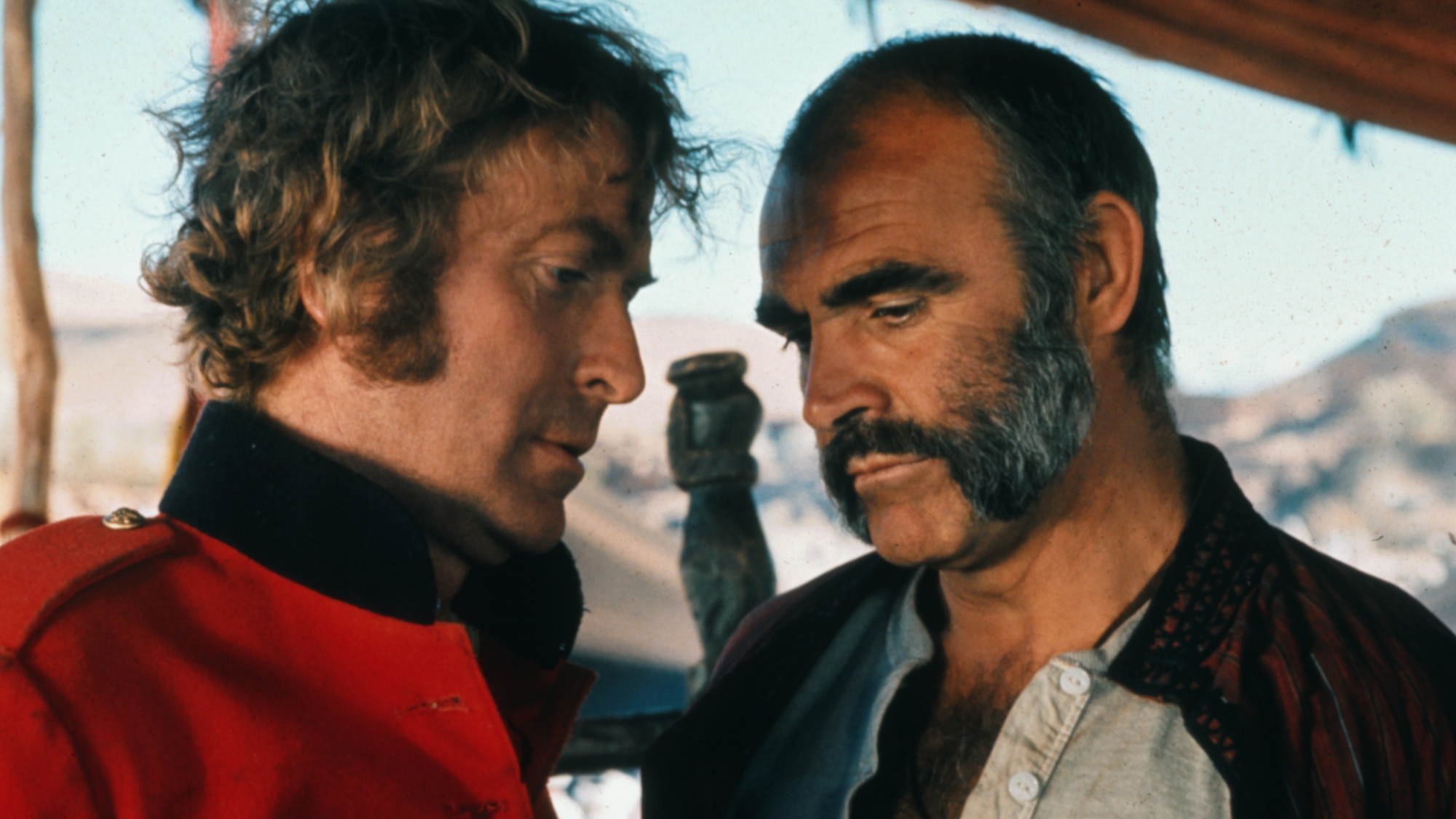
At nearly 70, Huston finally took on Rudyard Kipling with The Man Who Would Be King, a project he had been eyeing for more than 20 years … Huston had always admired the author of Kim and The Jungle Book, a mystic of Authority and Law who believed passionately in Liberty. There is no need to rack one’s brains, however, to discover why he was drawn to this magnificent story, which earned the praise of J.M. Barrie and Somerset Maugham. Daniel Dravot and Peachy Carnehan, the two roguish companions, former sergeants in the British Army, who conceive and carry out the mad plan to conquer – and plunder – the remote little kingdom of Kafiristan, beyond the Khyber and the mountains of Afghanistan, have the makings of the typical Hustonian hero, “condemned to have no law but his own”, that is, endowed with ontological freedom, with total openness to possibility: neither God nor master. It would be equally easy to find in the story that theme of defeat and cruel mockery, which robs the heroes of the fruits of their labours, perhaps over-theorised as the central motif of Huston’s cinema … More important still, however, are the themes of the loyal friendship binding the two adventurers and that of their defiant faith in the success of their reckless enterprise. As Huston himself says, The Man Who Would Be King has everything a good story should have: excitement, colour, spectacle and humour; adventure, drama, tragedy and good dialogue; truth, honesty and irony. While remaining outwardly faithful to Kipling and his characters, Huston imperceptibly shifts the story’s register, and not only in the dialogue, through irony: the belief in “the white man’s burden” and in the mission of the British Empire, which young Kipling bends unsparingly toward the grotesque, is eaten away, within the film, by acidic sarcasm that does not contradict the epic-adventurous dimension of the narrative. Huston rereads Kipling critically without distorting or falsifying him: he brings to the surface what in Kipling lies underground, makes plain what in the story is latent.
Morando Morandini, John Huston, Il Castoro, Milan 1995