Film notes
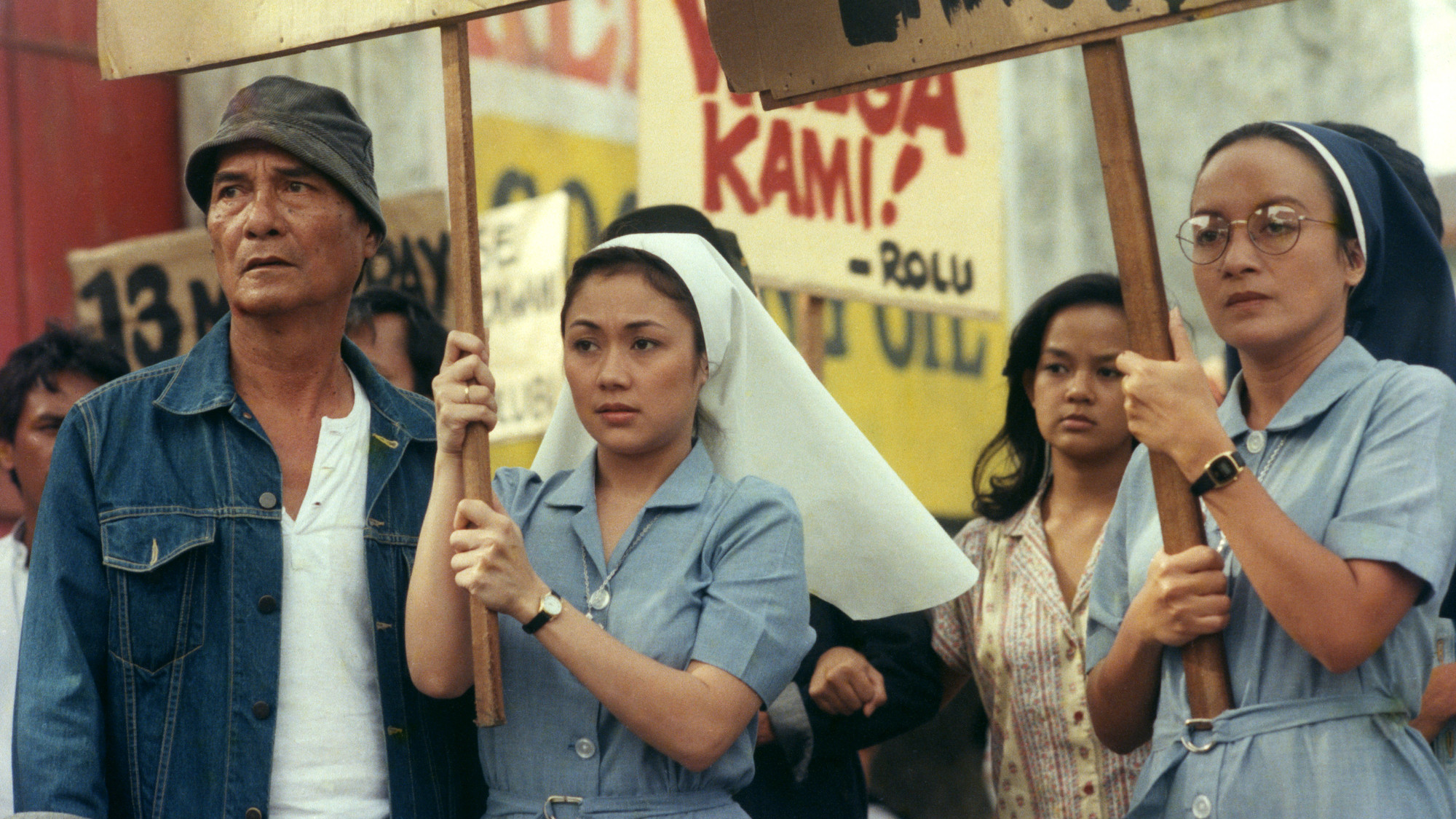
Sister Stella L is arguably the first motion picture from a major Filipino studio to respond to the assassination of Benigno “Ninoy” Aquino Jr. Not directly – the story focuses on Sister Stella Legaspi (Vilma Santos), her involvement in a cooking-oil factory strike, and her gradual awakening into full political awareness; no mention of Marcos, or of martial law. The fact that the film spoke frankly of labour unrest, featured songs and chants with a decidedly socialist slant, and towards the end suggested that police or military officers might be involved as strikebreakers – those were outright acts of courage, however. Everyone assumed Marcos’s grip on the nation was tight as ever, his ability to silence critics – or worse, make them “disappear” – as absolute; everyone assumed – and in those early days, they may have been right – that people’s lives were in danger, thanks to this film. But they were in an angry mood, and would not be silenced. You feel it radiating from Pete Lacaba’s script – like fever heat – and you feel it in the chanting sometimes heard on the soundtrack. Make no mistake, this is a Pete Lacaba film more than it is even a Mike de Leon film; the narrative is linear, the script construction muscular, the dialogue lean and functional … But de Leon has one of the strongest if not the strongest and most distinctive visual style in all of Philippine cinema, and subsuming it to the scriptwriter is no small feat … de Leon’s camera serves his story at all times, but the choice of material, the way the story unfolds, the overall tone you sense from one of his pictures – dark if not sardonic, at times both – is so unmistakable it’s startling to see the warmer, more earnest emotional palette found in this film. This combination of passionate (but rigorous) intelligence, and the intellectual chill surrounding it, holding it together, giving it form and structure, is a bracing mix – de Leon and Lacaba have not worked together since, so it’s possible this may be the only example of such a brew in local films, at least for now.
Noel Vera, Critic After Dark: A Review of Philippine Cinema,
BigO Books, Singapore 2005