
Film notes
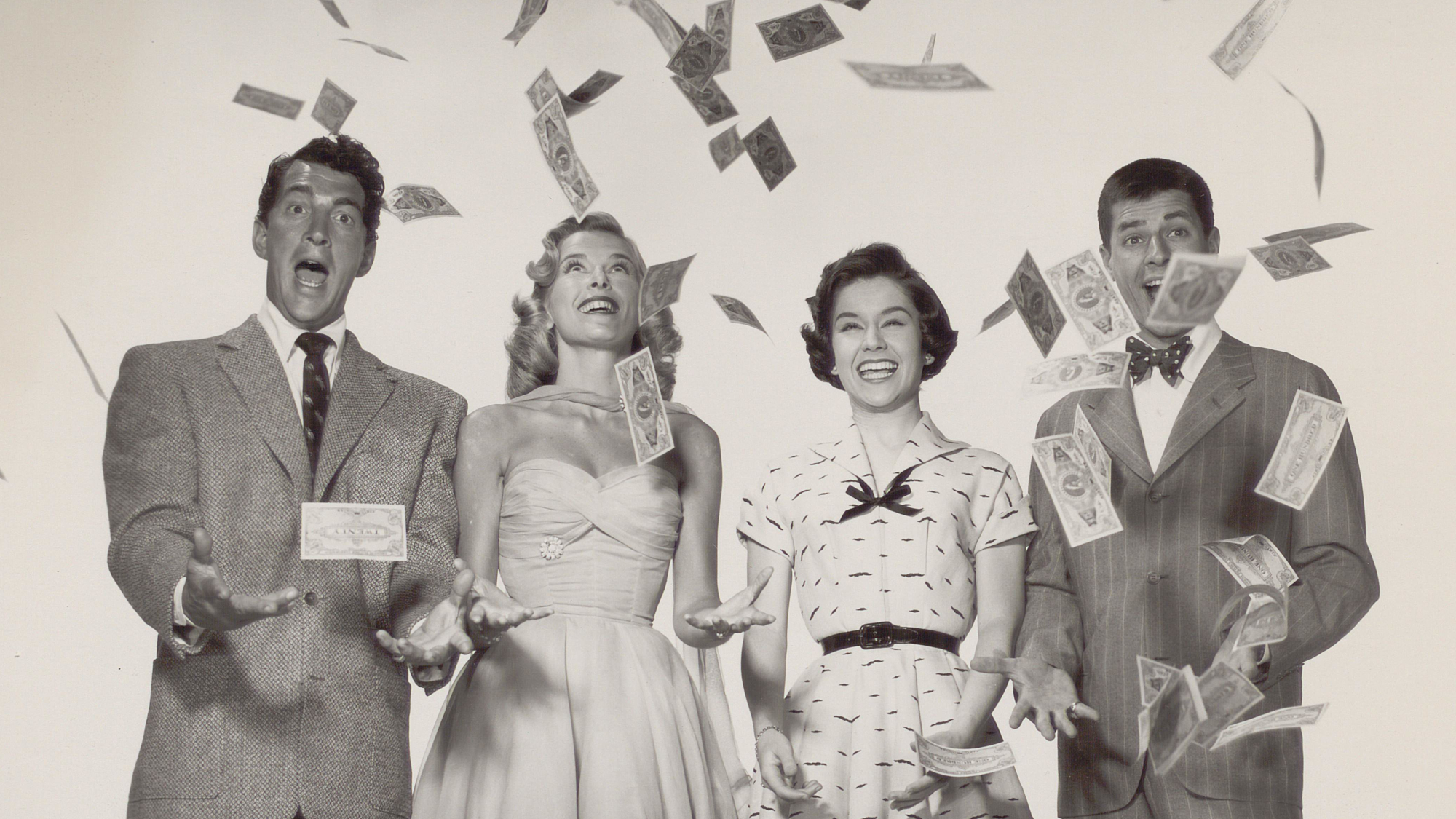
Dean Martin is a luckless racehorse bettor who, in order to clear his debt to gangsters, teams up with his hapless cousin – a veterinarian’s assistant played by Jerry Lewis – and the two become involved in various shenanigans. Here the majority of the jokes stem from the national and ethnic stereotypes of the boozy English gentleman and a sheikh with his colourful group of concubines. This is a 1950s film to the core in its reliance on the self-deluded concept of the triumph of (American) innocence in comedy and its eschewal of the complexities of gender, class and international relations, the latter embodied in the troubled relationship with America’s old cousins (the British) and new partners (the oil-rich Arab nations). Jerry, as Virgil (the closest name the screenwriter Hal Kanter could find to “virgin”), is virginal not only in his relationship with women, but more generally in relation to 1950s America. He unconsciously contributes to the fantasy balance required between his self-assumed innocence and Martin’s artful fraudulence on the road to mutual affluence. What is striking, though, is how Lewis’s own directorial work would later break that very mould and reject the idea of assimilation and conformism, making comedy out of agonising incompatibility. It is directed by George Marshall, who meant something to Lewis: Marshall directed Lewis’s first film, My Friend Irma (1949), and Lewis appeared in Marshall’s final film, Hook, Line & Sinker (1969), while three other collaborations were forged in the 20 years between them. Although Marshall was past his prime, and his finest comedies – including some Laurel and Hardy films – were made in the 1930s, Lewis, in conversation with Chris Fujiwara, still had some gentle words for the old-timer, calling him “very inventive” and someone with a natural sense of humour. The film was released in 3D during a strong year for the novelty format, and it can now once again be seen in stereoscopic form thanks to a new restoration.
Ehsan Khoshbakht