

Film notes
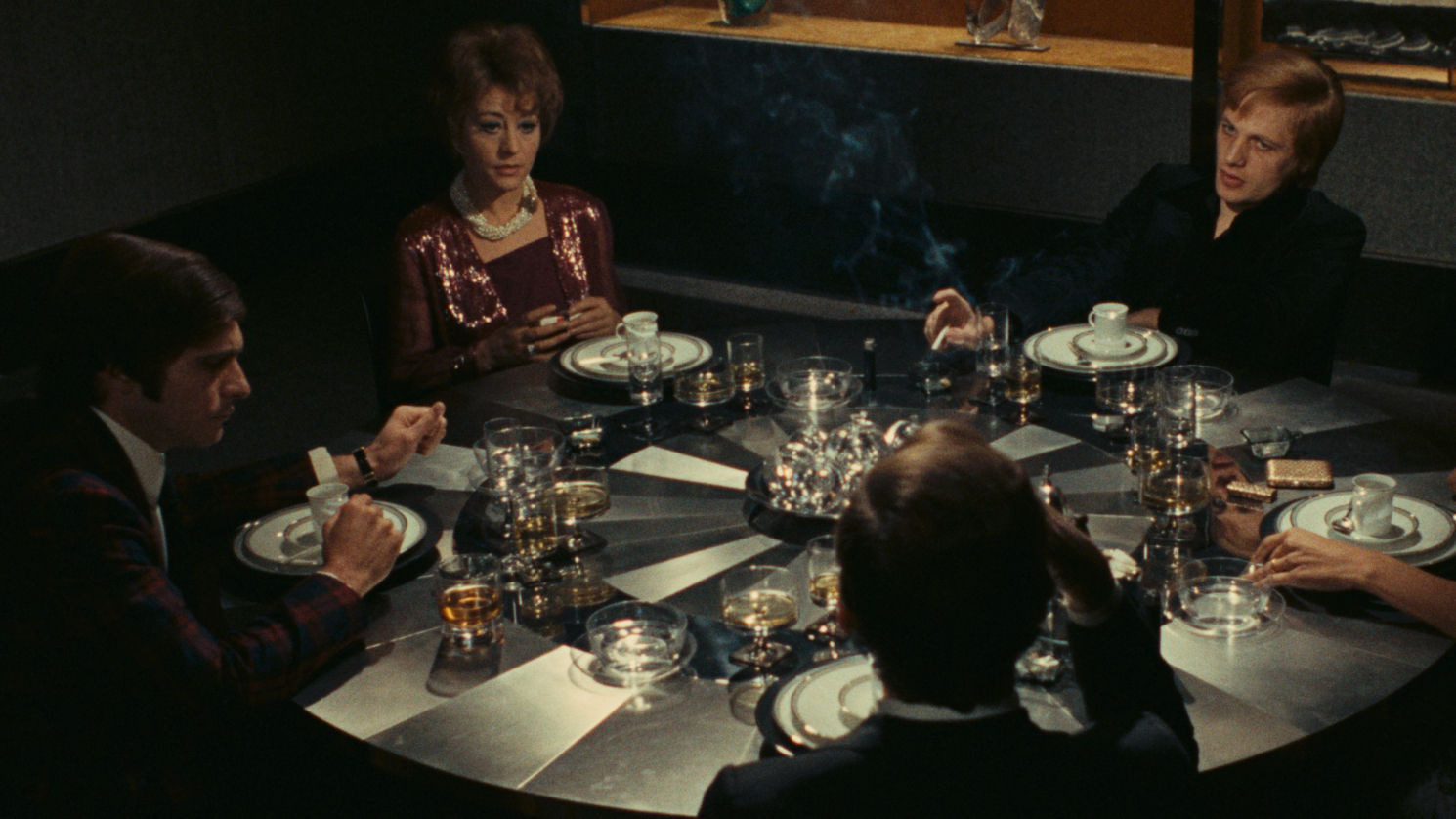
In 1969 Giuseppe Patroni Griffi adapted Metti, una sera a cena from his own play, which had enjoyed great success on stage in 1967 … With undeniable skill, he takes the quintessential topos of bourgeois theatre, the love triangle, complicates it with inflexions of sexuality unaccounted for by tradition and drains it of drama … He creates a series of characters emblematic of contemporary life whose overriding preoccupation (even if they parade cultural consumption and intellectual professions) is sex … Bolstered by Ennio Morricone’s hypnotic score, Patroni Griffi stretches time, loses himself in the contemplation of Florinda Bolkan’s skin and keeps alive a voyeuristic tension that remains largely unsatisfied … The three-way relationship is not a fearful transgression but the acknowledgement that bodies and desires move freely among people who belong to the same group. In this sense Alberto Moravia had seen clearly: for him, the film’s greatest interest lay in the observation that “the truly important social unit today is no longer the family but the clan”. And within the clan the patriarchal structure collapses, gender hierarchies weaken, roles blur. Between men and women there are no longer any differences … It is Nina who is the truly new character, the one who captures the imagination and accounts for the enormous success of a film that is anything but “popular”, built as it is on flashbacks, interweaving of fantasy and reality, and didactic Pirandellisms … Bolkan – “sibylline face and sinuous movements”, as Moravia writes – has almost severe features and an androgynous physique, which she can display with greater nonchalance and naturalness, as though her barely prominent breasts provoke less disturbance. The effect is probably the opposite: her slight departure from the canons of traditional femininity becomes the symptom of a new femininity, more exciting, unfamiliar and less easily regimented … But the strength and originality of the film also lies in its staging of eros while refusing the easy way out of tragedy, avoiding the death of any character, ignoring redemption and the shortcut of pathos. And this remains a rarity even today.
Alberto Pezzotta, La commedia borghese della rivoluzione sessuale, “Cinergie. Il Cinema e le altre Arti”, n. 5, 2014