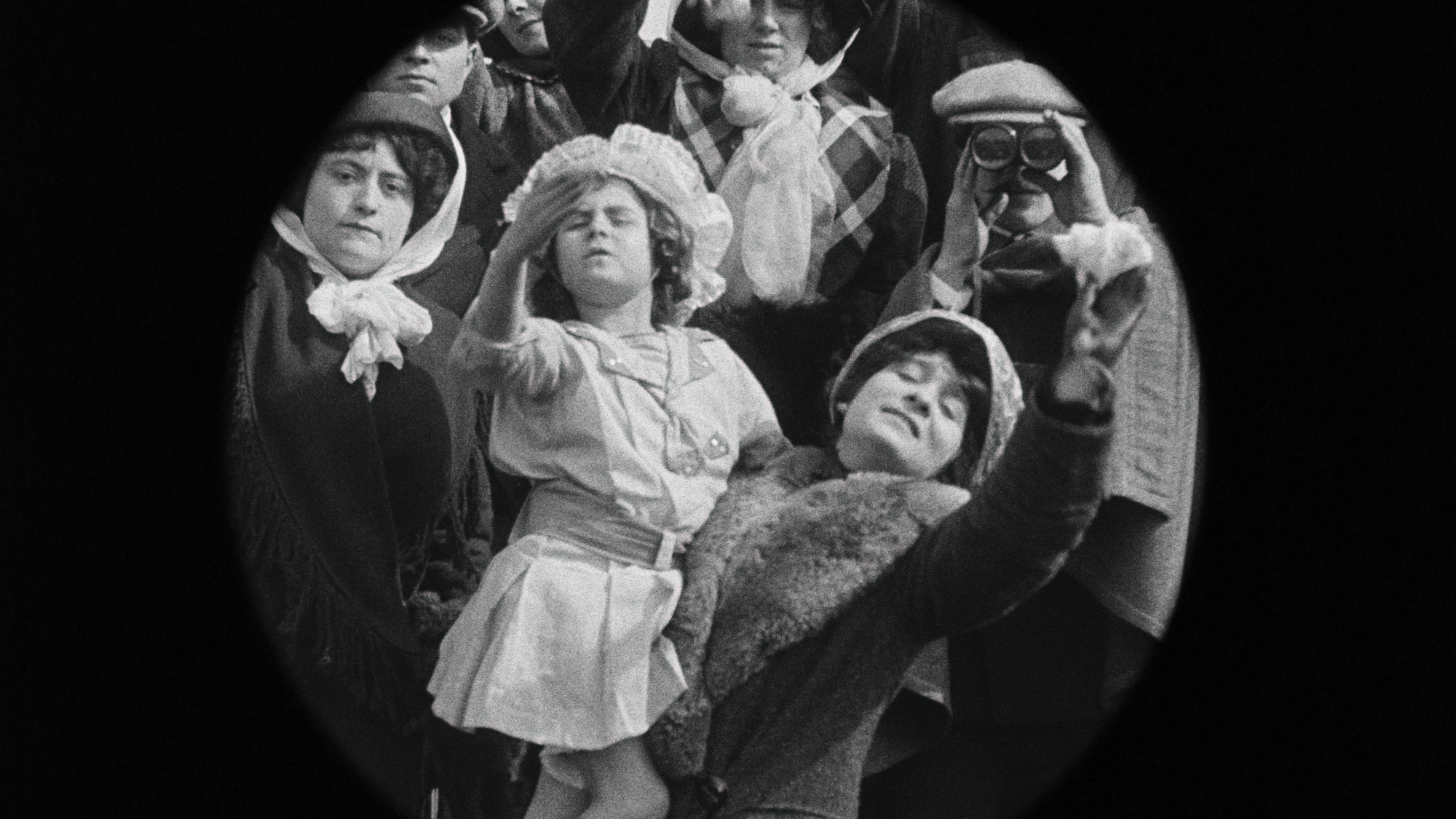
Film notes
Léonce Perret knew how to wield his refined cinematic syntax. While Feuillade confined himself to pedestrian, conventional vocabulary, Perret unleashed a brilliant display of all his savoir faire in editing, variations in shot composition or backlighting, along with the remarkable cinematography of his cameraman, Specht … Based on a banal script drawing on Ennery’s drama, The Two Orphans, while mixing in a few nationalistic scenes, Léonce Perret managed to craft a fluid and lively narrative by channelling an extremely refined cinematic vocabulary: backlighting, close-ups, low-angle shots, camera movements and a thousand other innovations he employed with flair, a direct contrast to Feuillade’s trademark austerity and a certain latent primitivism in Griffith’s cinema. In terms of the richness of his form – albeit not of his artistry – Perret surpassed Griffith’s Birth of a Nation, thereby establishing that French technique was still superior to American (except in editing).
Georges Sadoul, Histoire générale du cinéma. Tome III: Le cinéma devient un art (1909-1920). Premier volume: L’avant-guerre, Éditions Denoël, Paris 1951
Sadoul would speak very highly of Perret, claiming that he had outshone Griffith’s The Birth of a Nation. Such enthusiasm was arguably excessive. Nevertheless, it is a pleasure today to discover this scarcely known filmmaker. L’Enfant de Paris is propelled by a very dense, lyrically narrative screenplay, offering a series of episodes as fantastical as they are dramatic. Marie-Laure is a young girl whose mother dies of grief upon hearing of her husband’s disappearance. Shortly thereafter, the child is kidnapped by a cynical thug hoping to profit from his prey. Featuring police searches, highspeed chases, escapes and hideouts, Perret’s cinema possesses an undeniable sense of tempo. A work of finesse (great attention is paid to the lighting and shot composition), L’Enfant de Paris is at times reminiscent of, or perhaps even a precursor to, Franju’s fantastical realism (an association that strikes me as more fitting than the poetic realism suggested by some).
Jacques Morice, “Cahiers du cinéma”, n. 463, January 1993