
Film notes
A hundred years ago, Hugo von Hofmannsthal compared films to dreams, and ever since, film theorists have been obsessed by the relationship between dreaming and the cinema. When film plots involve dreams, the viewer’s ‘para-oneiric’ state becomes even more intense. Moreover, dreams are often incomplete, full of jump cuts and unintelligible actions by unknown people with intense but unexplained emotions, exactly like the fragments presented in this programme.
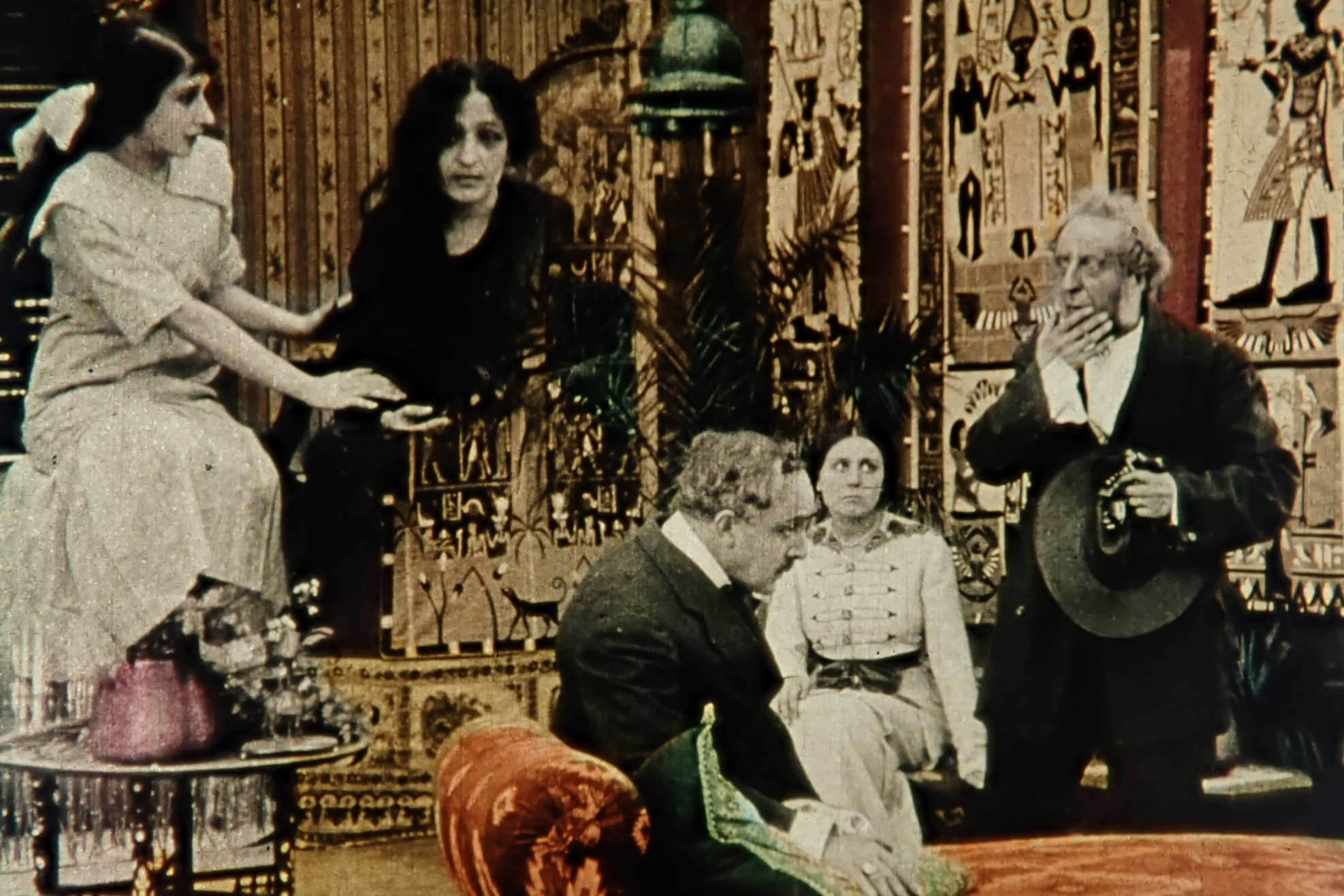
The device of a frame narrative for a dream vision or a visualised tale, very popular in European cinema in the early 1910s, can be seen in the imaginative Dream of a Shepherd, an unidentified Ambrosio production that smacks of scenarist Arrigo Frusta. It is echoed in the Messter-fragment No. 5647 where the dream anticipates a fatal destiny and helps to avoid it. Telling a tale can also provide a frame device for a flashback, as in La fuga dei diamanti. More spectacularly, visualisations of tales can appear in a partial insert in the frame, like a small screen, as in one of the most beautifully dreamlike films in the Komiya collection, the enigmatic No. 5563. With its stunning stencil-colouring and unreliable editing, this F.A.I. film leads us from one haunting landscape to another and into a vividly decorated Egyptian room, where a man conjures up the vision of a mad woman to stop another man seducing another woman… A shot confronting us with the question: where are we aesthetically in 2021? Far away, indeed.
In the Genina film Il castello del diavolo, a medieval tale about a Faustian bargain and the everlasting battle against unrighteousness is evoked within a contemporary frame narrative. No other art equals cinema in the effet du réel it achieves for re-enactments of times past, and Italian film production used this potential to its fullest. Napo Torriano, shot in 1910 on location in Lombardy castles, using authentic props provided by members of the Milanese aristocracy, who also acted in the film, still looks impressive in 2021.
Karl Wratschko