Film notes
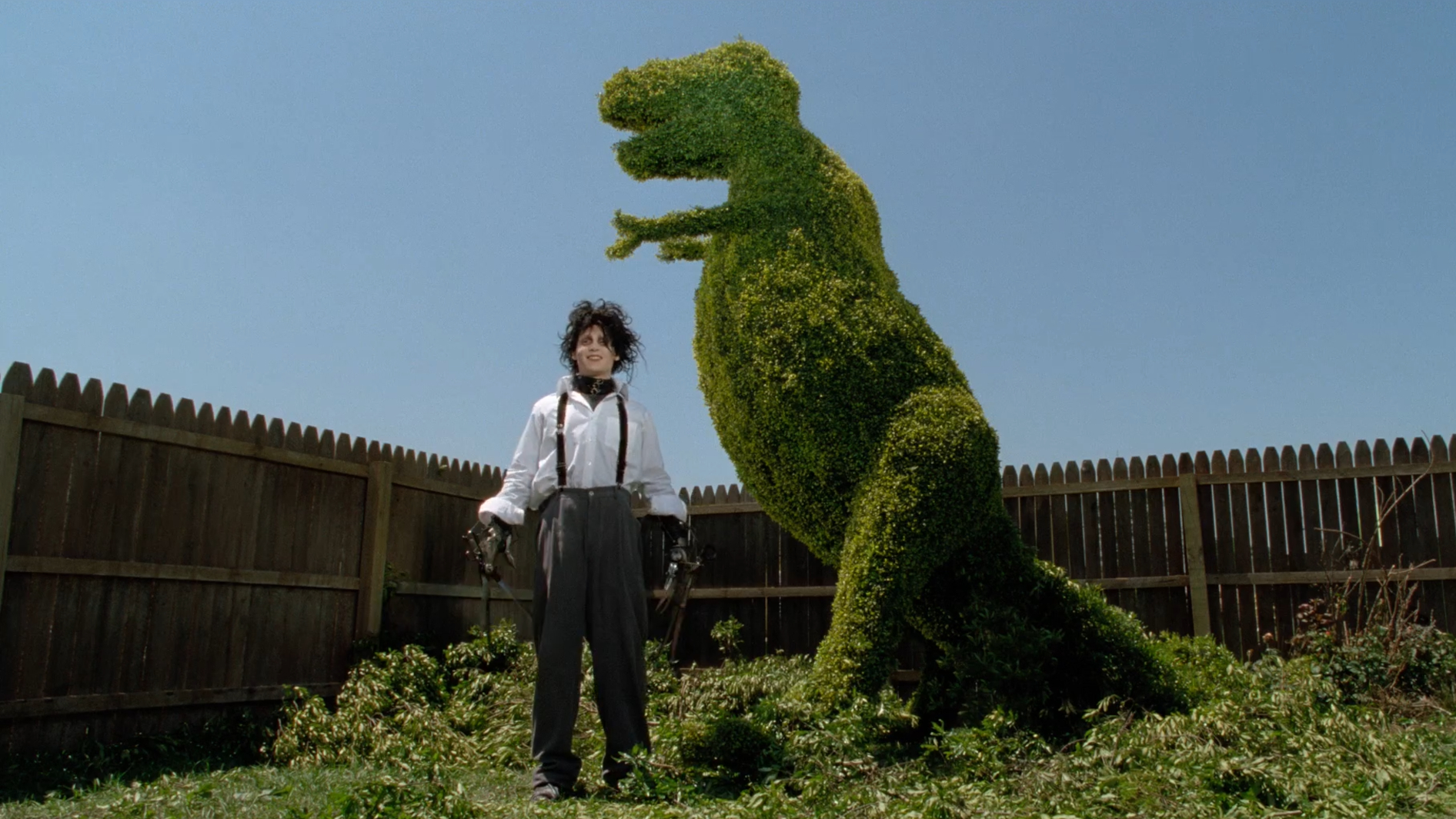
Edward Scissorhands was a deeply personal project. The film’s central character – a creature fashioned from nothing, encased in a leather shell like a machine brought to life, an “unfinished” boy with a pale porcelain face, who lives in the solitude of his Gothic castle and whose creator gave him knives and scissor blades in place of hands – was born from Tim Burton’s imagination and childhood, and was first sketched during his time at Disney … The film’s narrative form is equally personal: a grandmother tells a bedtime story to a little granddaughter who cannot fall asleep, and the grandmother will turn out to have been the monster’s girlfriend, Kim, the only person who truly understood him. She lives in anticipation of the return of this being, driven out by the townspeople and most likely taking refuge in the attic of his castle, a structure that looms over the eternally calm, pastel-coloured suburb from which Tim Burton conjures the most seductive and terrible deformities. For Burton, the end of the world is embodied by the symbols of contemporary American happiness, pushed to extremes, piled together and bloated, on the verge of imploding under the weight of their own presence: in Edward Scissorhands, the pastel-coloured houses, the gardens, the streets and the neat, well-kept cars are also signs of decay. Urban anxiety is now steering the world toward ruin, toward the end, toward definitive devastation, and drives “creatures” out into the open. The anxiety bred by this quiet, exasperated happiness draws the monsters out of their hiding places. And it is these creatures, all those monsters generously adopted by the filmmaker, true survivors, whose skin bears the last traces of a now rare art: cinema.
Antoine de Baecque, Tim Burton, Lindau, Turin 2007
I remember growing up and feeling that there is not a lot of room for acceptance. You are taught at a very early age to conform to certain things. It’s a situation, at least in America, that’s very prevalent and which starts from day one at school: this person’s smart, this person’s not smart, this person’s good at sports, this one’s not, this person’s weird, this one’s normal. From day one you’re categorized. That was the strongest impulse in the film.
Tim Burton, Burton on Burton, edited by Mark Salisbury, Faber & Faber, London 2000