The Cinephiles’ Heaven
[2018]
Programme curated by Cecilia Cenciarelli
A turning point for the Keaton Project, co-launched with the Cohen Film Collection in 2015 for to restore the films Buster Keaton made between 1920 and 1928. Sixteen of the thirty films – shorts and feature-length – have been completed. The roughly two-hundred elements inspected, repaired and analysed came to Bologna via Cohen Collection (former Rohouer’s) as well as from many film archives around the world. One of the outcomes of this project has been to finally have an accurate maps in terms of the location and condition of the film elements, including those we have not been able to access due to rights-related reasons. Luckily, that has only be the case only for a small minority, but it does confirm the importance of thoroughly and transparently documenting the selection and choices made during the reconstruction and restoration process, even more so in the digital era. It is also the evidence that the work carried by film archives is truly irreplaceable because of its inherent complexity and constant negotiating. As usual, the four films in this programme have been following the progress made with our research as opposed to chronological order. The difficulties encountered were mainly related with the poor conditions and/or deterioration of the materials (The Frozen North, for instance) or with incomplete first generation elements and choices regarding how and how much to integrate them with others (like The Scarecrow). In our case, we aimed to achieve a harmonious balance between completeness and the image’s photographic quality.
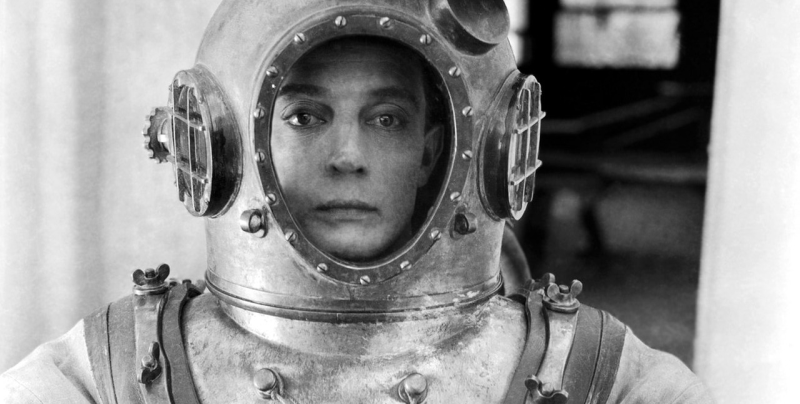
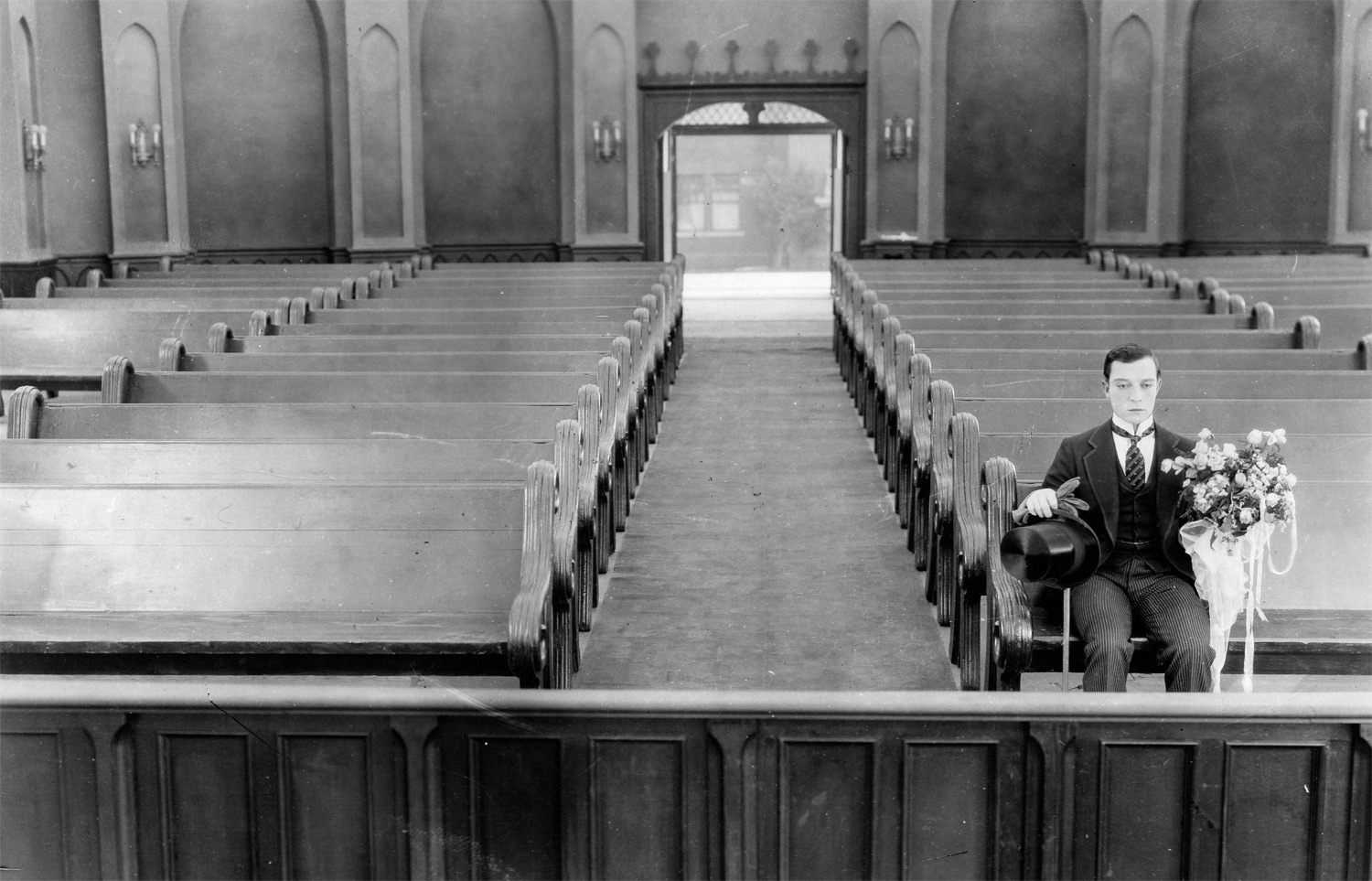
Watching these four films in succession demonstrates that the nineteen two-reelers Buster Keaton made in less than three years were anything but training for feature-length films. And the fact that this artist’s evolution does not seem as linear as his contemporaries, if not in the greater means available to him, perhaps derives from the fact that he had an innate, clear idea of film. Regardless of the overall success of his individual films, it is evident that ever since the beginning of his independent career Keaton conceived every comic situation “imagining it” in cinematographic terms. He told his stories with a movie camera instead of planting it somewhere and acting in front of it. Nor do we have to wait for his more complicated works, like The Navigator and Go West, to feel his magnetic gaze.
NB: Keaton’s eyes and gaze have been written about vastly, as we know. García Lorca’s short theatre piece El paseo de Buster Keaton perhaps says it best: “His sad infinite eyes, like those of a new-born animal, are dreaming of lilies, angels and silk sashes. His eyes are like the bottom of a glass, like a mad child’s. Very ugly. Very beautiful. An ostrich’s eyes. Human eyes in the exact balance of melancholy”.
Cecilia Cenciarelli
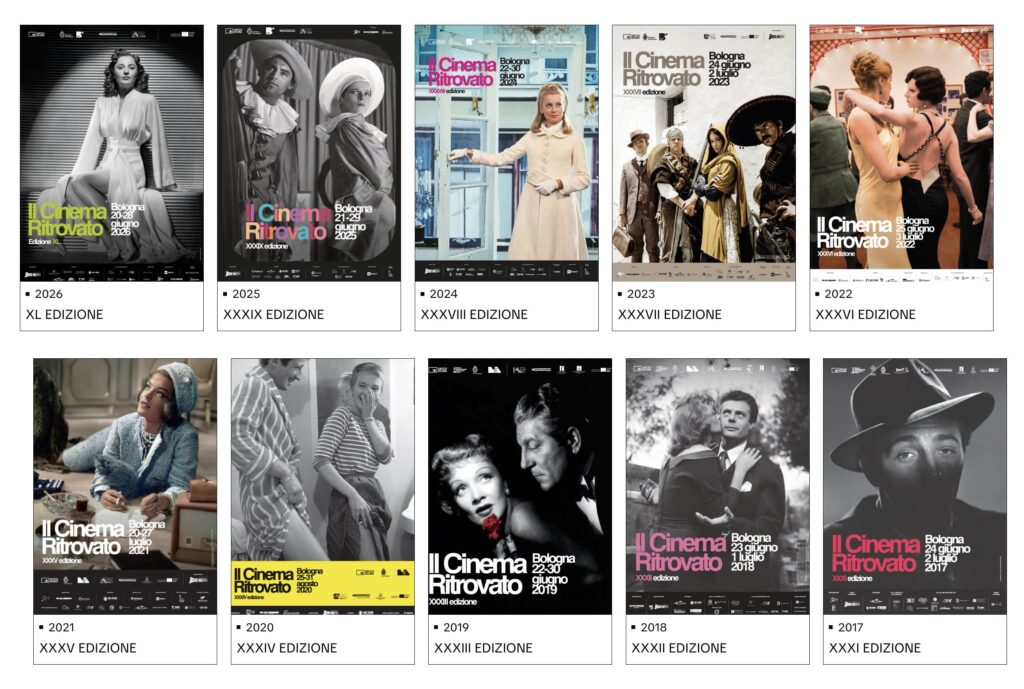
Edition History
Programme curated by Cecilia Cenciarelli ed Elena Correra
In collaboration with Tim Lanza (Cohen Film Collection)
Restoration notes by Elena Tammaccaro
“Muddy Waters” – reads the first intertitle card in Steamboat Bill, Jr.: the camera pans from right to left – from the American river to the Sacramento River – through the vegetation of Discovery Park. This masterpiece has survived in several versions which look slightly different from this very first shot, confirming how enigmatic and elusive, Keaton’s oeuvre still is. Tracing back the film sources is not an easy task as not only are the camera angle and the length of the shots different, but so are the takes (as evidenced by the ‘hat trial’ business). The main element used for this restored version is a 35mm full frame safety duplicate negative struck by Raymond Rohauer in 1969 (presumably from a nitrate negative, now completely decomposed), and therefore a ‘lineal descendant’ of Keaton and Rohauer’s partnership.
With Neighbors, The Goat e Battling Butler we had the advantage of dealing with minor works – or at least of being considered such. However, by extracting them from a filmography packed with masterpieces, we now have the luxury of rediscovering them and being surprised by Keaton’s extraordinarily mature thinking on display and by his infallible and modern comic intuition. Although having two of the three original negatives available, the restoration of these films was rather problematic. Inspection took into account thirty-four elements, provided by the Cohen Film Collection, as well as by many other international film archives, including the Cinémathèque Royale de Belgique, the Library of Congress, the Filmoteca de Catalunya and the Cinémathèque de Toulouse. In order to reconstruct and restore the films, twenty different elements were compared and analyzed. Critical questions include: the inherent physical condition of the elements, their lack of photographic definition or their incompleteness (which posed ‘ethical’ questions); the editing of the credits (usually ‘retouched’ by Raymond Rohouer in order to control distribution and copyright); the presence of negative A and B; tinting issues.
Finally, we have decided to devote a short programme to Keaton’s first appearances on the small screen. Television allowed Keaton to re-emerge from professional darkness and contributed greatly to his newfound popularity, his artistic redemption on the sets of films by Wilder, Chaplin and Curtiz, and the retrospective celebrations of his career in the Seventies. In September 1949 “Life” magazine published a lengthy and authoritative article by James Agee celebrating the achievements of silent cinema and its forgotten masters. Three months later, in December, Keaton stepped into the studios of the extremely popular Ed Wynn Show. “By that time, I had lost all hope; I thought I’d never again have the opportunity to act”, Keaton recalled. In compiling this brief programme we decided not to show the many appearances in which Keaton was asked to simply ‘do Keaton’. Instead, we focused on cases in which his towering talent speaks loud and clear. Watching him in the role of the pettyl, myopic bureaucrat in The Awakening, based on Gogol’s The Overcoat, it is hard to believe that this was the first dramatic role of his career.
Cecilia Cenciarelli
Launched during the last edition of Il Cinema Ritrovato in collaboration with the Cohen Film Collection, the Keaton Project completes its second year of activity with restorations of Cops, The High Sign, Seven Chances and The Paleface.
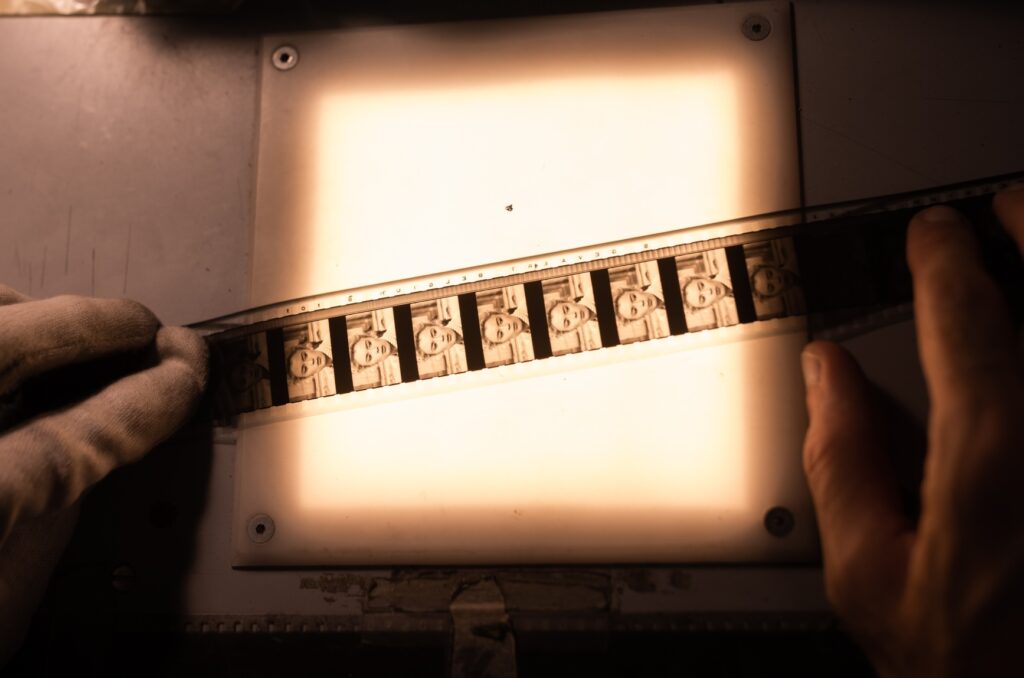
We believe that the singularity of the work carried out consists not solely in the end results, but above all in the scientific rigour and the time (a full year) devoted to every stage of the restoration process, from the study of the film and extra-film sources available, the search for materials, to the dating and comparison of over sixty elements that arrived in Bologna from many international archives. In the following texts, we have chosen to document and share the problems, dilemmas and discoveries encountered during restoration. The selection of these four titles neither reflects chronological criteria nor curatorial choice, but was dictated by the progress made in our research.
Watching The High Sign, The Paleface, Cops and Seven Chances one can easily identify the seeds of Keaton’s technical virtuosity, acrobatic audacity and surreal features which will be fully expressed in his mature works. Keaton shows amazing ability to use different registers, to avoid repetition, to stage an apparently unlimited variety of gags resulting from misunderstandings, dramatic events or from catastrophic misfortunes. Despite, or by the very virtue of, their weaknesses and imperfections, these films cannot be considered mere preparatory work – quite the opposite. They reveal all the freshness of a unique creative time when Keaton’s visual genius was vigorously emerging and clearly show what Walter Kerr described as Keaton’s rigorous approach to the film medium, the ‘integrity of the frame’, the notion that the camera must photograph reality without falsification.
So we invite you to enjoy these films as you would the first strawberry of the summer, which is never the best but still a delight, confident that in a few years’ time the restoration work will bring complete rediscovery of the full essence of Keaton’s work.
Special thanks to: Tim Lanza, Kevin Brownlow, David Robinson, Hooman Mehran, Frank Scheide, John Bengtson and all the film archives which have provided their materials. Our deepest gratitude to Matthew and Natalie Bernstein generously supporting the restorations of The High Sign and Cops.
Cecilia Cenciarelli
Programme curated by Cecilia Cenciarelli
On September 1949, “Life” magazine published James Agee’s possibly most famous piece called Comedy’s Greatest Era. Situated somewhere between journalistic inquest and poetic account, Agee’s celebration of four masters of silent comedy – Lloyd, Langdon, Keaton and Chaplin – aimed at reminding America of the uniqueness of an art form that was already slipping into oblivion.
In particular his portrait of Buster Keaton beautifully captured the essence of his art and marked the first critical appreciation that Keaton enjoyed since the end of his golden age: “He was by his whole style and nature so much the most deeply ‘silent’ of the silent comedians that even a smile was as deafeningly out of key as a yell. In a way his pictures are like a transcendent juggling act in which it seems that the whole universe is in exquisite fly- ing motion and the one point of repose is the juggler’s effortless, uninterested face”. Agee’s influential piece triggered a process of artistic rehabilitation and contributed to a new interest in Keaton’s masterpieces, at the time virtually unavailable.
At the beginning of the 1950s, thanks to his partnership with Raymond Rohauer, Keaton’s films were re-released. Although Keaton did not own the rights to his film, much to his frustra- tion, he had kept some rare prints, later transferred to safety stock. Several other ‘lost’ films were found by James Mason who had bought Keaton’s Italian Villa.
Like many collectors and distributors of the time, Rohauer would often alter the film’s editing or replace the original cards to claim copyright on them, charge a licensing fee and, one might argue today, make restorers’ life ‘more interesting’. As we embark on the challenging restoration of Keaton’s 1920-1928 short and long features, we know for a fact that studying and comparing the great wealth of the existing elements will be as time-consuming that the actual restoration work.
We owe a great debt to film historians and maverick restorers – Kevin Brownlow to name but one – who have paved our way and reminded us that restoration is not just about technical virtuosity but must necessarily involve a deep under- standing of cinema and its inner dynamics. Keaton’s films are, arguably, one of the most extraordinary exploration of film as a self-defining object, or, in Walter Kerr’s words: “While others, like Chaplin, were using film to point at themselves, Keaton pointed in the opposite direction: at the thing itself. He insisted that film was film, he insisted that silent film was silent. Whatever was idiosyncratic about him – clothes, stance, emotional makeup – would have to find expression in and about these two prime facts”.
Cecilia Cenciarelli