The Cinephiles’ Heaven
[2011]
Capellani ritrovato
His name was always familiar, yet it was only attached, shadow-like, to two films (Les Misérables, 1912, and Germinal, 1913). Cinema Ritrovato’s Albert Capellani retrospective, presented in two parts, in 2010 and 2011, is a major event: a great director and his work are re-discovered. In this year’s programme we are screening more than twenty titles, from all three stages in Capellani’s career: short films before 1910; the sublime masterworks from his years as artistic director of S.C.A.G.L., Germinal and Quatrevingt-treize, newly restored by the Cinémathèque française; and the largely unknown films of his American period. Rare copies of Camille (1915) and The Feast of Life (1916) were located in the collection of the Národní Filmový Archiv in Prague. We are able to show, at last, the complete L’Homme aux gants blancs (1908), in a newly restored version funded by the Fondation Jérôme Seydoux-Pathé. Germinal (1913) and Le Signalement (1912) are shown in the “Silent Colour” section, and several Capellani films are included in the section “A Hundred Years Ago: Seventy Films from 1911”.
To make the Capellani season last longer than the festival, we are bringing out a DVD, “Albert Capellani: A Cinema of Grandeur”, featuring twelve films made from 1905 to 1911 and including many extras. The edition is a co-production of the Cineteca di Bologna and the Fondation Jérôme Seydoux-Pathé.
Capellani, film director of two centuries
As a 20th-century director Capellani works with stories rooted in the present of their times: he achieves a wonderful Effet de Réel with Paris street scenes (Les Deux soeurs, L’Homme aux gants blancs). He weaves his characters and plots into continuous narratives consisting of photographic evidence of the sequence of events. He shows cinematographic images of great immediacy, which grab and hold the audience. This is the cinema of empathy, of feelings, the cinema of the now-past 20th century.
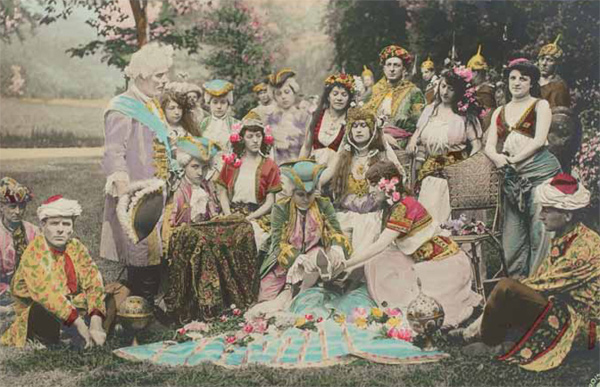
Capellani is a director of this 19th century. His films films allow us to participate in the cultural life of the 19th century: they give us access to its imaginary worlds, its entertainments and its fantasies. There are féerie subjects, with special effects and apotheoses (La Légende de Polichinelle, 1907). There is the fascination with the ancient world and its decadence – veil dances, shimmering colours, goblets of hemlock (Amour d’esclave, 1907)– and the “local colour”, be it Cuba (Feast of Life, 1916), Elizabethan England (Marie Stuart, 1908) or Paris, recreated in Studios in the U.S.A (The Virtuous Model, 1919). There are realistic reconstruction of events that took place in 1796 (Le Courrier de Lyon, 1911), and monumental frescoes of war and social struggle. (Quatre-vingt-treize and Germinal).
(Mariann Lewinsky)
Albert Capellani in France: 1905-1914
Albert Capellani came from the theatre and began his cinema career with Pathé in 1905. His contribution – as a man of letters with a tremendous capacity for hard work – came at a time when the company’s studios were embarking on a new phase of their history. Between 1906 and 1908 the team was changing radically, with the departure of directors such as Lépine and Heuzé and new arrivals including Denola, Burguet, Gasnier and Leprince. In 1908, in the early days of the first cinema crisis when, crucially, production policies were undergoing drastic changes, he made his mark with L’Arlésienne and Charles Pathé then promoted him to artistic director of the Société Cinématographique des Auteurs et Gens de Lettres (S.C.A.G.L.).
Albert Capellani was working at that time with the cameraman René Guichard and, whether supervising or directing in the studio in Vincennes on Rue du Petit Parc, his work schedule was hectic. In the space of a year, from March 1910 to March 1911, he made no fewer than 25 films! His directorial talent, manifested in his narrative skill and the fluidity of his editing, his naturalistic style, his talent for suggesting a protagonist’s character and intention, earned him respect in the professional world. When he adapted works he had read as a student, he was crucial to make the cinema “a great art” – which was what Charles Pathé and his colleagues were striving for, not only in setting up S.C.A.G.L., but also in initiating a system of film rental, which enabled them to offer more films in a wider variety.
Capellani’s influence grew throughout the 1910s, and we can easily imagine, from the testimony of Henri Étiévant, the impression he made on his team: “He was a large fellow, with red hair and a strong personality; very intelligent, a real gourmet, and a film maker who mastered his work with consummate skill.”
(Stéphanie Salmon)
Albert Capellani in America: 1915-1922
On April 24, 1915, Moving Picture World announced that the World Film Corporation had acquired the services of Albert Capellani, hailed as “the man who made Les Misérables”, a film released in America two years earlier but still regarded as a milestone. “Much of the general excellence of pictures may be directly traced to Mr. Capellani and his advanced ideas regarding the possibilities of the photoplay,” the World reported, which included being “one of the first to utilize the services of famous dramatic artists” in motion pictures. World, controlled by the Shubert theatrical organization, put Capellani to work on a series of theatrical adaptations, often with Parisian settings, shot at their Peerless Studio in Fort Lee, New Jersey. After completing Camille, starring Alice Brady, Capellani joined Maurice Tourneur and Emile Chautard at Paragon, a new studio which Jules Brulatour had constructed just down the street from the Peerless. Here he made La Vie de Bohème, again with Alice Brady, and began an association with Clara Kimball Young that would continue after Young left to establish her own production company. Those films, including The Common Law and The Foolish Virgin, were also made in Fort Lee, this time at Alice Guy Blaché’s disused Solax studio.
Capellani surrounded himself with many other French émigrés, including cameramen Lucien Andriot, Lucien Tainguy and Jacques Monteran, and designers Henri Menessier and Ben Carré (his brother, Paul Capellani, also appeared in many of the films). By the autumn of 1917 Capellani was working for Metro at their New York studio, where his films included three starring Alla Nazimova, notably The Red Lantern (shot in California when the 1918 influenza epidemic temporarily closed most of the studios in the East). Returning to New Jersey the following year he established Albert Capellani Productions at the old Solax studio, where he worked as both director and producer. Capellani supervised several George Fitzmaurice features while personally directing such films as Oh, Boy, an ambitious adaptation of a popular Jerome Kern musical, and The Virtuous Model, one of his most atmospheric “Parisian” reconstructions. On December 20, 1919, while Capellani was directing The Fortune Teller, a fire at the studio destroyed the Solax laboratory, which had only recently been enlarged and improved by the Blachés. Capellani subsequently joined William Randolph Hearst’s new production company, Cosmopolitan, for whom he made his last four American films. He returned to France after directing Marion Davies in an adaptation of Marie Corelli’s fantastic melodrama, The Young Diana (1922).
(Richard Koszarski)
Section curated by Mariann Lewinsky
Edition History
Thanks to the courtesy of many archives and Fondation Jérôme Seydoux-Pathé our programme comprises a first selection of 24 films by director Albert Capellani (1874-1931), spanning the eight years of his career in France, from his debut film Le Chemineau for Premiere in January 1906 to Le Chevalier de Maison-Rouge, also for Premiere, in January 1914, his last film screened in France before the war. Our last Capellani film is The Red Lantern, with Alla Nazimova in the lead, shot in the USA in 1919. We include it as a taster for next year’s festival when – alongside more of Capellani’s French films, some newly restored – we shall also be exploring his American work (1915-1922).
If I am not mistaken, this is the first ever good-sized Capellani retrospective. At the end of his essay on Germinal (in: La Persistance des images, 1996, pp. 40-41), Michel Marie noted that Capellani is probably the most underestimated director of the 1910s. Quite so, say I – and of earlier years as well. That this programme is now taking place is thanks to such films as Les Deux Soeurs (1907), Amour d’Esclave (1907) and Samson (1908). During the exhaustive viewings for the A Hundred Years Ago section, which have taken place here in Bologna since 2003, I have been struck every year since 2006 (1906) by the exceptional quality of the films of one Albert Capellani, an impression which was emphatically confirmed by last year’s L’Assommoir (1908) and La Mort du Duc d’Enghien (1909). Capellani’s work deserves to be comprehensively exhibited at last, noticed and appreciated beyond the limited circle of film historical research. In the writing of Richard Abel, Ben Brewster and Lea Jacobs, Tom Gunning, Michel Marie, Eric Le Roy, Bernard Basset-Capellani and others Capellani’s stature and significance are sometimes mentioned and sometimes emphasised. There are, on the other hand, scholarly publications about S.C.A.G.L. (La Société cinématographique des auteurs et gens de lettres), in which Capellani films appear but without so much as a mention of his name.
The programme is not structured chronologically but, like a book, divided into thematic chapters, with each configuration of films highlighting specific features of this great oeuvre.
Capellani’s speciality as a director is the broad scope of his narratives, connecting different locations and characters, which invests even short films with grandeur and space, to such an extent that the film lengths, given in either metres or minutes, often seem unbelievable. What? Can L’Épouvante really only be 11 minutes long? And Pauvre mère and Mortelle Idylle only 6 minutes each?
During the early years, Capellani was also working in the genre which, since 1902, had generated the longest films, the scènes de féerie et contes, where even super-productions of 275m to 400m (15-20 minutes) were not unusual. Stage spectaculars of this genre, a much-loved and historically important form of musical theatre in 19th-century France, spawned one final heir in the pre-1910 cinema (which is for us a unique and precious visual documentation of this extinct theatrical format). Capellani – a hundred years after the template was created – made, in Le Pied de mouton (1907), a captivating film version of the most famous of these stage shows, the 1806 mélodrame-féerie comique of the same name, by Alphonse Martainville and César Ribié, with music by Taix. Capellani also adapted other opéra-féeries, such as Cendrillon (1810, film version 1907) and Aladin (1822, film version 1906), by Nicolas Isouard.
Albert Capellani came from the theatre. According to a short biography, datable to 1911 (reprint: Henri Bousquet, Catalogue Pathé 1896-1906, 1996, s.p. [pp.970-971]) he was the successful director of the Alhambra Theatre when Pathé recruited him as a director in 1905. Like his brother Paul Capellani he was a trained actor, and the Bibliothèque Nationale has documents showing Albert Capellani appearing in stage productions at the Théâtre Antoine between 1904 and 1907, which means that his two careers, in cinema and stage, ran parallel for at least two years. In the summer of 1908 he was appointed artistic director of the newly-formed S.C.A.G.L., “où il débuta par un coup de maître: L’Arlésienne” (ibid).
As with Lubitsch and Ophüls, Capellani’s previous experience in the professional theatre becomes obvious in the way he directs actors and the positive relationship he forms with the audience. He had a tremendous feeling for sets and costumes, for special effects, for stories with a backstage setting and for stars – he worked with Mistinguett, Napierkowska and Nazimova, and under Capellani’s direction stage stars became film stars (or at least his films are among the best of their careers). He was also skilled at casting and brought his old colleagues from the Théâtre Antoine into his film productions. Alexandre Arquillière, for example, was givenin 1908 the role of Coupeau in L’Assommoir (then, from 1911, he would play Zigomar in Victorin-Hippolyte Jasset’s series).
Even light readers could not have failed to notice the concentration of literary titles in Capellani’s filmography, from his first, 5-minute film Le Chemineau, made in late 1905 (Victor Hugo’s Les Misérables, 1862), to the approximately 2-hour Chevalier de Maison-Rouge of 1914 (Alexandre Dumas père, 1846), from L’Arlesienne of 1908 (Alphonse Daudet, 1869) to Germinal in 1913 (Emile Zola, 1885). But passionate readers too may be unaware of how swiftly and how systematically successful prose writing was, in the 19th century, turned into plays and opera libretti (as in the case of La Glu), often by the authors themselves. (Today successful prose is still filmed and also, in a new development, successful films are now adapted for the stage.) Capellani probably consulted the original novels and their illustrations (for Les Misérables, 1912, this is certainly the case) but it is likely that his films are primarily based on the stage versions. Capellani was able to endow short films with a dimension of amplitude, but was equally skilled at handling the large-format dramaturgy of longer films. His L’Assommoir of 1908 is considered, at 740m or 40 minutes, to be the first long scène dramatique, and up until 1914, alongside many shorts, he regularly shot long and even very long films, such as La Glu, Le Chevalier de Maison-Rouge and the 1912 multi-part Les Misérables.
A keen innovator, prodigiously gifted director and efficient head of the S.C.A.G.L., Albert Capellani epitomises the grandeur, quality and creativity of Pathé during its ten most glorious years. A figurehead of the cultural mainstream; a man who brought to the cinema successful novels, celebrated theatre productions and fêted vaudeville stars; a film director who stood for impressively meticulous staging of historical material – the complete opposite of what would later delight the surrealists about the cinema before the First World War (the popular burlesque). Capellani’s profile made him the target of a film historical trend – now long discredited – which criticised “the theatrical” and promoted “the filmic”. This is perhaps why he was so underestimated.
Yet the greatest surprise awaiting us in Capellani’s work, from the very beginning, is exactly this, the strong presence of the filmic alongside the theatrical. The filmic quality is not only to be found in the fluidity of the narrative and the dramatically- effective montages, but also in the sheer photographic beauty of exterior shots, which is not found in the work of any of his contemporaries (except sometimes in non-fiction scènes d’art et d’industrie or scènes de plein air). Capellani and his camera crew captured the photogénie of a rain-sodden street in Mortelle Idylle (1906), the play of light with the shadow of foliage in L’Arlesienne (1908) and the architectonic pictorial elements of the bridge, emphasised by a high-angle shot, during Cendrillon’s nocturnal flight (1907).
No article written at the time omits to mention, after Capel- lani’s many talents, his likeable, warm-hearted personality. He was much loved by his colleagues and actors.
The Pathé catalogue text, which I have quoted twice, ends with a comment that S.C.A.G.L. “owes its prestige to Capellani who, despite his modesty, stands out as the most precious jewel in its crown.”
(Mariann Lewinsky)
Section curated by Mariann Lewinsky