[2003]
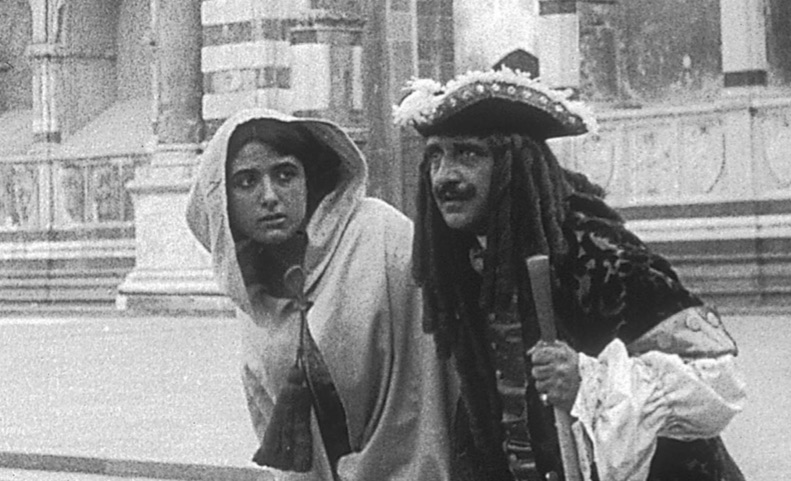
The project for the preservation and restoration of the films produced by Film d’Arte Italiana (FAI) has reached a new stage this year. A unique corpus of films produced by FAI was found at the Cinémathèque Française, and consisted of original nitrate negatives that had all been processed in the same laboratory. As a result of this discovery, in the 1990s the Cineteca di Bologna began the project of bringing this precious but little known chapter of Italian cinema back to the screens. In collaboration with the Cinémathèque Française, nineteen films have been restored so far, and eight additional titles have been preserved.
This year, restorations related to the FAI project focused on three films: MarcoVisconti (1911), Beatrice d’Este (1912) and Un dramma a Firenze (1912). In addition to the desire to add to the number of films that have been restored, these films were chosen to pay homage to the diva of Italian cinema par excellence: Francesca Bertini. Indeed, Bertini made her onscreen debut precisely with FAI. Though she became famous only later, these early years in the lower ranks were essential for her to gain experience in front of the camera. She stayed with FAI for two years, from 1910 to 1912, during which time she played a variety of roles in a total of twenty films. Today, fourteen of these films survive, several of which will be shown in this section of the Festival.
We have also chosen to present several other FAI films in which our diva does not appear. This choice stems from our desire to show, over the course of several years, the FAI production that has survived in an attempt to provide a clearer picture of a production company that had been considered minor until just recently. For consistency, we have given space this year to period films, which were typical of the first wave of FAI productions that include those featuring Bertini.
It is important to remember, however, that from 1913 on, FAI oriented its production towards more modern films, such as comedies and bourgeois melodramas set in contemporary times. For this reason, we have also chosen to present Silvio e lo Stradivarius, which provides a concrete example of this change in direction.
Alessia Navantier
Edition History
Film d’Arte Italiana was founded in Rome on 2 March 1909. Considered as a sort of subsidiary of Pathé, FAI was specialized in making film d’arte, meaning films adapted from world famous literary and/or theater works, as well as historical films. Over the years, however, new genres were experimented, and in 1912-13, production of modern dramas and comedies set in modern times began, using scenarios written specifically for the cinema. The so-called «Cine-drammi», «psychological films» or bourgeois melodramas, became popular (Resto umano, 1913, Usuraio e padre, 1914, Il fantasma della felicità, 1915, La modella, 1916), but there was no lack of comedies either (Il figurinaio, 1913, Il sogno di Giacobbe, 1914, Effetti di luce, 1916, Papà mio, mi piaccion tutti!, 1918) ), as well as several «war» (Il bacio della Gloria, Armi e amori, 1913) and propaganda (Per la Patria!, 1915). The FAI production house gave numerous artists the opportunity to make their film debuts – think of Francesca Bertini, Ferruccio Garavaglia, Ermete Novelli, Vittoria Lepanto, Guido Brignone, Ettore Berti, Augusto Genina, etc. – though they would become famous only later. Among the main directors, two names come to mind for their loyalty to the production house: Ugo Falena and Gerolamo Lo Savio. In the beginning, they alternated indiscriminately between direction of dramas and period films; later, while Falena tested his skills in the making of bourgeois melodramas and comedies, Lo Savio began to work on the administrative side of «Film d’Arte Italiana», holding the position of Managing Director until 1918. In addition to the previously mentioned Falena and Lo Savio, Lucio d’Ambra became one of the main screenwriters, bringing us incredibly successful films, such as Effetti di luce, La chiamavano Cosetta (1917), Papà mio, mi piaccion tutti!. Linked to Pathé by a series of contracts – in which the French company was primarily committed to processing negatives and distributing the films worldwide – FAI went through a difficult period at the end of the war, and in 1918 was sold to attorney Mecheri who merged the company with Tiber Films. In 1919, FAI became part of the UCI, and was thus destined to share the same fate. Between 1909 and 1924, FAI made 165 films, one third of which were found at the Cinémathèque Française. Most of the material consists of original, unassembled nitrate negatives. During the Nineties, in collaboration with the French Archives, the Cineteca di Bologna undertook a project for conservation and restoration of the FAI collection, supported by Proiecto Lumière and MEDIA. The work, entrusted to L’Immagine Ritrovata, has led to restoration of fifteen films: Luisa Miller, Tristano e Isotta, La congiura dei Fieschi (1911); Un dramma a Firenze, La sedia del diavolo, Il falco rosso, I carbonari, Una congiura contro Murat, Dall’amore al disonore, La giustizia dell’abisso (1912); L’assalto fatale, Resto umano, L’onore del banchiere (1913), Usuraio e padre (1914); Effetti di luce (1916). For the Festival of Il Cinema Ritrovato 2002, another section of this project will begin, consisting in restoration of several films which are representative of the new direction taken by FAI, starting in 1912. Among these films are: Il ritratto dell’amata; (1912), I carbonari (1912), Il bacio della gloria (1913), Resto umano (1913).
Alessia Navantieri, Michele Canosa