[MOVIE]
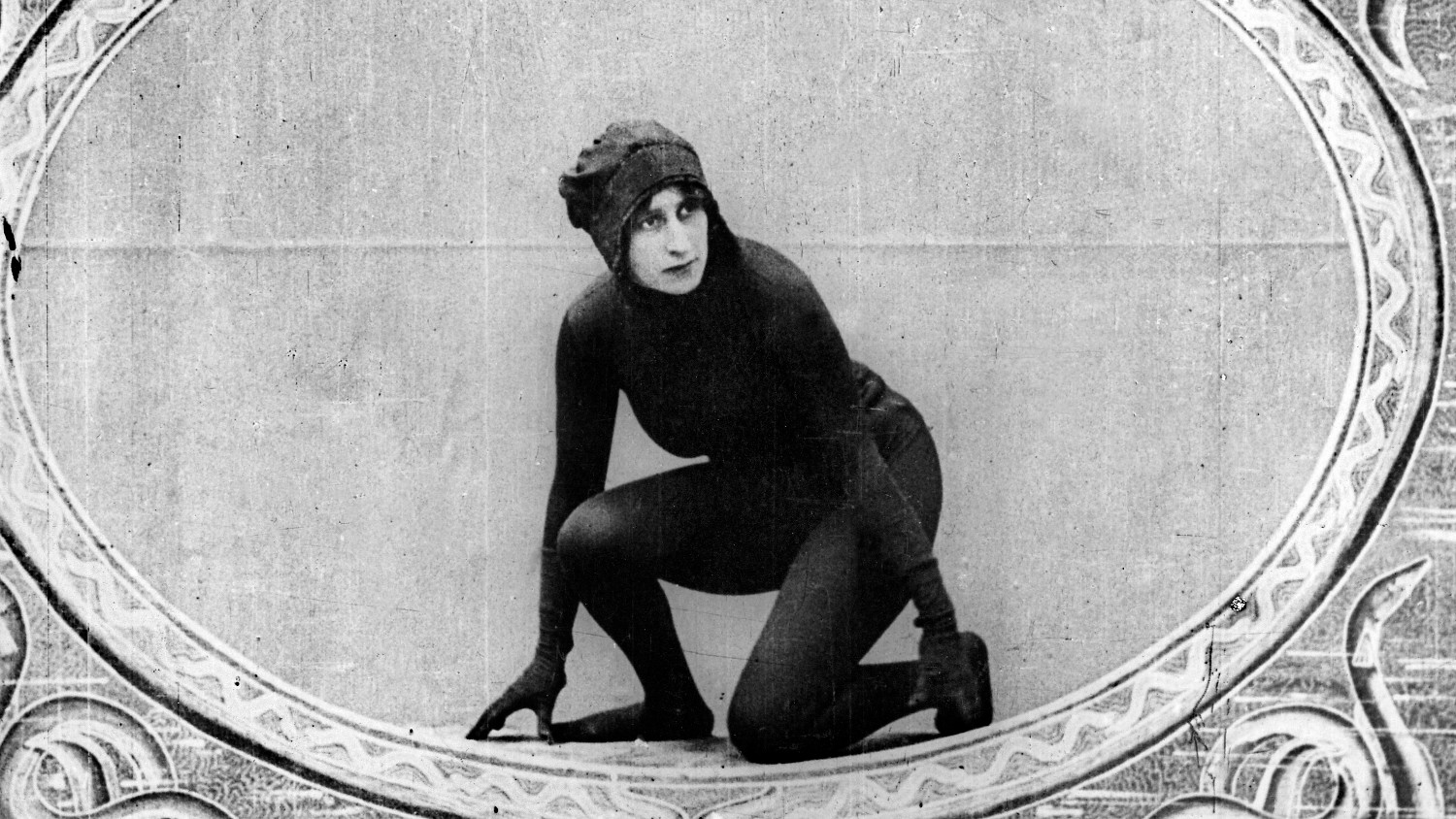
Sog.: dal romanzo Zigomar (1910) di Léon Sazie. Scen.: Victorin-Hippolyte Jasset. F.: Ravet. Int.: Alexandre Arquillière (Zigomar), André Liabel (Paulin Broquet), Josette Andriot (La Rosaria), Attilio Maffei (l’aviatore), Paul Guidé, Émile Keppens, Henri Gouget, Camille Bardou, Édouard Pinto, Marise Dauvray. Prod.: Éclair. 35mm. D.: 45’ Bn
Edition History
A quiz question for film buffs: in a superbly entertaining early French serial, a fascinating actress wearing a black catsuit appears in the role of a wicked female sidekick of the criminal male lead. What are the names of the dark-eyed actress and film director?
Victorin Jasset began working in the series format in 1908 and continued with it until his untimely death in 1913. In Peau d’anguille, the third and best instalment of his Zigomar series, La Rosaria (Josette Andriot), an accomplice of the bandit Zigomar (Alexandre Arquillère) has been promoted from her secondary role to the lead. At the very beginning, Andriot, in a black catsuit, glides out of a coffin – a slim, mesmerising silhouette. And we remain mesmerised long after the last scene of the film.
Her final devilish smile reveals to us how much she is going to enjoy turning imprisonment into an opportunity to hoodwink Detective Broquet and make a fool of him yet again. For no prison cell in the world is likely to detain a woman who, dressed as an oriental dancer, can deploy a circus elephant to rip a safe box full of cash out of a wall and make off with it unharmed (L’Éléphant cambrioleur) or, disguised as an elegant tourist, handle explosives and fly aeroplanes (Le Brigand de l’air). In Jasset’s subsequent series, Josette Andriot played the eponymous heroine, the shape-shifting, reality-defying spy Protéa, performing amazing stunts – the actress was an intrepid sportswoman. All this went on well before Musidora, in her famous catsuit costume, stepped into the role of Irma Vep.
Mariann Lewinsky

by courtesy of Marc Sandberg
Jasset’s third and last Zigomar film (after Zigomar 1911 and Zigomar contre Nick Carter 1912) is without a doubt the best of this series – which was as successful internationally as it was important historically. Was the reason, perhaps, that La Rosaria (Josette Andriot), accomplice of the bandit Zigomar (Alexandre Aquillère), had been promoted from her secondary role to the lead? At the very beginning of the first part (La Résurrection de Zigomar), Andriot, in a black cat-suit, glides out of a coffin; a slim, mesmerising silhouette. And we remain mesmerised, long after the last shot of the film. For her final, wicked smile shows us how much she is going to enjoy turning imprisonment into an opportunity to hoodwink Detective Broquet and make a fool him yet again. For no prison cell in the world is likely to detain for very long a woman who, dressed as an oriental dancer, can deploy a trained circus elephant to rip out and make off with a safe full of cash (L’Eléphant cambrioleur) or, disguised as an elegant tourist, handle explosives and aeroplanes (Le Brigand de l’air). So Jasset made the shape-shifting, elusive bandit-heroine the eponymous star of his subsequent series, the protean shape-shifter, the elusive spy Protéa. Victorin Jasset began working in the series format in 1908 with Nick Carter (six short episodes, shown at two-weekly intervals) and continued with it until his untimely death in 1913. All film histories have sung the praises of Louis Feuillade, while only a faint and superficial memory of Victorin Jasset remains. But he was the first to bring to the screen, well before Feuillade’s Fantômas (1913) and Les Vampires (1915-1916), the thrilling adventures of Zigomar and of Protéa. These films, suffused with generous amounts of self-irony, had a wonderful knack of telling audiences that everything they saw on the screen was pure fantasy, joyfully, playfully poking fun at the mystery adventures that Feuillade directed with such serious, heavy-handed and punctilious realism.
Vittorio Martinelli, Le dive del silenzio, 2001, p. 16