[MOVIE]
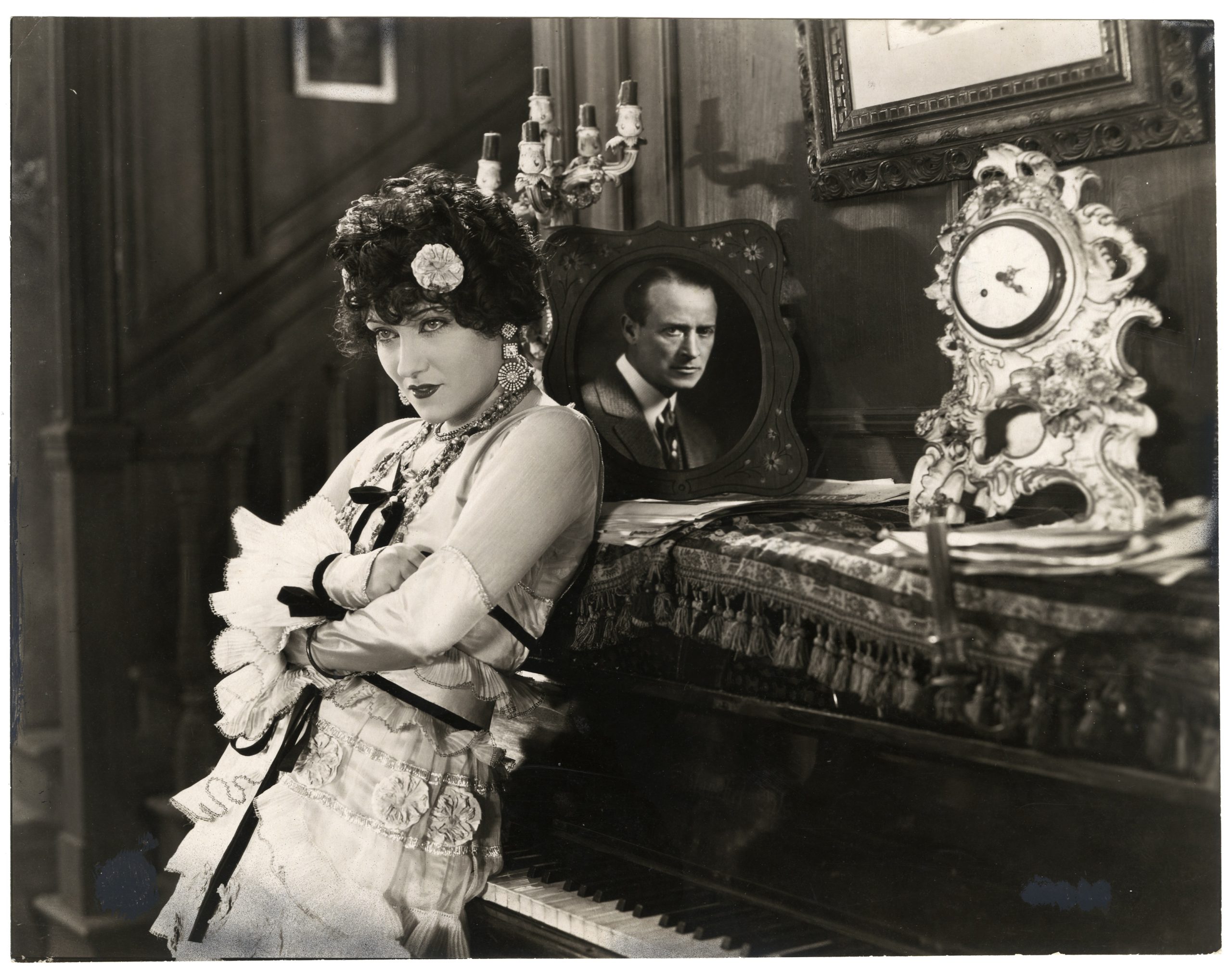
Sc.: Albert Shelby Le Vino. F.: Hal Rosson. In.: Gloria Swanson, H. B. Warner, Ferdinand Gottschalk, Lucille La Verne, Mary Thurman, Yvonne Hughes, Riley Hatch, Roger Lytton, Ivan Linow. P.: Famous Players-Lasky Corp. 35mm. L.: 1813m. D.: 80’ a 20 f/s
Edition History
Although Dwan took steps to limit the budget, Zaza is a handsome film that still looks more opulent than the 1939 remake directed by George Cukor. Dwan had told the studio that New York would be better locale to achieve the European background for Zaza. He claimed that for atmosphere he used French-speaking extras, who couldn’t speak a word of English… On a more practical level, Dwan arranged for his cameraman, Hal Rosson, to see a display of the piantings of
Toulouse-Lautrec to visualize the spirit of French cafés […]. Zaza was based on a French play by Pierre Berton and Charles Simon. In January 1899, a few months after Gabrielle Réjeane starred in the Paris première, a version produced by David Belasco opened in New York with Mrs. Leslie Carter in the title role. It was a great success. […..] The play is about a small town singer of great ambitions, who falls for one of her wooers – but when she learns that he is married and has a little girl who idolizes him, she breaks off the affair. Years after, when Zaza has won wealth and fame on the Parisian stage, her lover comes to see her. Zaza says she loves him as she does someone who is dead, and while she will retain sweet memories of him, she never wants to see him again. Zaza provides an affecting portrait of a woman who suffers greatly in love but pours her
life into her art and achieves independence and inner peace. But the character of Zaza also reflects the era of her creation. No matter how great her success, Zaza must leave the man she loves to a more respectable woman. For the 1915 version [with Pauline Frederick], reviews suggest that Famous Players wanted to exploit the oh-là-là quality of the play while toning down the tragic aspect […]; with Swanson, Dwan could project an image suited for the liberated 1920s. The story was updated from the 1890s to the period just before the World War 1 […]. Dwan again shows his great economy in storytelling and his film is rich in atmosphere, while running the full game of feelings. His final shot, showing a moment preserved at the edge of happiness, seems to glide into eternity.
Frederic Lombardi, Allan Dwan and the Rise and Decline of Hollywood Studios, McFarland, Jefferson NC 2013

Gloria Swanson was born in Chicago on March 27th, 1898, daughter of an army captain. In 1915, at the end of her studies, she found work at Essannay. She continued to work as an extra until Mark Sennett, in 1916, got her a contract with Keystone. Swanson took part in numerous comedies, and the expressive beauty of her face stood out immediately, as did her splendid light-colored eyes and her strong artistic temperament. She was then called in to work with De Mille on various dramatic comedies, including Beyond the rocks(1922) where, glittering with necklaces and fluttering in feathers and fringe, she languidly rejects Rudolph Valentino. She signed a contract with Paramount where she worked under Sam Wood and Allan Dwan, enriching her personal acting style with greater variety in tone. She then moved over to United Artists where she produced herown films. With Sadie Thomson by Raoul Walsh, she completely renewed her acting technique, practically eliminating sophisticated stylization in order to create a character who was no longer artificial but instead as real as possible. With the advent of sound she enrolled in diction and acting classes, but her new films were not received enthusiastically by the public. Swanson thus began working as a fashion designer and journalist. In 1945 she made an attempt on Broadway, before meeting once more with great cinematographic success in 1950 with Sunset Boulevard. That same year she triumphed on the stage in Twentieth Century. Her career continued on after that, with more minor successes in radio and television.
All of a sudden the flashes went off, a murmur ran through the crowd, and Gloria Swanson appeared under the TV spotlights. Her aggressive, square white teeth and steely eyes blazed, her heavy, swarthy veteran’s flesh full of strength and high spirits. Here, it was she who represented the infinite power and vitality of cinema, that people were confusedly searching for in that lobby, Gloria Swanson, the progenitor who came all the way here from the golden age of Hollywood. There was an underlying air of controversy in her self-assurance, her way of moving and speaking which pulled the movement of the entire crowd in her direction. It was a veteran’s reproach of generations who were not so full of energy. She entered the theater, and once she had disappeared everyone felt a bit faint and insecure.
Italo Calvino,“Venezia primo tempo. L’inaugurazione”, Cinema Nuovo, n. 42, 1 settembre 1954
1970s preservation from a nitrate print in the AFI/Paramount Collection