[MOVIE]
Edition History
Adapted from a novel by Hisao Sawano (1912-92), this outstanding film continued Yoshimura’s dramatic and resonant exploration of postwar Kyoto. While he normally worked from Kaneto Shindo’s scripts, here he collaborated with Japan’s leading female screenwriter, Sumie Tanaka (1908-2000). Her influence arguably brought a particular intensity to the film’s depiction of what critic Hitoaki Kono called “a new type of Kyoto woman”, convincingly incarnated by Fujiko Yamamoto (1931), then one of Daiei’s top stars. The film vividly explores the postwar clash between tradition and modernity through the story of a kimono designer’s affair with a married scientist.
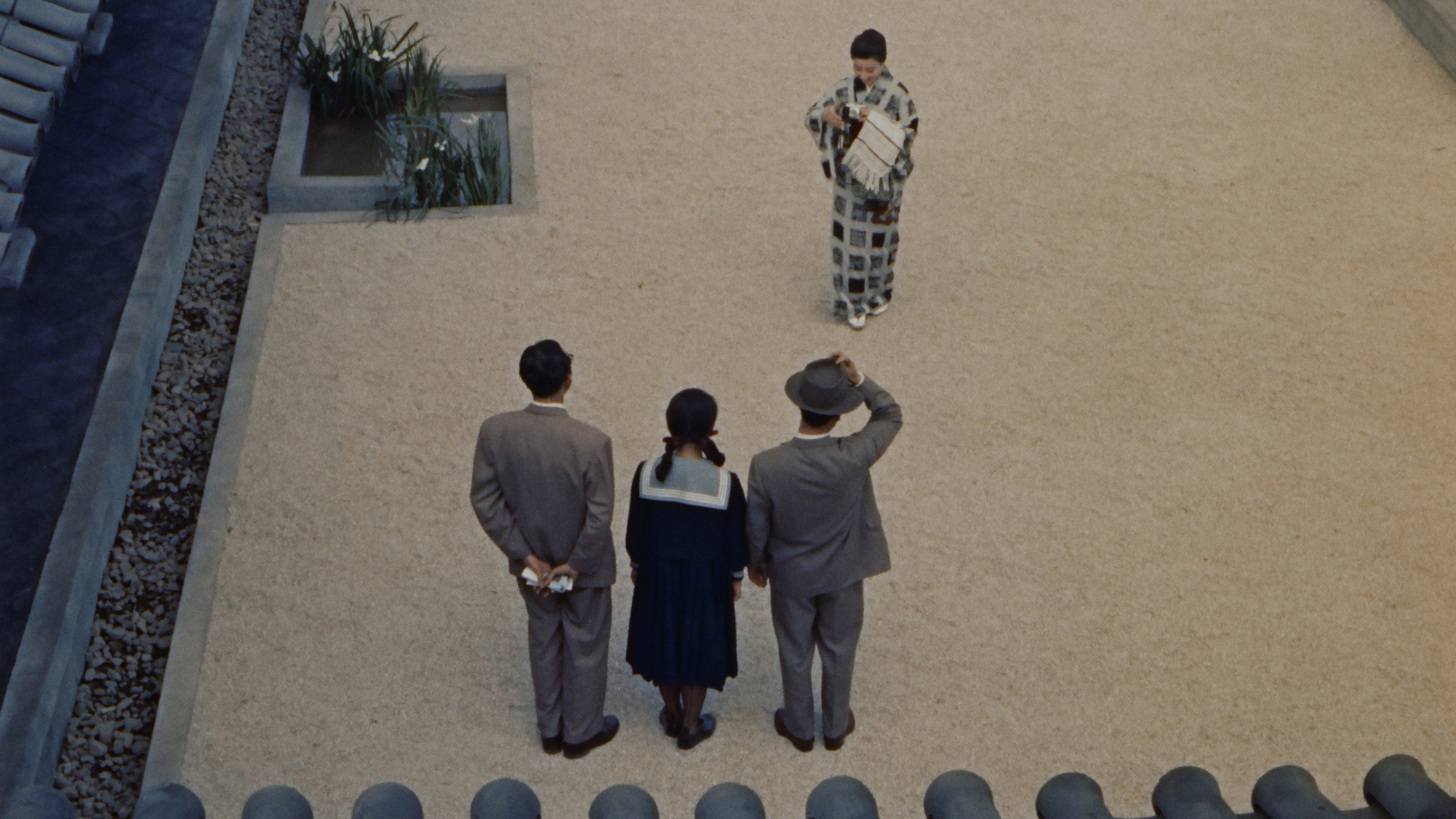
Yoshimura’s first film in colour, Yoru no kawa is both one of his most moving films and one of his most visually striking. Though Yoshimura himself was colour blind, he drew on theories of colour psychology in order fully to exploit the potential of the new medium. For Fumiaki Itakura, the production design achieves “a specific focus on the new technology of colour […], combining this with other elements of mise en scène, camera work and sound in order to depict the protagonist’s complex emotions.” Cinematographer Kazuo Miyagawa drew on the colours of the kimono patterns designed by the film’s heroine, while reflecting what Derek Owen calls “the dark qualities of the protagonist’s romantic entanglements” and, additionally, hinting at a political subtext: Yoshimura himself specifically associated the striking use of red, white and blue with the values of “liberty, equality and fraternity”. Miyagawa described the city of Kyoto as “a filmmaker’s dream”, and his lovely photography records the beauty of its urban landscapes, then still largely untouched by modernisation. The film’s visual splendour is shown to best advantage in this brand new 4K restoration from Kadokawa.
Alexander Jacoby e Johan Nordström

Restoration credits
restored in 4K by Kadokawa at IMAGICA Entertainment Media Services laboratory, from the original 35mm Eastman Color negative. Grading supervised by Masahiro Miyajima.
During the period 1951-1960, Yoshimura realised an impressive sequence of films focusing on working women in Japan’s ancient capital of Kyoto, which used personal dramas to explore the dilemmas of a nation in the throes of rapid and irreversible change. On this film he collaborated with a female screenwriter, Sumie Tanaka, whose influence arguably brought a particular intensity to the film’s depiction of what critic Hitoaki Kono called “a new type of Kyoto woman”. The film vividly explores the postwar clash between tradition and modernity through the story of a kimono designer’s affair with a married scientist.
One of Yoshimura’s most moving films, Yoru no Kawa is also one of his most visually striking: his first film in colour, it fully exploited the potential of the new medium. Cinematographer Kazuo Miyagawa drew on the colours of the kimono patterns designed by the film’s heroine while reflecting what Derek Owen calls “the dark qualities of the protagonist’s romantic entanglements” and, additionally, hinting at a political subtext: Yoshimura himself specifically associated the striking use of red, white and blue with the values of “liberty, equality and fraternity”. Miyagawa described the city of Kyoto as “a filmmaker’s dream”, and his lovely photography records the beauty of its urban landscapes, which then still largely preserved its historic wooden architecture.
Restoration credits
Da: National Film Center, Tokyo per concessione di Daiei.
This print was struck in 2010 from a 35mm original negative preserved by Kadokawa. Digital noise reduction was applied to the soundtrack