[MOVIE]
Scen.: Ring Lardner Jr., Michael Kanin. F.: Joseph Ruttenberg. M.: Frank Sullivan. Scgf.: Cedric Gibbons. Mus.: Franz Waxman. Int.: Katharine Hepburn (Tess Harding), Spencer Tracy (Sam Craig), Fay Bainter (Ellen Whitcomb), Reginald Owen (Clayton), Minor Watson (William J. Harding), William Bendix (‘Pinkie’ Peters), Gladys Blake (Flo Peters), Dan Tobin (Gerald Howe), Roscoe Karns (Phil Whittaker), William Tannen (Ellis). Prod.: Joseph L. Mankiewicz per Metro-Goldwyn-Mayer. DCP. D.: 114’. Bn.
Edition History
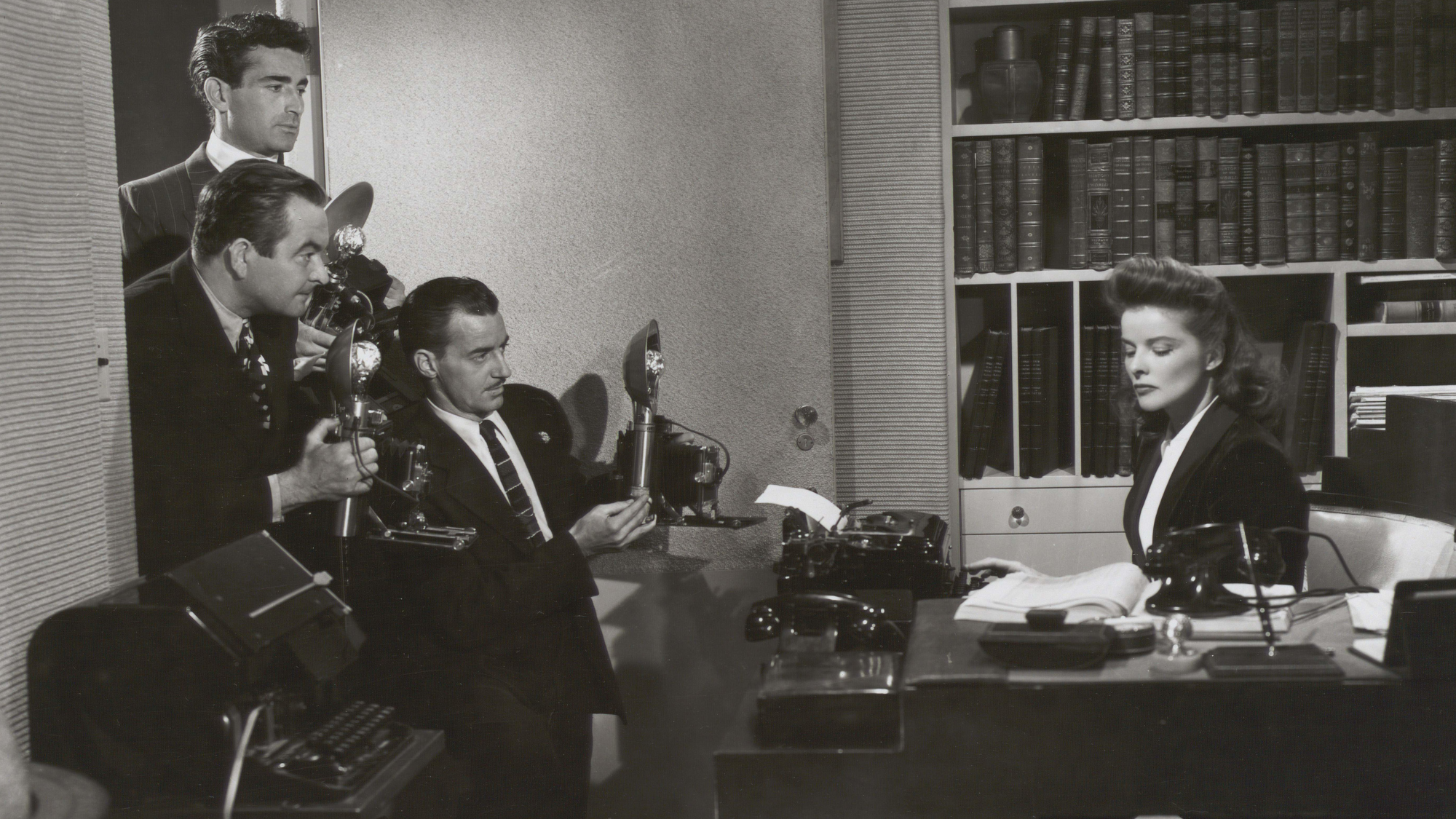
Hepburn’s first film with Spencer Tracy and, thanks to George Stevens’ direction, the most erotic. Based on a screenplay by Ring Lardner and Michael Kanin, the movie focuses on her unmarried state. As a globe-trotting reporter (based on Dorothy Thompson) Tess Harding (Hepburn) is a hard-charging woman who admires career women but knows “you can’t have it all.”
She’s already got a good deal: class (daughter of a former ambassador), education (several languages), while Tracy is the low-key one, a sports reporter who must oversee her comeuppance in the end. After winning the Woman of the Year award, she’s obliged to fix him breakfast – a feat at which she is inept and miserable. This Taming of the Shrew ending was added after preview audiences found her perfection threatening. My generation of feminists were horrified by this ending, but alas it has come to seem not so archaic in this conservative moment.
Molly Haskell
The idea for a relationship between a feminist political commentator and a sportswriter working for the same journal first came to Ring Lardner, Jr. as a sort of intellectual Taming of the Shrew – with his own sportswriter father and the political columnist Dorothy Thompson in mind. The script he wrote with Michael Kanin would win the duo an Oscar.
Adroit and breezy, George Stevens interprets most of the scenes like a silent film, focusing on orchestrating bodies and gazes, with a sense of relentless groove, as in the splendid kitchen sequence (the most Laurel and Hardy thing in a Stevens picture), which was an alternative ending devised by the director after the original ending – settling on a softer punishment for Tess – didn’t do too well with audiences. This scene, one of the greatest examples of performers’ timing on celluloid, is both an invitation to domesticity and a parody of it. While the message is dated, even for 1941, Tracy and Hepburn’s timeless performances make it look like a game played between the two of them. They radiate love and mutual admiration throughout, even when Tracy sports his tight-lipped grins and glares. They make it a film about their own first encounter and an on-set love story that lasted until Tracy’s death. The two are projecting each other, even in that infamous kitchen.
Ehsan Khoshbakht

George Stevens’s only MGM work and one of his most irresistible films is an Alice Adams in reverse: the story of a male character being snubbed by the world of the woman he loves. The idea for a relationship between a feminist political commentator and a sportswriter working for the same journal first came to Ring Lardner Jr. (soon one of the Hollywood Ten) as a sort of intellectual Taming of the Shrew – with his own sportswriter father and the political columnist Dorothy Thompson in mind. The script he wrote with Michael Kanin would win the duo an Oscar. It’s a film about World War II reaching America, before the country officially joined in the fighting on the battlegrounds. International politics even finds its way into the bridal chamber: a child refugee in the house, an anti-fascist fugitive in the bedroom. If the film’s image of war is apolitical, that is no doubt due to the fact that the filming wrapped before America’s entry into the war – though it premiered two months later, in February 1942. Adroit and breezy, Stevens interprets most of the scenes like a silent film, focusing on orchestrating bodies and gazes, with a sense of relentless groove, as in the splendid kitchen sequence (the most Laurel & Hardy thing in a Stevens picture) which was an alternative ending devised by the director after the original ending – settling on a softer punishment for Tess – didn’t do too well with audiences. This scene, one of the greatest examples of performers’ timing on celluloid, is both an invitation to domesticity and a parody of it. While the message is worryingly dated, even for 1941, Tracy and Hepburn’s timeless performance makes it look like a game played between the two of them. They make it a film about their own first encounter and a love that lasted until Tracy’s death. They radiate love and mutual admiration throughout, even when Tracy sports his tight-lipped grins and Stevensian glares, even in that infamous kitchen.
Ehsan Khoshbakht