[MOVIE]
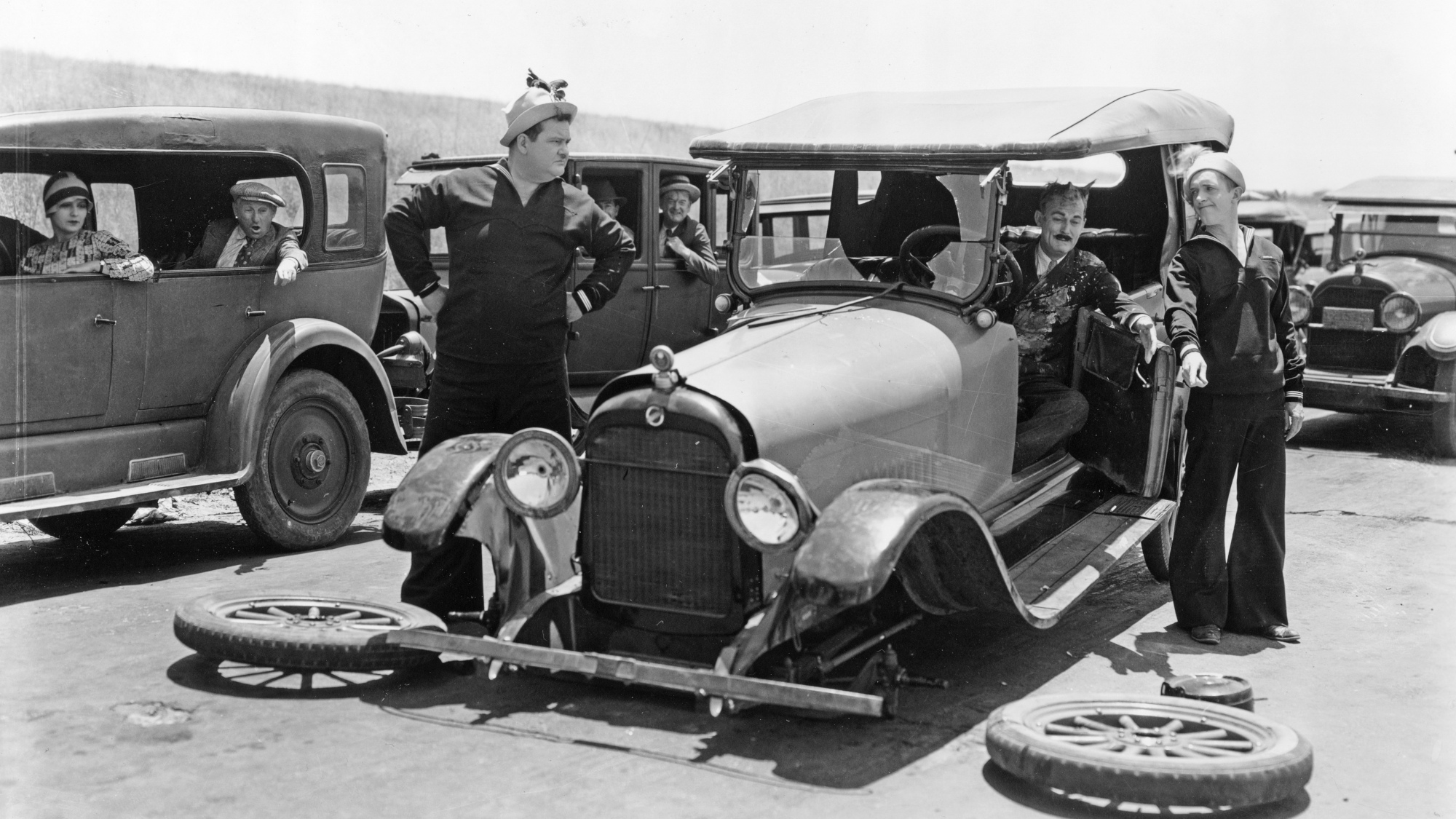
T. it.: Marinai a terra. Sog.: Leo McCarey. F.: George Stevens. M.: Richard Currier. Int.: Stan Laurel (midshipman Laurel), Oliver Hardy (on-board secretary Hardy), Thelma Hill (Thelma), Ruby Blaine (Rubie), Harry Bernard (truck driver), Edgar Kennedy (driver), Charlie Hall (shopkeeper), Edgar Dearing (policeman). Prod.: Hal Roach per Hal Roach Studios. DCP. D.: 21’. Bn.
Edition History
At a time when racist and socially problematic attitudes were casually flaunted (see Their Purple Moment and We Faw Dawn), Laurel & Hardy’s deconstruction of machismo (and militarism) looks like the flagship of their entire output. This is still true today – above all today. If the opening (vaguely) celebrates the campaigns of the American navy in the style of a mock newsreel, irreverence is just around the corner. Stan and Ollie are sailors on leave who strut about in a rental car with a bluster they can ill afford. They do not know how to drive; they are not even capable of unlocking a chewing gum vending machine, let alone emerging victorious from a fight with Charlie Hall (the “little nemesis” in many of the duo’s films). Two girls in a fix (Thelma Hill and Ruby Blaine) provide the ideal opportunity for Oliver to show off some of his renowned gestures, which cry out “leave it to me”, without the need for intertitles. It will be up to the women to physically defend the two little boys, as expected. This series of gags is functional to the climax that arrives in the very elaborate second part of the film: a traffic jam which waiting to be transformed into a devastating conflict. This war waged by a stupid and nasty humanity with a self-destructive tendency coincides with Hal Roach’s technical peak: no longer pies in the face, but a sumptuous chaos of wrecked cars. The dissolution of Fordism!
Alessandro Criscitiello

Restored in 2024 by Blackhawk Films at FPA Classics laboratory, from a 35mm nitrate dupe negative preserved by MoMA – The Museum of Modern Art. Special thanks to Katie Trainor, Dave Kehr and Rajendra Roy
In this hymn to motorised anarchy, sailors-on-leave Stan and Ollie rent a car and pick up the sassy team of Ruby and Thelma. One of the duo’s best two-reelers and a precursor to Jean-Luc Godard’s Weekend, it gives an epic scale to the ‘collective destruction ritual’ routine when in the climactic scene the agitated drivers caught in a traffic jam abandon civility and, in the absence of cakes, throw whatever is within reach, eventually leading to yanking off car parts. After the wreckage comes a parade of surrealistically shaped cars, which chase Laurel and Hardy’s vehicle, or what’s left of it, into a tunnel for one last climax. Closer in spirit to Keaton’s mechano-comic antics than the duo’s more domesticated comedies, its outstanding qualities are owed to the supervising director Leo McCarey and cinematographer George Stevens, who was responsible for shooting 35 Laurel and Hardy shorts. Stevens, previously not so keen on comedy, observed: “Laurel and Hardy were marvellous clowns, but also humanists. Although the story was not always immediately present in their films, their humanism gave them validity.” He was surprised to find out how much truth and “considerable art” could be found in their acts. It stayed with Stevens for ever and he even directed their segment in Hollywood Party (1934). From the duo, and working as a cameraman in comedy in general, Stevens learned how to adapt the formula of ‘delayed encounter, delayed reaction, explosion’ – in other words, the timing of comedy. He also realised that script, camera setup and direction should go hand-in-hand and remain flexible. Finally, he looked at Laurel and Hardy and learned how to direct husband-and-wife scenes.
Ehsan Khoshbakht

Courtesy of Beta Film
Restored in 2021 by Lobster Films from a 35mm master positive triacétate