[MOVIE]
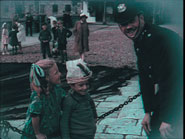
F.: Claude Friese-Greene; Prod.: Claude Friese-Greene Estratto. 35mm. D.: 4’. Ricreazione del Friese-Greene Colour / Recreation of Friese-Greene Color.
Edition History
This programme is designed to present examples of rare colour films, restored recently by the BFI National Archive and Prestech Film Laboratories. It will feature a range of films which between them offer a variety of different colour processes and different restoration techniques, including the latest digital methods. The programme includes an early example of Kinemacolor from 1906 and an extract from Claude Friese-Greene’s travelogue The Open Road (1924), in a colour system based, like Kinemacolour, on black and white film shot and then projected through alternating red and green filters. In addition we will be presenting new restorations of the French company Pathé’s beautiful stencil colour process and two very different examples of tinting and toning, restored by different means, one a fragment of ‘the other version’ of L’Inferno (1911) and Prekrasnaya Lyukanida (1912), one of the Starewich’s first animated insect romances from pre-revolutionary Russia.
Bryony Dixon
The Open Road was the culmination of Claude Friese- Greene’s development of a natural colour photography system in the early 1920s. He travelled the length of Britain’s west coast by car, from Land’s End to John O’Groats, filming people and places of picturesque interest along the way.
Designed as a travelogue in 26 episodes of approximately 15 minutes each, the first 9 episodes were screened at trade shows from November 1925. There is no indication that the series was in fact distributed. The original negatives were acquired by the NFTVA in the late 1950s in their uedited form.
In Friese-Greene’s system, the camera was fitted with a disc containing filters which exposed frames alternately through a red filter and a combination of a yellow filter and an unfiltered aperture. Colour was therefore recorded in an alternating pattern across the motion. The black-and-white print was tinted so that red-filtered frames were tinted red and the alternate frames were tinted cyan. The film flickered heavily in projection, but a colour image was perceived through the rapid alternation of the tinted frames.
This new print represents an hour of the footage in a form approaching the original running order. The colour has been synthesized digitally, based on the two tints of the only contemporary nitrate print known to exist. This print of Episode Three was discovered in the collection of the Cinema Museum, London.
Kieron Webb, BFI National Film and Television Archive
Version reconstructed in 2006 from nitrate original negatives. Funded by the Eric Anker-Petersen Charity