[MOVIE]
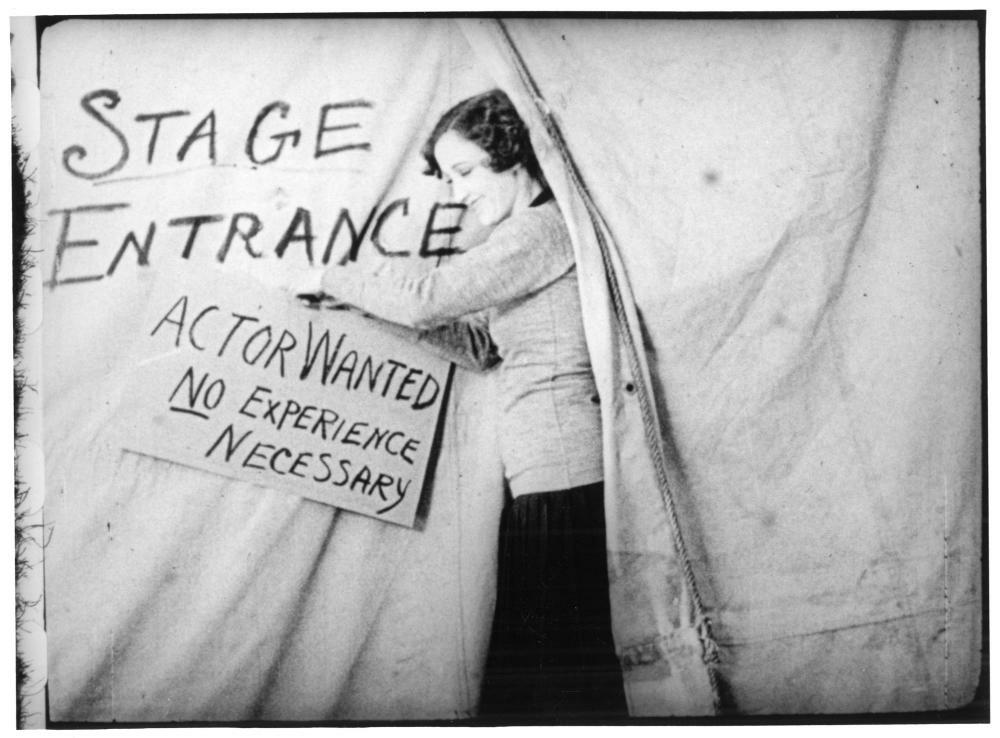
R.: Frank Capra. S.: da Come back to Aaron di Robert Lord e Ernest S. Pagano. Sc.: Elmer Harris. F.: Philip Tannura. In.: Bessie Love (Ginger Bolivar), Johnnie Walker (Don Wilson), Lionel Belmore (Jasper Bolivar), Ernst Hilliard (Wingate), Sidney D’Albrook (J. Madison Wilberforce), David Mir (Eric Barrymanie). P.: Columbia Picture. D.: 66’. 35mm.
Edition History
According to [Harry] Cohn, The Matinee Idol, a burlesque of the theater centering on the tribulations of a hammy tent company run by Bessie Love, “started the audience laughing in the first fifty feet and never allowed them to stop except for little impressive human touches injected here and there which never failed to register”. The “Variety” reviewer, Sid Silverman, gave resouding approval to what he called a “solid laugh and hoke picture (…) It’s a picture a good organist can have a circus with. The chest-heaving and gesturing drama lays itself open to all kinds of kidding sobs”. Columbia was starting to spend more money on Capra’s film, and that helped elevate The Matinee Idol in status to a movie that “Variety”, said could play on its own without a second feature on the bill. “A few more thousands spread between production and cast,” the trade paper observed, “would have made this one worthy [of] the deluxe sites around the country”. Rediscovered by the Cinémathèque Francaise in 1992 and restored by Columbia in 1997, The Matinee Idol drolly reflects Capra’s experience of amateurish theatrics at Manual Arts [High School] in the Civil War play The Crisis.
Joseph McBride, Frank Capra: The Catastrophe of Success, Simon & Schuster, New York 1992 (revised edition, St Martin’s Griffin, New York 2000)

The year 1928 was a decisive one in the career of Frank Capra. After the failure ofFor the Love of Mike (1927) – a comedy, missing today, interpreted by a very young and still unknown Claudette Colbert, straight after the end of the association with Harry Langdon – the young filmmaker was directed by his friend Max Sennett to Columbia, which was seeking new talents. As is known, Frank Capra was to work for Harry Cohn’s studio until 1939, producing his most famous films and making a noteworhty contribution to the fortunes of the small production company.
“Working nonstop, six weeks for each title (two to write the screenplay, two for the filming, and two for the editing), I made two more: So This Is Love, a comedy with Buster Collier Jr., Johnnie Walker and Shirley Mason, and The Matinee Idol, a theater curtain comedy with Johnnie Walker and Bessie Love. In these works I tried to add another ingredient of sure success to the comic element: a bit of a love story. It seemed to work”.
“Harry Cohn was the archetype of a breed of moviemakers I had not met before: tough, brassy, untutored buccaneers, second-generation opportunists attracted to a proven bonanza. Spawned in the confining poverty of Jewish ghettos on the East Coast, they broke out like young lions and headed west – to defy the odds and the gods in the carnivorous game of moviemaking. They were not actors, writers, directors, or technicians. They were indigent, hot-eyed entrepreneurs, gamblers who played longshots. Many had been exposed to the film fever while working as ushers, ticket takers, messengers delivering cans of film. Some were grub-staked by relatives already in the film business – as exhibitors or producers. But most came to Hollywood with little more than guts and gall, knowing they had as good a chance as the next guy to beg, borrow, or steal enough cash to “shoot the dice” and make some cheap, sensational pictures for the thousands of third-rate movie houses.
Harry Cohn, an ex-streetcar conductor and former song plugger for Tin Pan Alley – who snarled out of the side of his mouth with the best of them – was hit by film fever. With his wife’s money, and his older brother Jack and Joe Brandt as partners, Harry Cohn put together a small film company: C.B.C. (Cohn, Brandt, Cohn) Productions – with its un-unique trademark of a Lady holding up a freedom torch. Arriving in Hollywood, Harry stuck his camel’s head under the tattered flaps of a studio on Gower Street. Soon the camel was in, all others out. Unfurling a new sign, Columbia Pictures Studio, he pushed off into the foggy seas of “quickie” production. When I arrived at Columbia Studio, the Lady’s torch was still above the waves – the rest of her was anxiously treading water.
The title of the box-lunch picture was That certain thing; a quickie feature film, budgeted at less than twenty thousand dollars, as I remember. Mack Sennett spent twice that for a two-reeler”.
(Frank Capra, The Name Above The Title. An Autobiography, New York, Macmillian, 1971)

The print on which the Cinémathèque Française based its restoration has a long history. The print, in diacetate (1928), was deposited at the J.P. Boyer laboratory in Nimes by the Fédèration Française dec Ciné Clubs. The Cinémathèque Française inherited the depository after J.P. Boyer went out of business. Various research has indicated that this is the only print in existence of a lost film by Frank Capra. With the agreement of the depositors it was decided to restore the film.