[MOVIE]
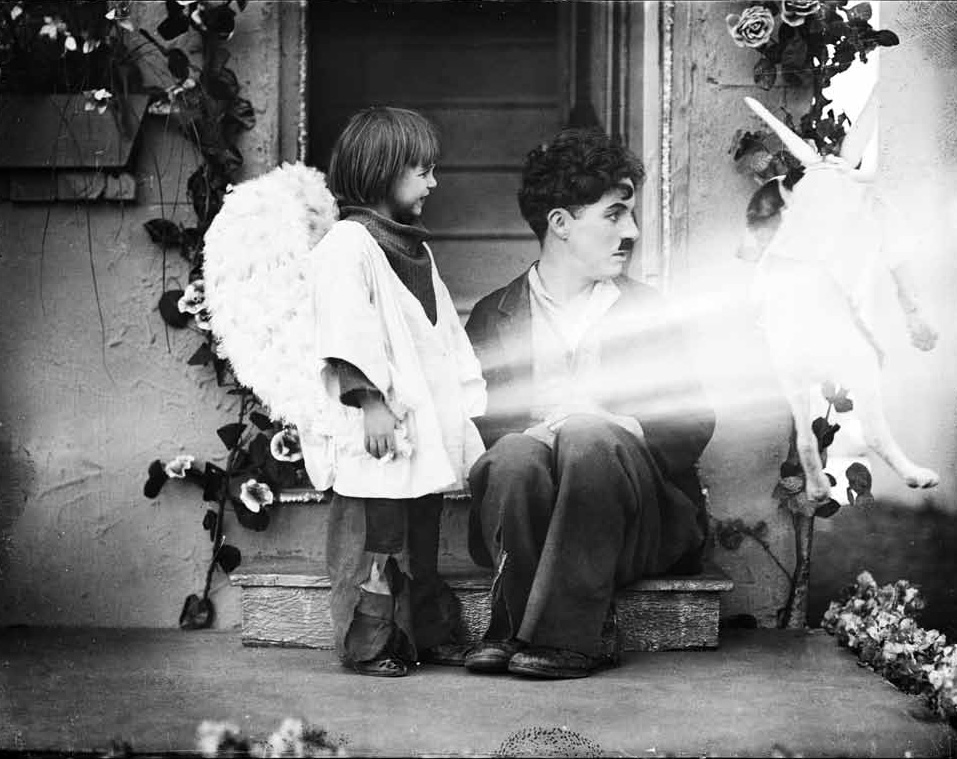
R., S.: Charles Chaplin. F.: Rollie Totheroh. C.: Charles Chaplin. In.: Charles Chaplin (il vagabondo), Jackie Coogan (il monello), Edna Purviance (la madre), Carl Miller (L’artista), Tom Wilson (il poliziotto), Chuck Reisner (il “cattivo” del quartiere), Albert Austin (il ladro), Henry Bergman (il padrone dell’ospizio), Lita Grey (l’angelo), Nellie Bly Baker, Monta Bell, Raymond Lee. P.: United Artists. 35mm. L.: 1565 m. D.: 83’ a 21 f/s.
Edition History
We know everything about The Kid. For example, we know that when Chaplin risked losing the negative due to his pending divorce, he packed it off in twelve cases (with five hundred reels hidden in coffee cans) and took them to Salt Lake City. Once there, he and Rollie Totheroh edited the film in a hotel room using makeshift equipment, choosing from over two thousand sequences scattered on top of the beds, furniture and even in the bathroom.
We also know about Jackie Coogan. Aside from being Chaplin’s most magical co-star, he also sparked Chaplin’s imagination for The Kid: just a few minutes of seeing Coogan onstage at the Orpheum Theatre and Chaplin was already imagining the film’s key scenes and outlining its plot.
Last, we know, although we tend to forget it now that nearly a century has passed since its making, that The Kid, like all of Chaplin’s movies, was made ‘against and despite’.
Many advised him against venturing into the virtually unexplored terrain of a film that had to maintain a credible balance between farce, comedy and melodrama for almost an hour. Chaplin, however, took on the drama with confidence and honesty, mitigating farce with poetry, curbing sentimentality with pure comedy, and finding space for the surreal and oneiric. If it is true, as many critics believe, that Chaplin drew upon the humiliation of poverty and emotional scarring he experienced as a child, then perhaps there is no more sincere and authentic account of childhood than TheKid.
Cecilia Cenciarelli
Restored by Cineteca di Bologna at L’Immagine Ritrovata laboratory. Original score composed by Charles Chaplin in association with Eric James, restored and adapted by Timothy Brock
“Charlie – the Kid. It seems fitting that the title of one of Chaplin’s most popular films be next to his name: it helps to understand his essence, just like the nicknames “the Conqueror”, “Lionheart”, or “the Terrible” explain the profound natures of William, who conquered the islands that would become Great Britain, of Richard, the legendary hero of the Crusades, and of the wise tsar from Moscow, Ivan Vassilievic IV. (…)
“Remember that scene in The Kid, when I tossed food to a poor family’s children like crumbs to pigeons?”
This conversation takes place on Chaplin’s yacht, where we are guests for three days on the ocean’s waves near Catalina Island, in the midst of sea lions, flying fish and marine gardens that can be contemplated through glass-bottomed boats.
“Well I did it on purpose, out of scorn. I never liked children”.
The author of The Kid, who made half the world cry for that poor abandoned urchin…doesn’t like children. Is he a “monster”?!
(…) The yacht continues to rock. The rocking reminds Chaplin of the swaying movement of elephants. “I despise elephants. They’re so strong but so docile!…”
“What animal do you like?”
“Wolves!” he replies without a moment’s hesitation. And with his grey eyes, his grey eyebrows and grey hair he looks like wolf. (…)
A wolf.
Forced to live in a pack. And to always be alone. Just like Chaplin! Constantly fighting with his pack. One is the enemy of the other and everyone is an enemy of everyone else”.
Sergej M. Ejzenstejn, Charlie the Kid (1937) (extract), in Id., Charlie Chaplin, SE, Milano, 2005

Preserved From An Original First Generation Element Corresponding To The 1921 Version. The Scenes Eliminated By Chaplin For The 1971 Version Will Be Shown At The End Of The Screening. Restoration In Progress By Using Photochemical And Digital Techniques By L’immagine Ritrovata And Dyte.
“Charlie – The Kid. It seems to me that the title of one of Chaplin’s most popular films ought to be accosted specifically for its name: let’s consider the essentials […].
Chaplin’s particularity is the following: despite his white hair, he conserved his ‘child-like gaze’ and his instinct to react in the first degree at the drop of a hat.
From here his freedom with regard to the ‘moralizing gaze’ […].
Chaplin chose to return to infantilism as a means to evade the real world, the bound and regulated world that revolves around him. It is insufficient. It is a palliative. But it is relatively within his proportions, the proportions of his means […].
This is the secret of Chaplin. The secret of his eyes, of his gaze. It is in this sense that he is inimitable. Here lies his greatness […]. To perceive even the most terrible, most pitiful, most tragic events through the smiling eyes of a child. To be capable of capturing these various manifestations of the world immediately, in a single stroke of genius, beyond any sort of moral or ethic appreciation, devoid of judgment and without condemnation – to be capable of perceiving them as a child does in a fit of laughter: in this sense he is different, incomparable, unique.
This immediacy and this spontaneity of the gaze generates a comic sensation. A comic sentiment […]. The capacity to see as a baby sees appertains only to Chaplin, present in no one else […].
To see the world in this manner and to have the courage to manifest it on the screen, is the genius’ perogative […].
Chaplin and reality act in unison, ‘in a pair’, all in a series of circus entrances […].
Elie Faure wrote of Chaplin: ‘Dances from one foot to the other, – and what sad feet they are! – showing in this way the two extremes of thought: one is called consciousness, the other concupiscence. Hopping from one foot to the other, he seeks an equilibrium of the soul, that he finds with the intention to quickly lose it’.
That which a satiric author must develop on two levels of his work, Chaplin puts on only one level. He laughs spontaneously, ingenuously […].
If the method of Chaplin’s child-like gaze makes a thematic decision that eventually develops the comedy, at the level of the subject matter, he is almost always a situation comedian opposing an infantile approach to life with a rude-adult manner of affronting it […].
The cruel amorality of infantile conduct (the nature of Chaplin’s comedies) shines through his characters along with all the rest of the emotionally moving quirks of infancy.
The last frame of The Pilgrim is practically the consummate model of the intrinsic characteristics of a hero: in fact, it is the model that recurs from one film to the next in every conflict, that we could reduce to a single, fundamental situation; it’s a diagram of the method that permits him to obtain all those incredible effects.
The flight on horseback across the frontier, is effectively the symbolic dead-end where one finds the individual half-adult/half-child in an environment and a society that is decisively composed of grown-ups.
However Chaplin might interpret his finale, it is clear that, for the ‘little man’ in contemporary society there is no place to go […].
That which is so disconcerting is the liberty of Chaplin’s moral tones. No chains, no obstacles, no impediments: this gives the author the possibility to project a comic light upon the phenomenon that might furnish his character with its distinguishing traits”. (Sergei Eisenstein, Charlie Chaplin, Circé, Belfort, 1997)
Preserved from an original first generation element corresponding to the 1921 version. The scenes eliminated by Chaplin for the 1971 version will be shown at the end of the screening. Restoration in progress by using photochemical and digital techniques by L’Immagine Ritrovata and Dyte.