[MOVIE]
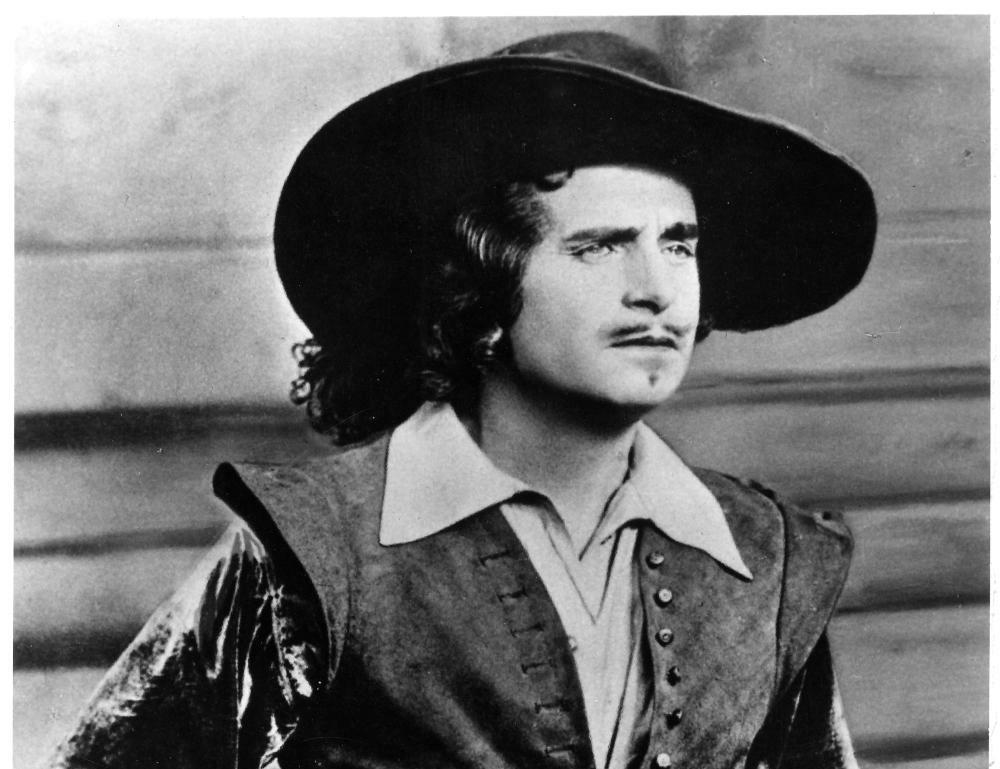
S.: basato su I Tre moschettieri, Vent’anni dopo, e L’uomo dalla maschera di ferro di Alexandre Dumas padre, e dalle memorie di D’Artagnan, Richelieu, e Rochefort. Sc.: Lotta Woods (didasc.: Elton Thomas). F.: Henry Sharp. Scgf.: William Cameron Menzies. In.: Douglas Fairbanks (D’Artagnan), Marguerite de la Motte (Constance Bonacieux), Leon Bary (Athos), Belle Bennett (Anna d’Austria), Dorothy Revier (Lady de Winter), Rolfe Sedan (Luigi XIII), William Bakewell (Luigi XIV), Gordon Thorpe (Luigi XIV bambino), Nigel de Brulier (Richelieu). P.: Douglas Fairbanks per la United Artists. 35mm. L.: 2644m. D.: 95’ a 24 f/s.
Edition History
This was Fairbanks’s last silent film, and he put his heart and soul as well as a great deal of his money into it. His Three Musketeers of 1921 had been banned from France because the French had made their own version, and they considered Doug’s to have historical flaws. So he determined to make this one irresistible to the French. He hired the illustrator of Dumas – Maurice Leloir – who wrote a charming memoir called Five Months with Douglas Fairbanks. He was consulted on every detail of production and even gave deportment classes. Laurence Irving, grandson of Sir Henry Irving, the great English actor, also began his film career on The Iron Mask and went on to design the next Fairbanks film, The Taming of The Shrew. He was fortunate on both these films to work alongside William Cameron Menzies, who had conjured up the Arabian Nights world of The Thief of Bagdad. Having known Doug since they both worked for D.W. Griffith in the teens, Allan Dwan became a close friend and directed him in several of his finest pictures, A Modern Musketeer, Robin Hood and this one. “The theatre was too small for Doug”, said Dwan. “He was active – liked movement and space – so he enjoyed every minute of film-making”. Everyone agrees that Fairbanks was born to play D’Artagnan – in Modern Musketeer (1917), which he wrote and directed, Dwan had Doug’s mother reading The Three Musketeers during her pregnancy. Fairbanks was a tremendous romantic. He wanted to make films that continued the sense of adventure that he felt had gone from much of the world. He fell in love with the film medium because it enabled him to tell his story in mime, by suggestion, action and movement. When David Gill and I were making the Hollywood series in the late 70s, we interviewed Dwan. He said that when he filmed the talking prologue, Fairbanks had been shaken to hear that first recording of his voice. It had the high pitch that every actor of the time feared. Dwan told him not to worry and brought in a voice double. But then we spoke to the man who had recorded it, Ed Bernds. Absolutely not – Fairbanks did it himself. And the voice is recognisable from his talkies. Well, they say if you listen to two witnesses to a car crash, you wonder about history. We also tracked Laurence Irving to his home in Kent, and he told us how Doug had done the incredible leap to the convent window without a double and without safety precautions beyond the laurel hedge Irving had positioned beneath the tree. He also told us a story which became the finale to the entire series. Fairbanks was about to film the talking prologues and he took Irving to the newly-built sound stage. “The studio had been hung with heavy blankets, and the most menacing thing was the microphone on a long arm. Douglas paused, looked into this darkness and then he turned to me and said ‘Laurence, the romance of motion pictures ends here’ “. We know that it didn’t. But Fairbanks had no enthusiasm for talkies and this beautiful film is his farewell to the art he loved so much.
Kevin Brownlow

Restored by Photoplay Productions
“In March 1929 the première of The Iron Mask showed audiences a hybrid product with images and sound. The latter consisted in monologues recited by Fairbanks Senior, a Movietone musical accompaniment and several sound effects. In 1954 a second version was distributed with a more accurate sound accompaniment, comprising a musical score and a voice-over comment. This time the voice was Douglas Fairbanks Junior’s. This version was about twenty minutes shorter than the one from 1929: the order and length of scenes were partly changed and other sequences from another Douglas Fairbanks’s film, The Three Musketeers (1921), were added.
In the Sixties the Museum of Modern Art entrusted around two hundred cans of nitrate film to the Nederlands Filmmuseum. This material comprises probably all the takes shot in producing the film, from different camera angles and, in some instances, from several cameras. More than eighty percent of this material is composed of duplicating negative and therefore quality is poor. But the image content is extremely interesting. One thing which is particularly striking in these shots is the fact that Fairbanks was then still doing many of his stunts. In several scenes it is clear that the 45-year-old actor was having a hard time in carrying out some of his feats, and in these instances the ‘human’ side of the great star strongly emerges before our eyes. On the other hand he is still capable of stirring a great admiration when with a rather superhuman effort, he manages to complete successfully his stunts. During Il Cinema Ritrovato a selection drawn from the massive bulk of takes from the Nederlands Filmmuseum will be screened, from which a portrayal of Fairbanks will emerge quite different from the one we may expect: a different one but certainly not less effective”.
(Daan Hertogs)
“In 1929, with sound films already well established, Fairbanks made one more silent film, The Iron Mask (with spoken prologue and epilogue; in the 1952 reissue now circulating these have been dubbed by Douglas Fairbanks Jnr.). The story of the saintly heir to France who is imprisoned in a fiendish iron device by his evil twin has an extraordinary pathos – in the treatment of both brothers – quite without precedent in Fairbanks’ work. What is more startling is d’Artagnan himself. He can still perform wonders; but he is grey-haired, and at the end of the film he dies – the first Fairbanks character to admit mortality. His spirit rises from his body and strides off into the skies in company with his three brave friends, all of whom have gone before. It seems almost like an elegy for Fairbanks’ silent cinema”.
(David Robinson, The Hero, cit.)