[MOVIE]
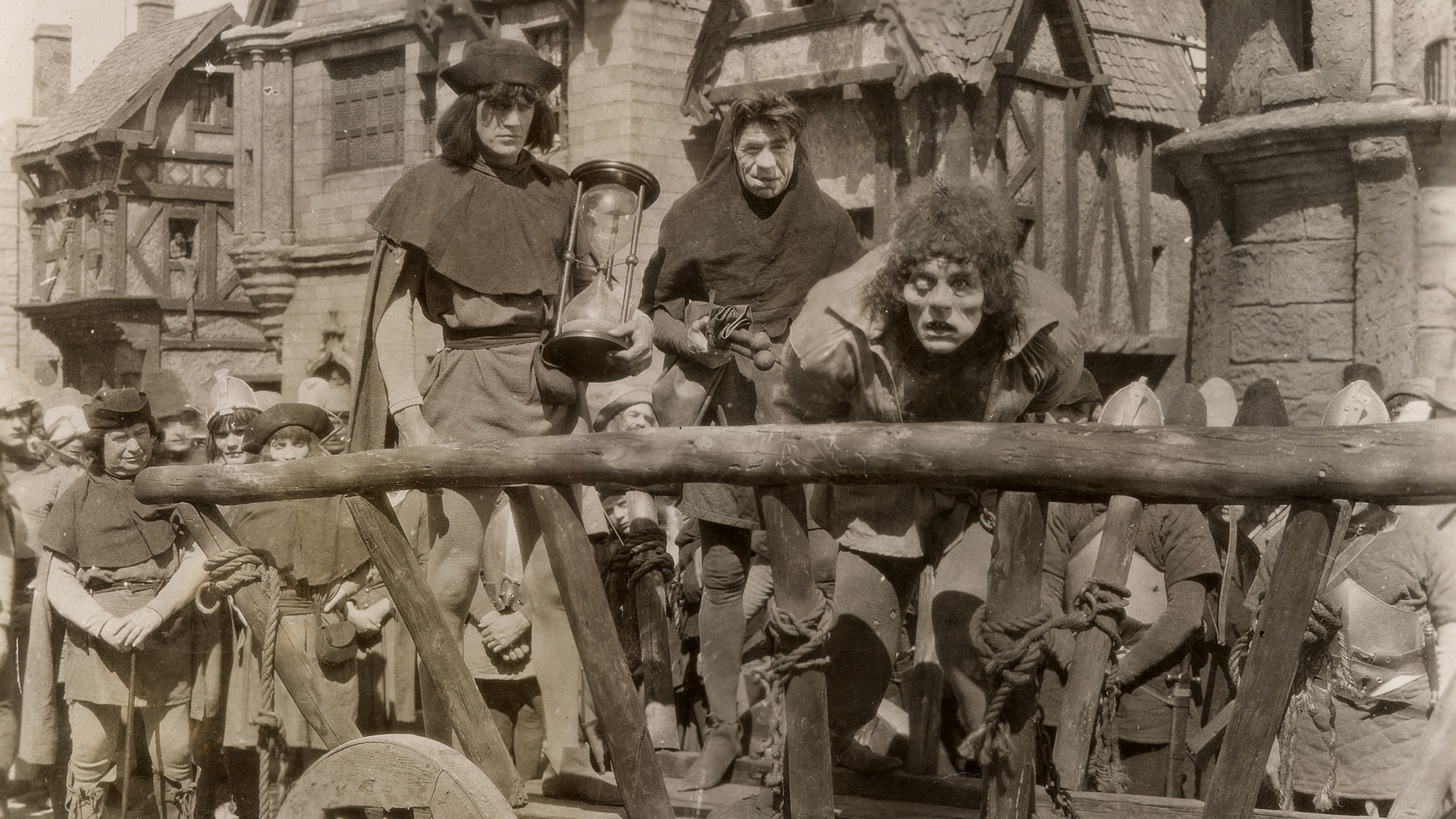
Sog.: dal romanzo Notre-Dame de Paris (1831) di Victor Hugo. Scen.: Edward T. Lowe Jr., Perley Poore Sheehan. F.: Robert S. Newhard. M.: Edward Curtiss, Maurice Pivar, Sydney Singerman. Scgf.: E.E. Sheeley, Sydney Ullman. Int.: Lon Chaney (Quasimodo), Patsy Ruth Miller (Esmeralda), Norman Kerry (Phoebus de Chateaupers), Kate Lester (madame de Gondelaurier), Winifred Bryson (Fleur de Lys), Nigel De Brulier (Don Claudio), Brandon Hurst (Jehan), Ernest Torrence (Clopin Trouillefou), Tully Marshall (re Luigi XI), Harry von Meter (monsignor Neufchatel). Prod.: Carl Laemmle per Universal Pictures Corp. DCP. D.: 110’. Col. (tinted).
Edition History
This characterisation marks the fourth real milestone in Chaney’s distinguished career for with it he was for the first time the undisputed star of a big-budget film and it brought him into close professional association with Irving Thalberg, then working as a production executive for Carl Laemmle at Universal and thus responsible for the best films emerging from MGM. From the beginning, Thalberg had only the highest regard for Chaney’s work, and the Chaney productions he sponsored at Universal and subsequently at MGM were always to reflect faultless taste and careful thought and to provide their star with superlative acting roles… Chaney’s Quasimodo stands as the only one who is emotionally stirring and truly tragic; his Quasimodo was the ugly beast who adored and protected the beautiful gypsy girl Esmeralda, and although his make-up was grotesque and repulsive, no one could miss the innocent beauty and childlike devotion flooding this unfortunate monster’s heart. His performance was not just an acting tour de force; it was much more than that – a believable interpretation of a very human being.
The ugly hump that disfigured his shoulders and back consisted of 40 pounds of rubber, and he added another 30 pounds of weight to his own with a breastplate and leather harness. When Charles Laughton did his version of Quasimodo for RKO’s Hunchback of Notre Dame, he used a papier-mâché hump that only weighed two pounds for he knew he could never achieve what Chaney had with so excessive a handicap. Said Laughton: “Chaney not only was a great actor; he was a magnificent dancer. The famous ballet stars, like Nijinsky, could express every emotion and every shade of meaning in the movements of their bodies. Chaney had that gift. When he realised that he had lost the girl, his body expressed it – it was as though a bolt of lightning had shattered his physical self. Extraordinary, really!”
DeWitt Bodeen, “Focus on Film”, n. 3, 1970

Courtesy of Park Circus. Restored in 4K in 2019 by Universal Pictures at NBCUniversal Studio Post using a 16mm print provided by Jon C. Mirsalis and a 16mm tinted print provided by The Packard Humanities Institute
OfThe Hunchback of Notre Dame, Universal lost all the 35mm elements. Until now, the film could be seen only in Blackhawk’s 16mm prints. Recently, David Shepard found an original 16mm print, dated the Twenties, printed from the original 35mm camera negative. Endless thanks to David Shepard who allowed us to screen, for you and for us, this unique material.
“In 1923 Universal consummated a two-picture deal with Chaney. They had determined to make a 12-reel Super-Jewel picturisation of Victo Hugo’s Notre Dame de Paris. This caracterisation marks the fourth real milestone in Chaney’s distinguished career: for with it he was for the first time the undisputed star of a big-budgeted film, and il brought into close professional association with Irving Thalberg, then working as a production executive for Carl Laemmle at Universal and so to be responsible for the best films emerging from MGM. From the beginning Thalberg had only the highest regard for Chaney’work, and the Chaney productions he sponsored at Universal and subsequentely at MGM were always to reflect faultless taste and careful thought, and to provide their star with superlative acting roles.
Chaney’s Quasimodo remains a definitive performance, although The Hunchback of Notre Dame has twice been re-made in talking films, once by Charles Laughton and more recently in Paris by Anthony Quinn.
Chaney’s Quasimodo stands as the only one which is emotionally stirring and truly tragic: his Quasimodo was the ugly beast who adored and protected the beautiful gypsy girl Esmeralda, and although his make-up was grotesque and repulsive, no one could miss the innocent beauty and childlike devotion flooding this unfortunate monster’s heart. His performance was not just an acting tour de force; it was much more than thet -a believable interpretation of a very human being.
The ugly hump that disfigured his shoulders and back consisted of 40 pounds of rubber, and he added another 30 pounds of weight to his own with a breastplate and leather harness. When Charles Laughton did his version of Quasimodo for RKO’s Hunchback of Notre Dame, he used a papier maché hump that only weighed two pounds, for he knew he could never achieve what Chaney had with so excessive handicap. Said Laughton: ‘Chaney not only was a great actor; he was a magnificent dancer. The famous ballet stars, like Nijinsky, could express every emotion and every shade of meaning in the movements of their bodies. Chaney had that gift. When he realised that he had lost the girl, his body expressed it -it was as though a bolt of lightning and shattered his physical self. Extraordinary, really!’”.
DeWitt Bodeen, Lon Chaney, l’uomo dai mille volti, Focus on film, n. 3, 1970
From David Shepard’s private collection