[MOVIE]
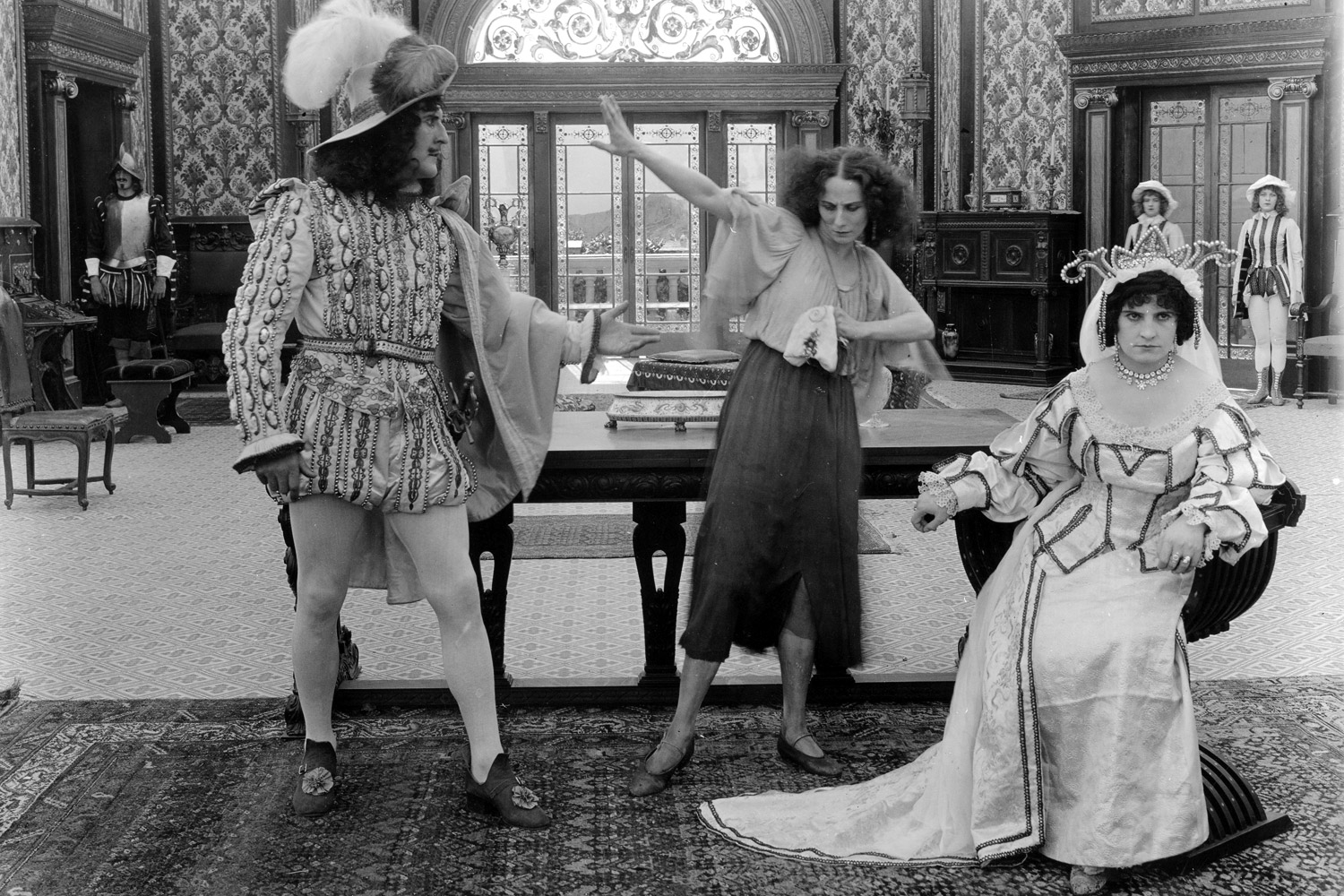
Scen.: Lois Weber, Marion Orth. F.: Dal Clawson, Allen Siegler, R.W. Walter. Int.: Anna Pavlova (Fenella), Rupert Julian (Masaniello), Wadsworth Harris (duca d’Arcos), Douglas Gerrard (Alphonso), John Holt (Conde), Betty Schade (Isabella), Edna Maison (Elvira), Hart Hoxie (Perrone), William Wolbert (Pietro), Laura Oakley (Rilla), N. De Brouillet (Father Francisco), George A. Williams. Prod.: Universal. Pri. pro.: 3 aprile 1916. 35mm. L.: 2280 m. D.: 112’ a 18 f/s. Bn.
Edition History
<!--
@page { margin: 2cm }
P { margin-bottom: 0.21cm }
-->
<!--
@page { margin: 2cm }
P { margin-bottom: 0.21cm }
-->
The Dumb Girl of Portici (1916) was a project by two powerful artists: director Lois Weber and dancer/choreographer Anna Pavlova. The production was huge, one of Universal’s most expensive up to that time.
The only version known to have survived was a 35mm nitrate reissue print dating from the 1920’s preserved at the BFI until we located a second print at the New York Public Library. Even though this was 16mm and probably duped from a Kodascope reduction, it could be used to complete the existing 35mm print and bring the film back closer to the original version.
The 35mm print had remade 1920’s intertitles but fortunately the 16mm print had the original plain-looking titles standard to Universal productions. The decision to replace all the titles in the 35mm print with the originals considerably smoothed the narrative flow.
As examined the 16mm print in detail, we found extra shots that were absent from the 35mm print. (Invariably, these turned out to be scenes of extreme violence and bloodshed – pretty graphic stuff for 1915.) It was fairly easy to reinstate them into the continuity of our digital workprint from a narrative point of view and although the image quality is decidedly lower than the bulk of the film, we feel that the restored version is now probably as close as we can get to the original continuity until (wishful thinking) a more complete print is unearthed.
A final story: the ending of the film bothered us – it bore one of those awkward reissue titles and was exceedingly abrupt. The film ends with a Pavlova dance number, but in the 35mm print, had been cut to about 35 seconds. We looked back over the 16mm print and discovered something that had been there all the time, spliced near to the beginning of the film, where the star does a short exhibition dance. It was well over two-and-a-half-minutes long and a complete routine – Pavlova’s parting gift to her audience. Feverishly, we placed the sequence at the tail and removed the intertitle and – there was our ending: delicate, beautiful, sad, and joyful.
Geo Willeman and Valerie Cervantes

Restored in 2015 from a 35mm nitrate print of BFI and a 16mm print of New York Public Library
“Cabiria stood for spectacle, The Birth of a Nation for emotional thrill, Carmen for individual force, The Dumb Girl of Portici for artistic force”, proclaimed Kitty Kelly in the “Chicago Tribune”, placing Lois Weber’s monumental feature alongside the era’s greatest spectacles. Newly restored by the BFI and accompanied by John Sweeney’s new score, The Dumb Girl of Portici is among Weber’s most ambitious productions. An adaptation of Daniel Auber’s 1828 opera, La Muette de Portici, this extraordinary film marks Anna Pavlova’s only feature film appearance. Signing the famed ballerina was a striking coup for Universal, on par with the much-heralded debut of soprano Geraldine Farrar in Cecil B. DeMille’s Carmen the previous year. Pavlova had already turned down several offers to appear on screen, but Carl Laemmle reportedly wooed the dancer by showing her Universal’s impressive production facilities and allowing her to choose the property in which she would appear. Remembering “ever since I was old enough to know what the stage meant, I have been possessed of a desire to play the role of Fenella”, Pavlova asked to star in a screen adaptation of Auber’s opera. Set in 17th-century Naples, The Dumb Girl of Portici tells the story of Fenella’s tragic involvement in a revolt against Hapsburg rule, led by her brother Masaniello. Noted for its introduction of dance into opera, it had rarely been produced because the role of mute Fenella was considered unusually demanding. But it furnished an ideal screen vehicle for Pavlova. After shooting was complete, she toured the U.S. in a stage production of La Muette de Portici jointly mounted by the Boston Opera Company and her own Ballet Russe.