[MOVIE]
Edition History
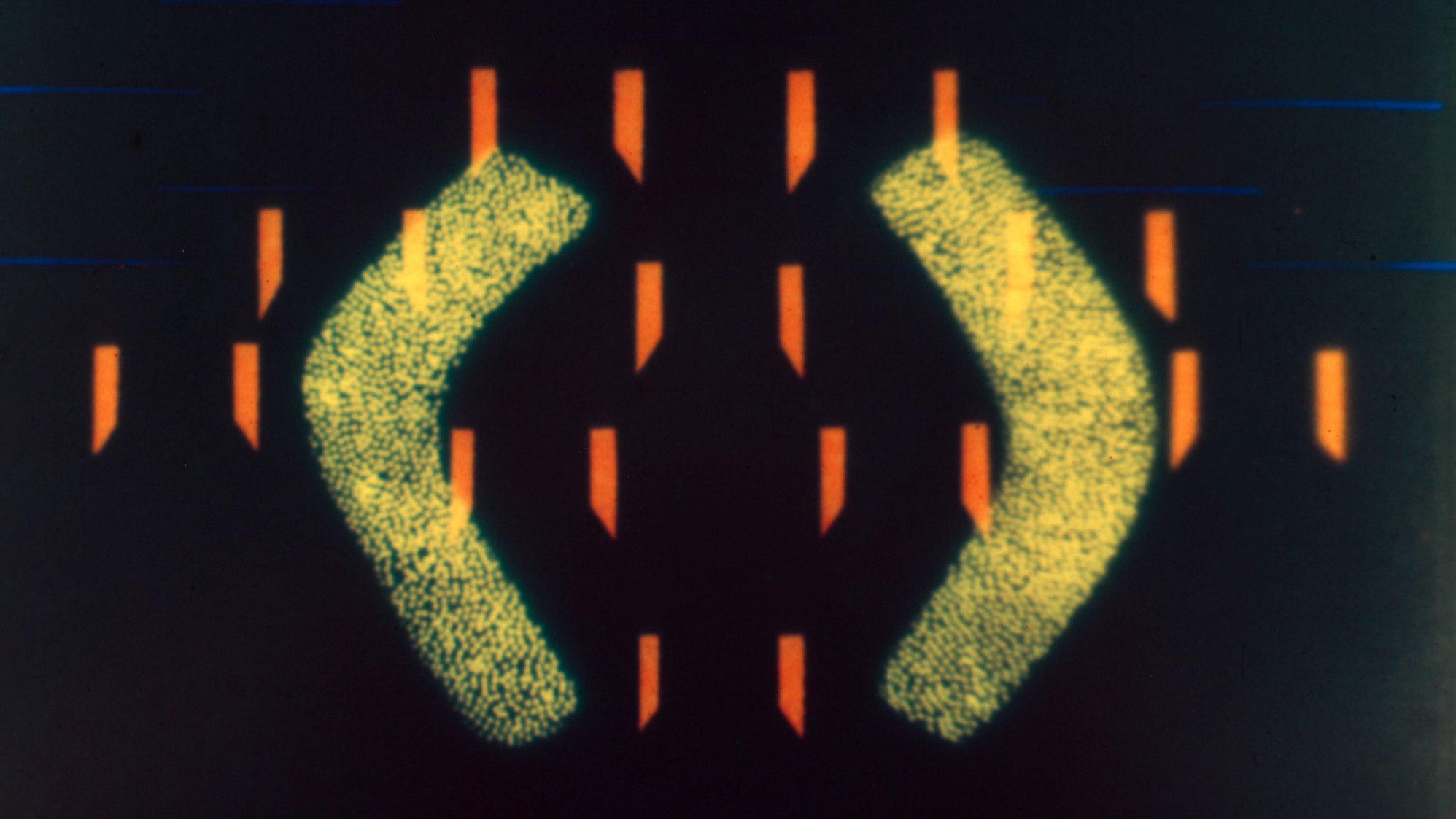
Tanz der Farben is the only film by a director whose brother is widely known. Hans Fischinger learned his craft by working for his brother, Oskar, in the early 1930s, being largely responsible for the artistic and technical execution of his brother’s ideas. When Oskar Fischinger immigrated to the USA in 1936, Hans remained in Germany and his life followed the path of many other German men: he left for the battlefield in 1940 and never returned. But before that, Hans Fischinger, without any employees, designed all the tools he needed for his experiments, even building some of them himself. Tanz der Farben took two years to make and involved some 10,000 individual drawings. The Gasparcolor film, with its firework display of forms, lights and colours and a soundtrack combining several operatic arias, among them Dance of the Hours from La Gioconda, premiered on 26 February 1939 and ran successfully for two weeks. However, on 14 March, Tobis bought the rights to Tanz der Farben, but never screened it in Germany, thus quietly suppressing it.
Lou Burkart
Courtesy Stefan Fischinger.
Restored in 4K in 2021 by DFF – Deutsches Filminstitut & Filmmuseum in collaboration with Bundesarchiv and Scan2Screen Technology at Cinegrell laboratory, from a 35mm vintage Gasparcolor print. Funding provided by FFE – Förderprogramm Filmerbe.
Oskar Fischinger’s works have gained popularity at once – popularity incredible for abstract cinema. And one of his goals indeed was – accessibility. So abstract images were always accompanied by ‘comprehensible’ music: jazz or popular classics. Since the 1930s Fischinger’s colour suites have been screened widely and researched thoroughly. And yet, we are still lacking ‘definite’ versions of some of his films, we do not have a complete and accurate list of all the animated commercials he made in the 1930s.
One of the cores of Gosfilmofond is the former collection of the Reichs-filmarchiv. Several Fischinger prints filmed in beautiful Gasparcolor have been recently located in the Russian archive – some of them have been identified decades ago, but nobody cared to compare prints with those existing in Europe and the U.S. Quadrate (1934) may be the rarest of them. Only small portions survive in the Fischinger collection of the Centre for Visual Music. A pure abstraction, the film was banned by the Reichsfilm- kammer. It may even be that Fischinger never finished this work – a lack of soundtrack in the existing fragments supports this hypothesis. But the Gosfilmofond print, albeit fragmentary, is synchronized with Otto Nicolai’s overture to Die lustigen Weiber von Widsor (a year later Fischinger will use it for Komposition in Blau)…
The Pink Guards on Parade (1934) – a commercial for pink Euthymol toothpaste manufactured by Parke-Davis. ‘Pink’ is the main word here: this little film had to be made in colour. While Fischinger had his fun mastering object animation and reaching a stereoscopic effect on a flat screen. A truly international work, Pink Guards were filmed in Berlin on Gevaert stock received from Belgium, and the prints were made in London, the new headquarters for Gasparcolor. Various elements (soundtrack, reels of negative, colour tests) are known to exist in different archives, and there’ve been two successful reconstruction attempts – in 2001 by William Moritz and in 2014 by Andrea Krämer. But only now have we obtained an authentic Gasparcolour print. And the footage slightly differs from the reconstructed versions – so there is still work to do for scholars and restorers.
Practically nothing is known about Meluka gaar frem! – aside from the fact that in 1934-35 Fischinger was working on several advertising shorts, and one of them was for Meluka cigarettes. This film must have been commissioned by Danske Reklame Bureau. It is another little variation on the theme of marching cigarettes, echoing the discoveries made for the famous Muratti Greift Ein. More research has to be done, but in the meantime we can enjoy a completely unknown work of the great filmmaker.
Tanzder Farben (1939) is by no means a lost film. Created by Hans Fischinger, Oskar’s younger brother, it is considered the last abstract film made in the Third Reich. And it is a worthy swan song. Oskar was experimenting with volume, texture, he tended to have a certain graphical ‘dominant’ in each film. Hans preferred thin lines, sharp angles – which created an effect of a more rough and tense movement with a ‘space resistance’. Tanz der Farben indeed resembles a non-figurative universe living by constantly changing laws. The Gosfilmofond print is quite unique – it is in fact three prints spliced into one, and these prints differ: Hans Fischinger was trying several colour solutions for the same musical sequence.
Peter Bagrov

Da: Goslfilmofond per concessione di Stefan Fischinger