[MOVIE]
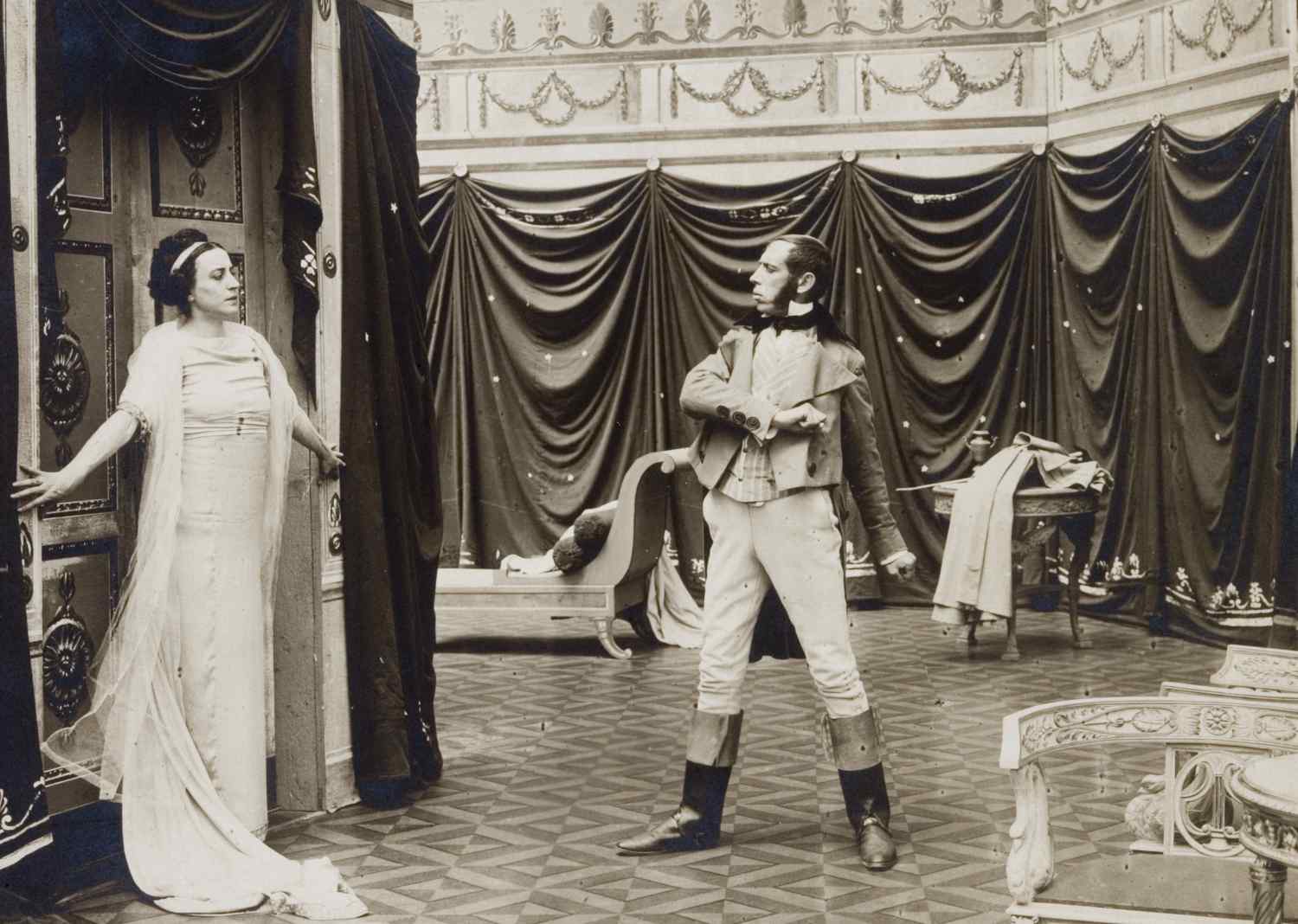
Sog.: ispirato al racconto La Grande Bretèche di Honoré de Balzac. Scen.: Arrigo Frusta. F.: Giovanni Vitrotti. Scgf.: Decoroso Bonifanti. Int.: Mary Cléo Tarlarini (Bianca Maria), Alberto A. Capozzi (l’ufficiale dei dragoni), Luigi Maggi (marchese di Croixmazeau), Luigi Bonelli, Mirra Principi. Prod.: S.A. Ambrosio 35mm. L.: 220 m (l. orig.: 253 m). D. 11’ a 18 f/s. Tinted (Desmetcolor).
Edition History
Spergiura! with an exclamation point. More than an objective observation, it is an accusation made in a moment of anger. But who makes this accusation? And are we expected to share the underlying moral judgment? Certainty wavers. Fact: Bianca Maria is no angel, she cheats on her husband with a handsome officer and swears on the cross that she is pure as a lily. But what adjective (with a lot of exclamation points) could we use to describe the cuckolded spouse? His revenge (a recurring theme in Frusta’s films, almost to the point of obsession) is wicked and fiendish and planned down to the last detail: to wall up his wife’s lover alive. It is just as cruel seeing the poor man who opens the door believing it will lead to a way out but instead finds a brick wall that means certain death. Loosely based on Balzac’s Grande Bretèche, this movie launched Ambrosio’s ‘Serie d’Oro’.

Restored in 2009 by Cineteca di Bologna, Museo Nazionale del Cinema and Deutsche Kinemathek at L’Immagine Ritrovata laboratory from a positive nitrate preserved by Deutsche Kinemathek
In the autumn of 1908 film publications announced that important “film d’arte” from France were about to arrive on screens in Italy: as predicted L’Arlésienne, L’Empreinte, L’Assassinat du duc de Guise received the public and critical acclaim they deserved; just a few months later, Italy had its own production company, similar to the S.C.A.G.L. and Film d’Art of France, that intended to make films based on history and literature. Established in Rome in 1909, Film d’Arte Italiana was a kind of subsidiary of Film d’Art and Pathé Frères; it immediately started to produce impressive “artistic films” of adaptations of famous literary works and plays. In its first year of operation F.A.I. screened in Italy Carmen, Otello and La signora delle camelie adapted from the novel written by Alexandre Dumas, fils. The longed for union between cinema and art finally seemed to be a reality; in France famous dramatists like Edmond Rostand handed their works over to filmmakers, and in Italy S.A.F.F.I. – Comerio secured a working relationship with Gabriele D’Annunzio, the undisputed authority of the national cultural scene. Art fever would soon hit the entire Italian filmmaking movement with film adaptations of masterpieces by Schiller (La campana, Cines and L’ostaggio, Ambrosio), Dumas (La signora di Monserau and I tre moschettieri, Cines), Defoe (Il naufrago, Ambrosio), Gautier (Capitan Fracassa, Pasquali & Tempo) and Balzac (Spergiura!, Ambrosio).
Cinematographers fearlessly dealt with the literary heights of every age: Shakespeare’s tragedies quickly became a favorite with Itala producing Giulio Cesare in 1909, Cines Macbeth and F.A.I. Otello; that same year Cines also tackled Alessandro Manzoni (L’Innominato) and S.A.F.F.I. – Comerio courageously took on Dante Alighieri (Saggi dell’Inferno dantesco).
But it was not just literature that sparked the enthusiasm of producers and audiences alike: more than ever films showed their power as a time machine, unearthing historical events and heroic deeds. In a kind of archeological resurrection, ancient Greek myths and Roman plays were brought back to light (of the projectors…); in darkened theaters Renaissance conspiracies, the trials and tribulations of the French Revolution and Napoleon’s epic all came back to life. History projected in the present: this is the miracle of filmmaking, all the more so when the past is recent. Taking a cue from the motto “dilettare ed istruire” (entertain and instruct) touted by the press and state institutions, the filmmaking world turned its lens on the Risorgimento’s heroes; movies like Il piccolo garibaldino and Il conte Confalonieri, martire dell’indipendenza italiana made more than just a small contribution to reinforcing in cinema audiences that sentiment of national identity, which in early 20th century Italy was still fragile and uncertain.
Giovanni Lasi