[MOVIE]
Scen.: Charles Chaplin. F.: Roland Toteroth. Scgf.: Charles D. Hall. Int.: Charles Chaplin (la recluta), Edna Purviance (la ragazza francese), Sydney Chaplin (il sergente/Kaiser), Jack Wilson (il principe tedesco), Henry Bergman (il sergente grasso/maresciallo Hindenburg), Albert Austin (il soldato americano/soldato tedesco/autista del Kaiser), Tom Wilson (il sergente istruttore), John Rand, Park Jones (soldati americani), Loyal Underwood (un tedesco). Prod.: Charles Chaplin per Chaplin-First National 35mm. L.: 829 m. D.: 41′ a 18 f/s. Bn e col.
Edition History
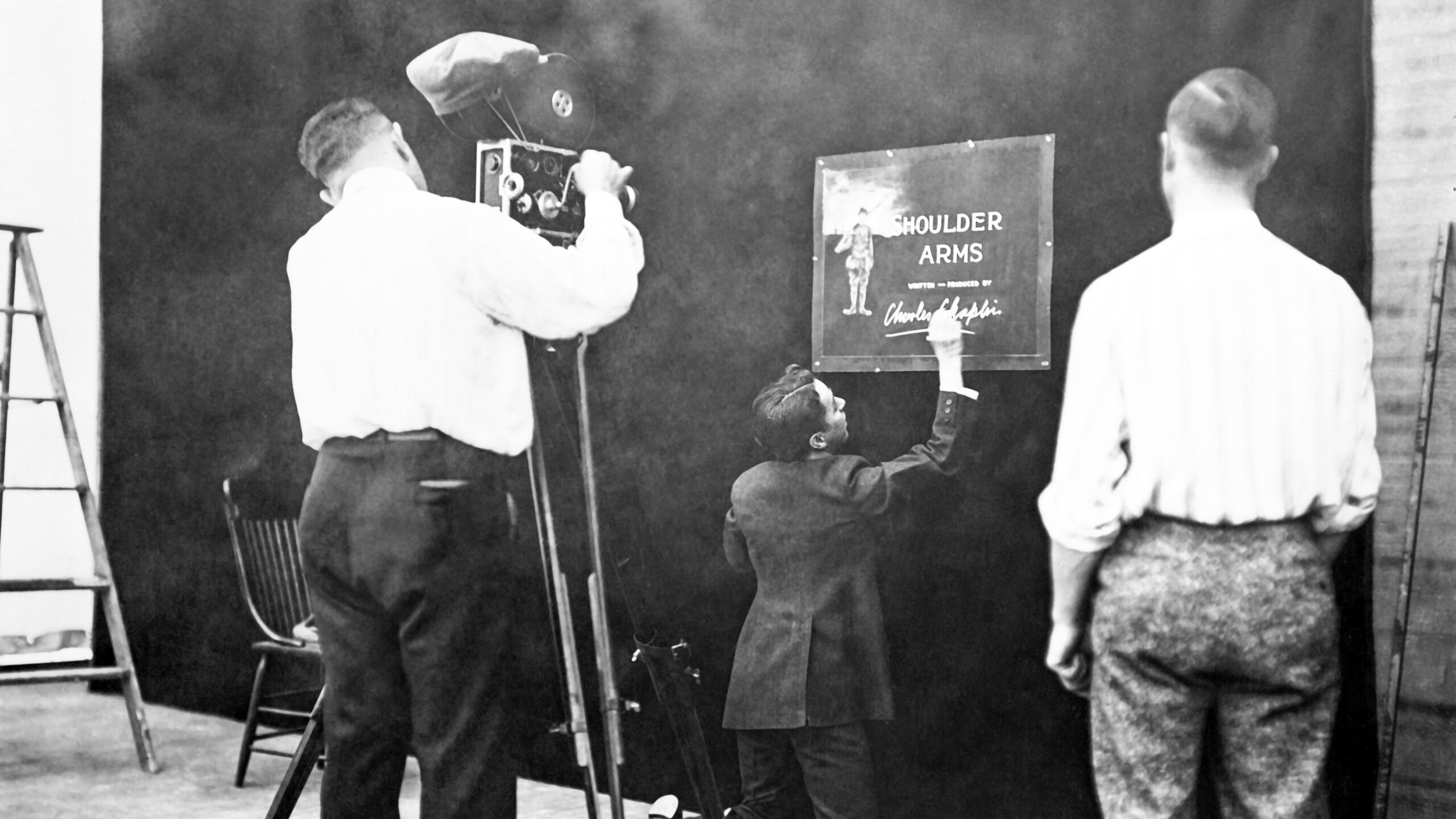
Released in October 1918, three weeks before the Armistice, Shoulder Arms was the first comedy to treat the war as material for sustained burlesque. Chaplin’s colleagues warned him the timing was suicidal; they were wrong. The film became his biggest commercial success to date, and was especially popular with returning soldiers. Where contemporary propaganda films demonized the enemy, Chaplin approached the war from the perspective of the average enlisted man – a hapless doughboy navigating flooded bunks, mail call, and the long squalid holding pattern of trench life, before disguising himself as a tree and somehow capturing the Kaiser. Sydney Chaplin appears in several roles, including a lively turn as a German officer. The version audiences have watched for decades was reconstructed from backup camera angles and second-choice takes, assembled from degraded C and D negatives after the original A negative deteriorated beyond use. MoMA’s restoration, drawn primarily from surviving prints based on the original A-negative material, corrects the jittery motion caused by stretch-printing for sound-era projectors and returns the film to its original 20 frames per second. Subtle but consequential differences emerge: Chaplin’s performance carries different emotional inflections, and the film’s rhythm reflects his actual intentions rather than the compromises of a reconstruction.
Dave Kehr

Reconstruction of the original 1918 release, restored in 4K in 2026 by MoMA in collaboration with Cineteca di Bologna under the aegis of Association Chaplin and Roy Export S.A.S. at Metropolis Post laboratory, from a 35mm print preserved by Det Danske Filminstitut, 35mm fragments from the Lobster Films Collection, 16mm and 28mm prints provided by Bruce Lawton and The Malkames Collection, a 16mm print preserved by Wisconsin Center for Film and Theater Research – University of Wisconsin-Madison. Original titles recreated with the support of George Eastman Museum. Funding provided by Lillian Gish Trust for Film Preservation
At the beginning of Shoulder Arms: a tracking shot shows Charlie walking along the trench, oblivious of the occasional blast. The camera follows him to the end of the corridor, then draws backward through the audience, not along an aisle but as if he is walking between the theatre seats. As if he was inviting us to join him at boot camp with the tacit promise that he will, ultimately, succeed in making us laugh hard about the least funny subject of all: the war. Technically speaking, this was one of Chaplin’s most advanced films to date: split narrative, impressive sets, sophisticated camera work and brilliant mise-en-scène. It is packed with comic moments that explode as often as grenades with some memorable scenes, namely the hilarious, celebrated occasion when he camouflages himself as a tree (not really ‘camouflage’ – Bazin would argue – more like “one of those little Indian insects that can take on the appearance of leaves” or an insect playing dead, the only difference between them and Charlie being “the speed with which he returns from his condition of spatial dissolution, into the cosmos, to a state of instant readiness for action”).
Shoulder Arms is the first of many films that Chaplin will shoot against his colleagues’ and friends’ advice: “It’s dangerous, at this time, to make fun of the horrors of the war”, DeMille had warned him. He went ahead, initially planning to make it his first feature, shooting extensive footage of the Tramp as a family man prior to enlistment, then cut it and released it as a three-reeler. Shoulder Arms was one of Chaplin’s greatest commercial successes, and for a long time both audiences and critics would measure subsequent films by its standards. But there’s more to it. It hit the public at exactly the right time, making them laugh about the idiocy of it all, and thus becoming an essential part of the World War experience. “How did you capture thirteen German soldiers by yourself?” – Charlie is asked by his superior – “I surrounded them”, he explains.
Cecilia Cenciarelli

Restored in 2018 by Cinémathèque suisse and Národní filmový archiv with the support of Memoriav and Národní filmový archiv at Bonton A.S. and Lýsa nad Labem laboratories. Tinting and toning by Jan Ledecký. Special thanks to Kate Guyonvarch and Chaplin family for screening permission