[MOVIE]
Edition History
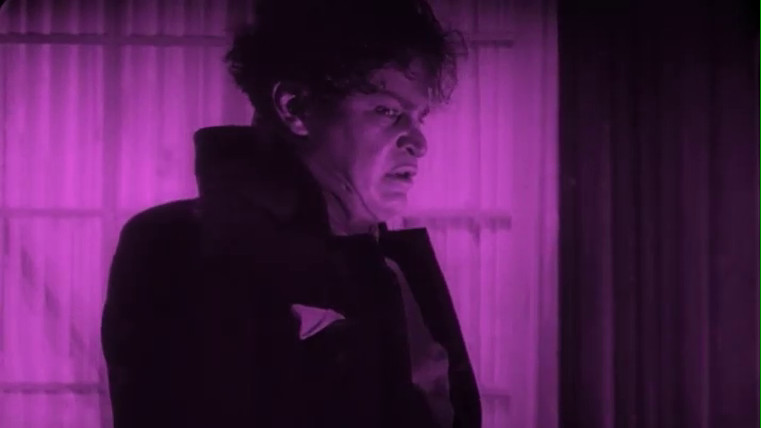
The interplay of light and shadow is a defining characteristic of those German films made in the late 1910s and early 1920s that have been collectively (and rather simplistically) labelled “Expressionist”. The supernatural Kammerspiel film Schatten arguably represents the apotheosis of the shadow motif in German silent cinema; shadows serving here not only as a key stylistic device but as an intrinsic element of the narrative.
While Arthur Robison is credited as director, it would be wrong to label Schatten “a film by Arthur Robison”. On the contrary, the film is a prime example of film-making as a collaborative art form, and just as much “a film by Albin Grau” or “a film by Fritz Arno Wagner”, whose set design and camera-work respectively are integral to the look and atmosphere of the film, even more so than they were to F.W. Murnau’s Nosferatu, released the previous year.
Like the “screen poems” (Siegfried Kracauer) made around the same time by screenwriter Carl Mayer in collaboration with Lupu Pick and Murnau – Scherben (1921), Sylvester (1923-24) and Der letzte Mann (The Last Laugh, 1924) – Schatten was, upon its initial German release in October 1923, completely devoid of intertitles. Thus, the contribution of the cast in conveying the inner emotional and psychological workings of the anonymous protagonists is every bit as important as the lighting, design and mise-en-scène.
While it has long been considered part of the German silent cinema canon, Schatten is still somewhat overshadowed (no pun intended) by the work of Murnau, Fritz Lang and G.W. Pabst, indeed perhaps due to its lack of a clearly distinguishable auteur. Nonetheless, Paul Rotha, in his influential study The Film ‘Till Now (first published in 1930), praised Schatten as “a rare example of complete filmic unity,” in which “[t]he continuity of theme, the smooth development from one sequence into another, the gradual realisation of the thoughts of the characters, were flawlessly presented” and “[e]very filmic property for the expression of mood, for the creation of atmosphere, that was known at the time was used with imagination and intelligence”. Watching the film today, it is hard to disagree.
Oliver Hanley

courtesy of Friedrich-Wilhelm-Murnau-Stiftung
“Schatten is undoubtedly one of the most famous films of German expressionism, therefore so many prints of the film are conserved by many archives. The restoration started by the analysis of all the existing materials, by reconstructing the story of the several ‘restorations’ and preservations that the film has had (and suffered) in the past, and by trying to come as close as possible to the original version. We can now say that all existing materials and prints were originated from two different negatives. The first negative (chronologically, because there is no possible way to ascertain that this was the ‘first-choice’ negative) corresponds to the prints printed in Germany (Cinémathèque Française’s print, with French intertitles) and in United States (at Museum of Modern Art) and most probably in Spain (at Filmoteca Española); the negative was arranged in small reels and the prints were all ‘pos-cut’. The second negative – which differs from the first because it is produced by using different takes, mostly with very different acting and camera angles – had been spliced together in order to be able to produce “neg-cut” prints; at this stage, the editing of the film was also changed, to obtain a better continuity. This second negative produced the prints found in London (which later originated the so-called Czech version) and in Milano (at Fondazione Cineteca Italiana).
According to all documents, the film was originally released without intertitles (except the credit titles), then, following complaints from distributors and audience some intertitles were added. For this reason the reconstructed version has no intertitles.
Schatten is, above all, the work of Albin Grau, the film’s producer, creator and artistic director. Only by examining the film in the context of its creator can we really understand its significance. Schatten is a film about esoteric philosophy. It is an esoteric film even if, on a first viewing, it doesn’t seem to be. In order to understand it, we have to penetrate the mind of Albin Grau.
My own lengthy essay on Albin Grau was published in issue no. 27 of the magazine Archives de la Filmoteca de la Generalitat Valenciana and I don’t intend to dwell upon the same arguments. Nevertheless, I feel that it is essential to offer some brief biographical notes, and including with them some new information.
Albin Grau was born at Schönefeld, not far from Leipzig, on 13th June 1884 and died on 27th March 1971. After working as an apprentice baker, he completed his studies at Dresden Academy of Art. After the First World War – during which he fought on the Russian and Serbian Fronts – he settled in Berlin working as an artist and publicity agent for Norddeutsche Lloyd. He then came into contact with the world of cinema as poster designer, working with Sascha Goron on the publicity campaign for F.W.Murnau’s Der Gang in die Nacht. Grau met two practitioners of the occult, Heinrich Tränker and Gregor A. Gregorius (whose real name was Eugen Grosche), in 1888 in Leipzig. They had just founded the Pansophische Loge. Interested in the world of cinema, which he regarded as a means of spreading his own ideas, he persuaded various members of the occult to establish a production company which was given the theosophical name of PRANA. After employing Galeen as script writer and Murnau as director, he produced Nosferatu in summer 1921, broadly based upon the novel Dracula, by Bram Stoker, who was probably a member of the Golden Dawn. He failed to pay royalties in respect of this work and lost the suit brought by Stoker’s widow, bringing about the bankruptcy of production company.
Grau refused to give up and produced another film, Schatten, with a new production company called PAN. The film did not have sufficient public success to guarantee the continuity of the production company, despite winning very favourable critical acclaim”
(Luciano Berriatùa, “Schatten”, the Esoteric Face of Chinese Shadow, Cinegrafie, n.12, 1998)

“The painter Albin Grau gave Robison the idea of this story: a jealous husband, irritated by his wife who let herself be wooed by four knights, suspects one of them to be her lover. During the supper, a sort of illusionist enters in the room and begins to entertain the guests with shadow games. This mysterious character, who has the intuition of an approching tragedy, hypnotises everybody and then let their shadows act on the wall. So he makes them do exactly what they were determined to do, if they had been dominated by instinct. Later the shadows return to their respective owners who leave the hypnosis. Serenity gets back to family, the lover leaves with the others. And the daylights appears.
As in all expressionist works, the situation of Schattenmay seem melodramatic or even absurd. But the film visual impact (thanks to the splendid photography of Fritz Arno Wagner who alternates lights and shadows in an elliptical game of chiaroscuro, the styled recitation of the actors, the hieratic rythme imposed by the direction; all of this creates a silent ballet, a metaphorical pantomine punctuated by projected shadows on the walls and windows, enlighted by external lights, as frightning signals, as these mirors that reflect different images”.
(Vittorio Martinelli, Cinegrafie, n.7)
“London Nov. 20. Whether or not Warning Shadowsarouses intense admiration or intense dislike, there is no half-way attitude; no one will deny that it is unlike any other film ever shown. Its appeal is uncompromisingly highbrow. If advertised as a show for those who have the taste of connoisseurs it could be screened in New York with every chance of success.
This drama, say the program which is so silent regarding facts, is wholly dependent upon the mental co-operation of the spectator. You are asked to replace the sub-title, which is entirely absent, out of your own imagination. The plot is not so difficult as that; it is, in fact, simple enough to do without captions.
This magical and magnificent film ends with quiet, homely touches to assure that the world is sane when not colored by the emotions of the spectators.
Throughout, the perfection of details shows the hand of a master. The photography, too, is excellent. Yet Warning Shadowsit is said, has had to wait two years before being exhibited in london. How long will it have to wait before it will be ready for exhibition to the average picture patron?”
(Jolo, Variety, , 3.12.1924)

The basis for the reconstruction was a print of the French version, conserved by La Cinémathèque Française, 1643 mts long. Some mistakes in editing have been corrected; above all it has been possible to insert some sequences from a print of the Czech version, conserved by the Narodny Filmovy Archiv (lenght 1703m. and printed from the B-negative of the film). The head titles have been reconstruted. The lenght of the present print is 1923m (according to the German censorship card, the film did measure 2002m in its version without titles).