Int.: Anna Magnani. DCP. D.: 1’ (excerpt). Col.
[MOVIE]
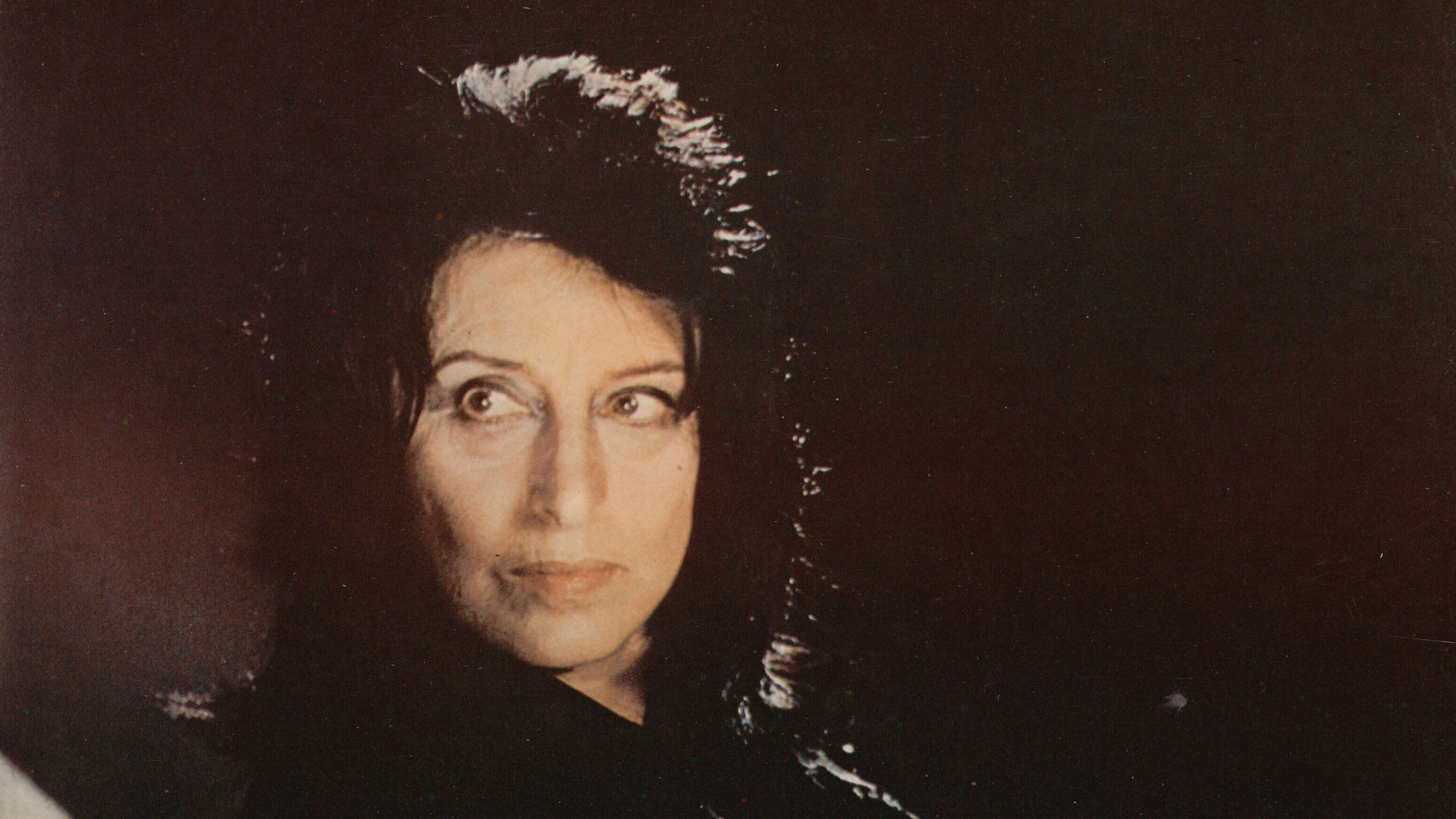
Int.: Anna Magnani. DCP. D.: 1’ (excerpt). Col.
Edition History
When I saw Roma for the first time I felt like I was watching two different films, divided in sections, intertwined in sections. I went back to see it two, three times, with an insatiable longing and a desire to think about it, as had been the case for me with La dolce vita when I was 20. Not long before that, while Fellini was filming the ‘festa de noantri’ in Trastevere, I had spent a whole afternoon, or thereabouts, talking openly with him about his cinema in his office in Via Sistina.
You could divide Roma in two parts. The first section was about a Rome that was finally the vulgar, carnal and violent Rome of Belli (not the ‘good-hearted’ version of Zavattinians and post-Zavattinians), while the second (which still managed to amaze) imaginatively dealt with scenes that could, I wrote, create a sense of surprise and enthusiasm in foreigners and not just Italians – an ‘archaeological’ past, a Vatican fashion show… Yes, I said to myself, “the end of the poet is to arouse wonder”. And then I put together, in this programme, Fellini and Kubrick as the last Méliès-type magicians, in opposition with the heirs of Lumière, and I was surprised that Fellini had been Rossellini’s most faithful student… But there is wonder and wonder, and in Roma the wonder created from direct experience seemed greater than any imagined, expansive version.
In other words, it seemed to me that the more genuine Fellinian Rome was one marked by experience, which was also the Rome of Ilbidone, of Nights of Cabiria, the ‘real’ one discovered by a provincial Moraldo, the vitellone from Rimini, before he became the reporter that Marcello bewildered and was swept away by the ‘Capital’.
In the review I wrote about Roma at that time (the spirit of ’68 was still very much alive) I wrote about the final sequence with unidentifiable young people riding on motorcycles across the landmark sites of the so-called Holy City, which was Fellini’s unsettling vision of the future: not about “exterminating and foreign angels” but “future ministry employees who will vote for neo-fascism” (read, today, Di Maio or Salvini). What came out of it was a combination we could not have foreseen; not Fellini nor, in my small way, myself. His nostalgia was and is untamed – this searching, sometimes deviating, artist, who scrutinised and searched, who sensed instinctively or understood. And who amazed with his extraordinary abilities.
Goffredo Fofi

Restored in 4K in 2019 by Cineteca di Bologna in collaboration with Titanus, with funding provided by Hollywood Foreign Press Association at L’Immagine Ritrovata laboratory
To the projection are matched some outtakes recently found at the National Film Archive, where they appear , among others , Marcello Mastroianni and Alberto Sordi .
What is Rome? What do I think of when I hear the word Rome? I’ve often asked myself this. And I know more or less. I think of a large reddish face rather like Sordi’s, Fabrizi’s, or Ms. Magnani’s. An expression slightly weighted down and preoccupied by gastro-sexual needs. I think of a dark brown, sludgy land; a broad swaddled sky, as a backdrop, with purples, blacks and silvers; mournful colours. But by and large it’s a comforting face. Comforting because Rome allows you every type of speculation in a vertical sense. Rome is a horizontal city, made of water and land, stretched out – and therefore the perfect platform for flights of fancy. (…) Rome is a mother, and she is the ideal mother because she’s indifferent. She’s a mother with too many children and so she can’t focus her attentions on you, she doesn’t ask anything of you, she has no expectations. She welcomes you when you arrive and she lets you go when you leave, just like with Kafka’s courthouse. There is age-old wisdom in her – almost African, prehistoric. We know that Rome is a city steeped in history, but its atmosphere resides precisely in something prehistoric, something primordial: it stands out clearly in certain endless and desolate views, in certain ruined buildings similar to fossil finds, all bony like mammoth skeletons… (…) With her placental belly and her motherly appearance, she avoids neurosis but also hinders development to full maturity. There are no neurotics here, but there are no adults either. It’s a city of lazy, sceptical and rude children – who are also a little deformed, since hindering growth is unnatural. This is also why there’s this extreme attachment to the family in Rome. I’ve never seen a city anywhere in the world where relatives are talked about so much. (…) I had thought of a Rome scrutinised by a foreigner, a city very close but as far away as a different planet. This initial idea, almost without me even noticing, gradually took shape to become the project for the film as we see it. And now the film is finished, I really don’t know if it fully reflects the initial inspiration. No, I really can’t say. (…) A lot of things were left out of the screenplay: we wanted to do a scene on the night tram, one on a Roma-Lazio football match, with a fan who loses his bet and has to jump in the fountain in Piazza degli Eroi… A scene on Rome’s women, one on its Ponentino westerly breeze and its clouds… They were all left out. But above all the scene on the Campo di Verano Cemetery was left out. (…) Even in its burial ground, Rome preserves its feel of a large apartment where you can stroll around in your pyjamas and slippers. But I didn’t shoot this scene. Nevertheless, the film still has this feel of a huge cemetery teeming with the life that is Rome.
Federico Fellini, Roma & Fellini, in Federico Fellini, Roma, edited by Bernardino Zapponi, Cappelli, Bologna 1972
In his third ‘false’ documentary, following Fellini. A Director’s Notebook and I Clowns (1970), Fellini frees himself of every restraint of narrative linearity, preferring the mysterious and allusive charm of fragmentary evocation. Roma in fact starts with ten short scenes set in a Romagna town in the ‘20s and ‘30s. Here the name and image of the Eternal City conjures up a distant and mythological entity, summoned into that small world by roadside memorial stones, the radio, and the sounds and images passed on down by the school and especially by the theatre and cinema. The fragments then become longer, showing the arrival in Rome of a young man (a Fellini self-portrait) who, in 1939, discovers the crowded labyrinths of the Roman homes and the gargantuan open-air suppers. Then the present suddenly breaks in, with Fellini’s crew intent on making the film we are watching. 1970s Rome is condensed into: the hellish scene of car traffic on the orbital motorway, where all sense of time and space is lost; the fanciful journey on the underground hiding the mystery of ancient Roman houses; the ghostly and grotesque ceremony of an ecclesiastical fashion parade; and the chaotic euphoria of the Festa de Noantri celebrations. But the present is obstructed twice by the past, and two pieces surface like visions from the memory: the comic and cruel spectacle of a variety act at the little Barafonda theatre, and the underground world of brothels, with the procession of prostitutes offering themselves to their hungry customers. After a fleeting appearance by Anna Magnani, the kaleidoscope closes with an apocalyptic vision of Rome at night, invaded by a swarm of faceless motorbike riders, who seem to announce dark threats for the future. The naive waiting of those who, from the provinces, dream of the legend of Rome is thus placed in contrast with the bloody, sensual and cynical reality of the capital and above all with the seemingly liberalized mood of the ‘70s streaked with the signs of ruin. Keeping a lower profile than he did in the two films from ‘69 and ‘70, Fellini intertwines slightly self-referential echoes (the Barafonda audience includes a presence bringing to mind Luigi A. Garrone, AKA ‘Gattone’, who should have featured in Moraldo in Città; the atmosphere of the Roman house overshadows the Attalo cartoons for the ‘Marc’Aurelio’ paper, which Fellini worked for as a young man; the Pope is impersonated by Guglielmo Guasta, a humorist, colleague and friend in those years). The orbital, underground and Via Albalonga supper scenes were actually shot in the studio. The ecclesiastical parade – the sarcastic, marvellous portrait of the decay rife in the Church and among the papal nobility – was admired by Buñuel, who wanted to play one of the bishops. However, the bankruptcy of Giuseppe Pasquale, majority shareholder in Ultra Film, interrupted the shooting; it was resumed thanks to the intervention of Banca del Lavoro and with Fellini forfeiting some scenes.
Roberto Chiesi

Restoration carried out in 2010 by L’Immagine Ritrovata.
Restoration of the integral version presentated by Enrico Magrelli (CSC-Cineteca Nazionale), Alberto Barbera (Museo Nazionale del Cinema di Torino) and Gian Luca Farinelli (Cineteca di Bologna)
Int.: Anna Magnani. DCP. D.: 1’ (excerpt). Col.
We know that it was the producers who suggested this semi-documentary episode on the distinctive Urbe district; they felt that in such a visionary film dominated by the past, international spectators enamoured with local colour would appreciate an episode set in modern, working-class Rome […]. Every year, the Trastevere district holds festivities with a significant name: the Festa de Noantri [Our Festival] […]. Fellini concludes the Trastevere episode with a very brief homage to the actress who, more than any other, embodies the city: Anna Magnani. The mythic heroine of Roma città aperta is entering her home, in Palazzo Altieri (although the scene is shot near there, in Piazzetta Mattei, close to the ghetto). The actress died two years later, in September 1973, and so this fleeting appearance became her slightly melancholic farewell to the cinema. “Anna… do you want to say anything about Rome? You are virtually its symbol… She-wolf and vestal virgin… What do you think you most resemble in this city?” A quick word. “Federico, go to bed…. I don’t trust you! Ciao! Goodnight!” She cuts him short and closes the door. No, Anna Magnani will definitely not be the one to disclose to Federico the secret of this city, which for nearly three thousand years has “refused to reveal itself”.
Aldo Tassone, Fellini 23½. Tutti i film, Edizioni Cineteca di Bologna, Bologna 2020