[MOVIE]
Edition History
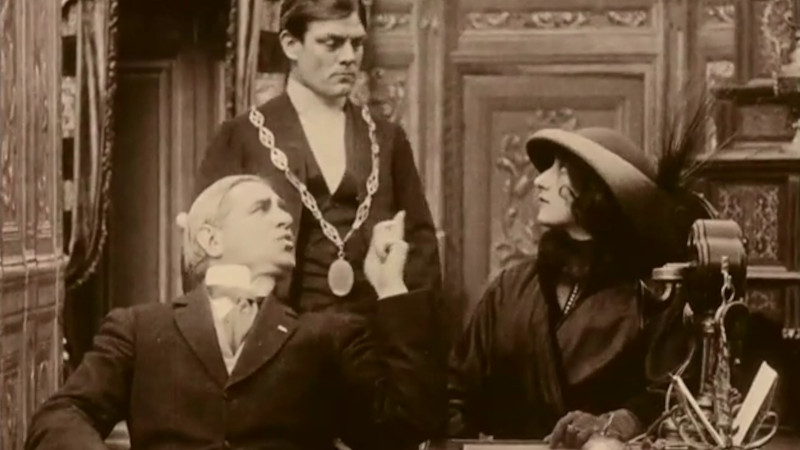
The film was restored in 1998 from an interpositive struck from the incomplete original nitrate negative and a fragmentary Dutch copy, both of which are held in the collection of Cinémathèque française. A 16mm interpositive from Argentine was also used in the reconstruction of the film, which remains incomplete. In 2013, Cinémathèque française undertook a 2K digital restoration, adding tints taken from the Dutch nitrate negative. The original negative also provided usefulinformation regarding tinting, which had been overlooked at the time of the initial restoration work. The typeface used in the title cards by Francis Lacassin were reworked according to the 1913 Éclair intertitles, found on different copies.
If “the finest films are those we haven’t yet seen”, then Victorin Jasset’s Protéa has long been a hidden gem of cinematic perfection. Highly popular in its day (if proof were needed, it had its fourth sequel in 1919), it has held legendary status for eight decades, up to its initial restoration by Cinémathèque française in 1995. Unlike NickCarter, Zigomar and Balaoo, Protéaowes nothing to literature or infra-literature and it spawned a strictly cinematographic myth, a character born out of and for cinema, (and hot on its heels came Musidora and the serials with Pearl White, Ruth Roland, Helen Holmes, etc). From that point, Protéa, among other prophecies, foretold a new genre in film: the spy movie. From Protéathrough to GoldenEye; or from Protéa through to Black Widow, to continue the superwoman theme. Proteus, son of Poseidon in Greek mythology, had the dual gift of being able to predict the future and change shape at will. Following in his footsteps, Protéa is a worthy rival when it comes to nimble costume changes and showing her genius in matters of disguise, an art replicated by her partner, l’Anguille (The Eel), who is similarly adept. A dimorphic heroine, she was described by historian Francis Lacassin as an “interpreter of a dozen roles of both sexes: a business woman in the office of Messinia’s Chief of Police when he entrusts his mission to her; a woman of the world with two different guises travelling on the Orient Express to appropriate the diplomatic papers of the Count of Varallo; an acrobatic cat burglar in a night-time raid on the Celtie Ministry of Foreign Affairs; an elderly lady pleading her case to the minister; an aide-de-camp; a gypsy violinist at a grand ball; the ‘spouse’ of the Albanian ambassador; an arsonist turned firefighter; a lion tamer in a fairground menagerie; a peasant; an officer of Celtie”, etc. In an age when special effects were still known as ‘tricks’, Protéa, pioneer of transvestism, queen of cross-dressing and changing before our eyes, ushered in the promise of change in a bright cinematic future.
Bernard Benoliel

Josette Andriot (1886-1942) did not, of course, have the looks of a typical preFirst World War romantic lead. But, hired by Jasset in 1910 for her riding skills, she revealed her other accomplishments – as a champion swimmer and acrobat, as the occasion demanded – before demonstrating her utter versatility in the character of Protéa. This part was to overturn the traditional adventure genre which – be it novel or cinema – was usually embodied in a male hero. This innovation was indisputably the brainchild of Jasset, even if Feuillade would perfect it in Les Vampires, and would bring new life to the subject matter of action films. The Americans would learn from it: in the serials they launched from 1915, to rival French production, they would always give the lead to a woman: Pearl White, Ruth Roland, Helen Holmes, Juanita Hansen.. (…) Thus Protéa, in 1913, was the first adventure heroine of the silent cinema. Three years before Mata Hari and Marthe Richard came on the scene in real life, she was the first female spy, the first heroine of what was not yet called the “film d’espionnage” but the “film patriotique”. She was a Mata Hari who, as well as dancing, had learned to tame wild beasts and take off from a terrace in a speeding car, a Marthe Richard who, as well as flying a plane, had mastered the art of jumping, on a bicycle, across a bridge in flames. Produced and then distributed by Éclair in September 1913, Protéa signalled the apotheosis of an actress whom Jasset had until now used in roles which were notable but too discreet to qualify her for the stardom she would prove worthy of. The success of the first Protéa was as much due to the genius of Jasset as to the personality of the young actress.
Francis Lacassin