[MOVIE]
P.: Belge-Cinéma Film L.: 860m. (l.o.: 1050 m.), D.: 47’, col. e bn, 35mm
Edition History
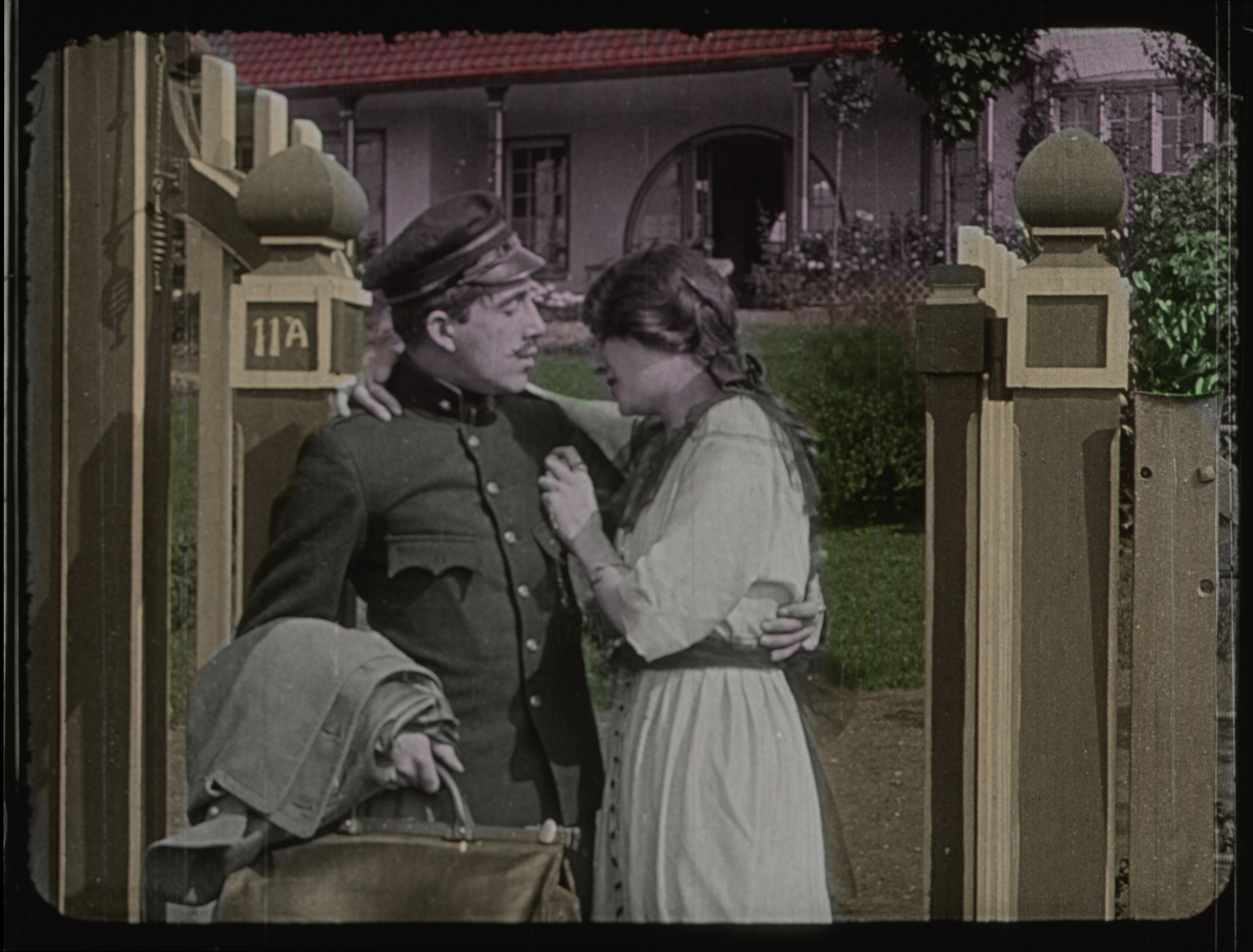
Of the many gems the cinema of the Teens holds, one of the most breathtaking is undoubtedly Maudite soit la guerre. Rediscovered by Eric de Kuyper at the Filmmuseum in Amsterdam in the 1990s, this anti-war melodrama, filmed by Alfred Machin immediately before the War in his studio and around Brussels, revealed one of the most talented directors of the Teens and an almost unrivalled use of film technique from editing and air fights to the unforgettable use of color, and one of the best pacifist movie ever made.
As Eric de Kuyper so precisely wrote in an important essay about the film, its narrative text and subtext(s) are all supported by a wonderfully precise use of stencil coloring – almost unique at the time for its extensive use – and for the fascinating interaction with tinting and toning.
Unavoidable chapter in the history of color in film, the chromatic composition of Maudite soit la guerre is constructed around the leitmotiv of two pastel, understated colors, the pink of the geraniums in the girl’s villa and the variations of brown (from terra di siena to ochre) of the uniforms and the battlefield, with the reds of the explosions providing the counterpoint.
Nicola Mazzanti

“In the last few months, or rather the last few years, the term ‘machin’ in different film archives has become the name of an eminent pioneer of cinema. It is no longer a common French term (a ‘machin’: a tool, a gadget, an object). Alfred Machin’s contribution to French film production in the early years is remarkable, but it is not only limited to this: Machin was at the origins of the development of the Dutch and Belgian film industries. Nevertheless, this has not prevented his name from going into oblivion. It is for this very reason that certain countries, and their respective film archives, have united their forces to ensure that this personality re-emerges from his obscure past.
The archives started to search under the name ‘Machin’. Rusty cans were opened in the hope of re-finding some of his films. Researchers dedicated themselves to the most minute analysis of old cuttings from newspapers, magazines and catalogues, concerning themselves to jealously guard the only available biography (at the moment Francis Lacassin is working on a re-edition of his book). The archives have worked assiduously on the restoration of those films by Machin that are still available. They have based their work on correspondence, long telephone conversations, appointments, decisions and discussions. A collaboration network has been created between dozens of researchers united by a common objective. Thus, the dust of the old containers and the yellowed newspapers have been transformed into a life story.
It is a mosaic which is still incomplete. However, for the moment, the treasures which we have arranged furnish an interesting profile of the life of this singular character and of the rich legacy which he has left us -the spark from which most of European cinema has been born”. (Marianne Thys).