[MOVIE]
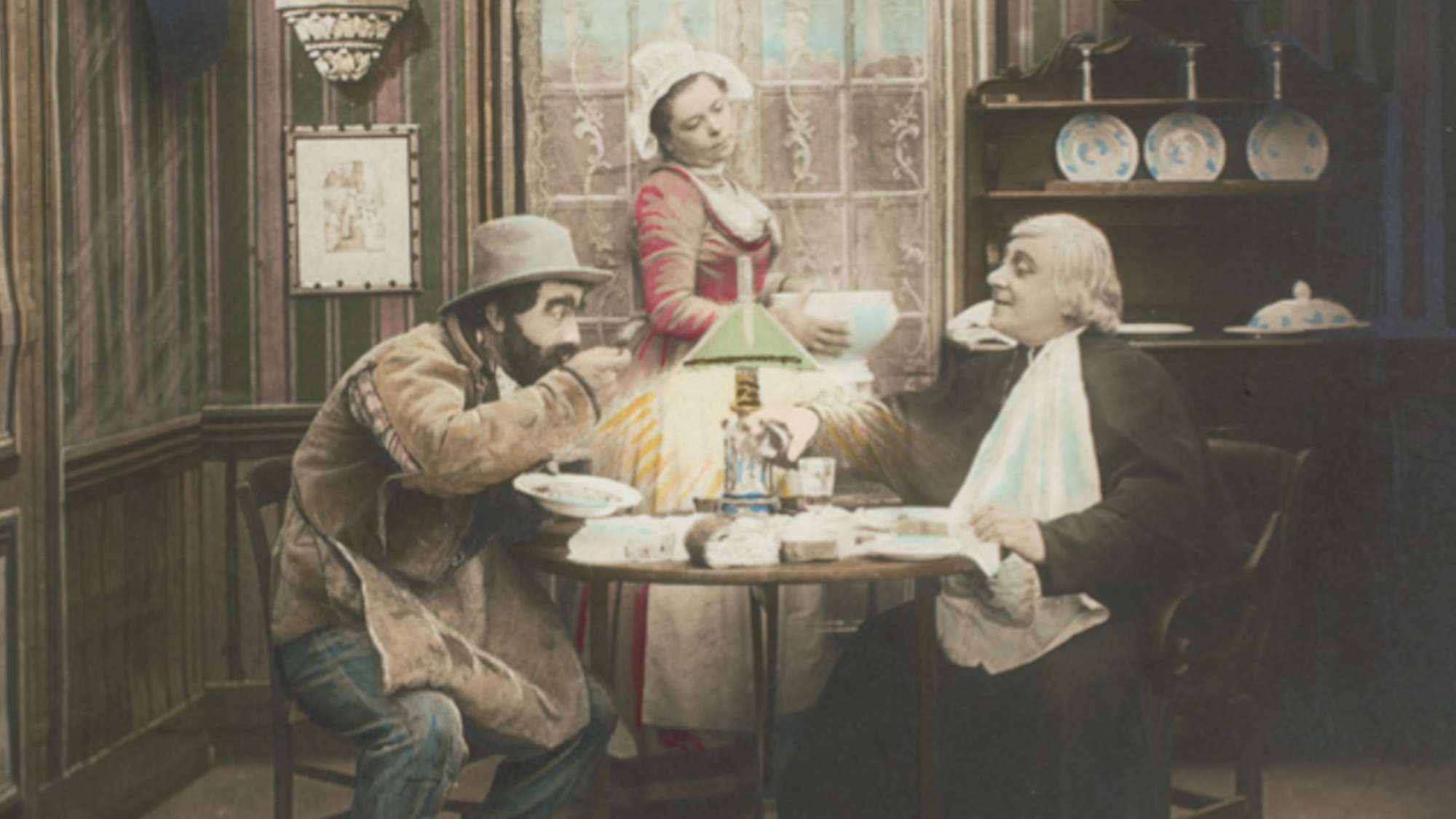
Sog.: from novel I miserabili (1862) di Victor Hugo. Prod.: Pathé Frères (scène dramatique et réaliste, n. 1330), 35mm. L.: 96 m. D.: 5’ a 18 f/s. Col. (from a tinted nitrate print)
Edition History
Photo © Fondation Jérôme Seydoux-Pathé

Restored by EYE Filmmuseum at Haghefilm laboratory, from a nitrate print
Time and Narrative II
Soon after its invention the Cinématographe began to incorporate all forms of entertainment and performances, as well as appropriating their contents and effects. Beginning in 1897 historical, literary, and biblical narrative material was being adapted for the cinema, normally passing first through other media, such as opera (Faust, Cinderella), stage productions, and magic lantern slide series. Already by 1900 Pathé and Méliès féeries were more than 200 metres long. Among the biggest French productions of 1905 two fairytales stand out, Pathé’s La poule aux oeufs d’or, in 4 parts and 12 scenes, based on the tale by Jean de La Fontaine, and the 460-metre (30-minute) Les milles et une nuit by Méliès. The importance of fairytale films in the production of the time can probably be explained by the fact that children were a very important audience: “Ce n’est pas dans les drames et les films acrobatiques que je mettais le meilleur de mon espoir. C’était dans les féeries. J’en ai tourné beaucoup pour les enfants …» [«It was not in dramas and acrobatic films that I put my best hope. It was in fairytales. I made many of them, for children…»] (Ferdinand Zecca, quoted by Bousquet, p. 866) Revived every few years, the many versions and remakes of fairy stories provide ample opportunity for comparison – and it just so happens that 1905 is halfway between two versions of Belles au bois dormant (Sleeping Beauty), made in 1902 and 1908. And cinema did not just absorb literature; it also generated its own in the form of booklets, which often told the stories in a more extensive way than the films.
Mariann Lewinsky