[MOVIE]
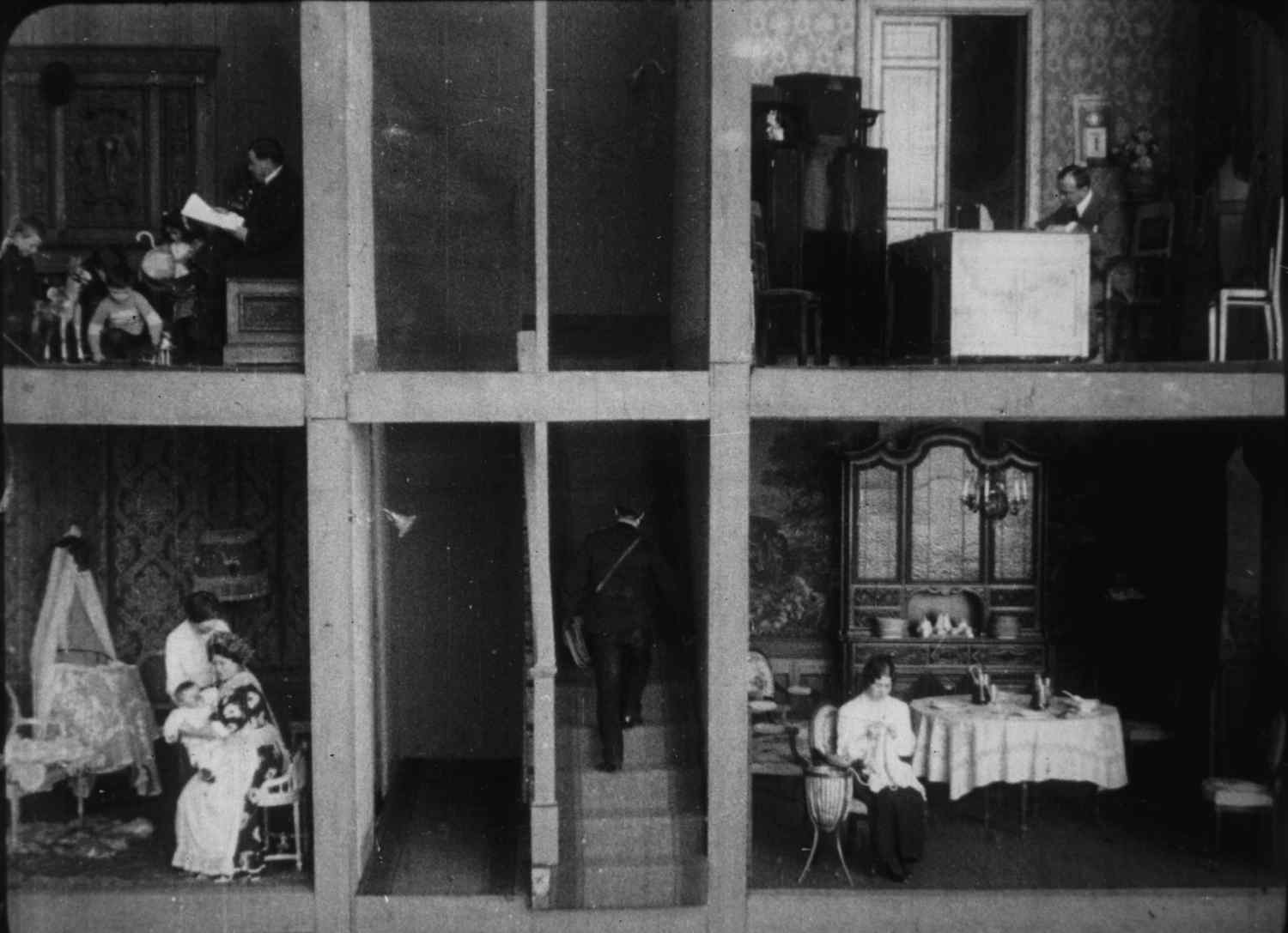
Sog., Scen.: Arrigo Frusta. Int.: Eleuterio Rodolfi (il dottore), Gigetta Morano (Gigetta), Umberto Scalpellini (Cornelius), Nilde Bruno (una balia). Prod.: S.A. Ambrosio. 35mm. L.: 192 m. D.: 11’ a 16 f/s. Tinted (Desmetcolor)
Edition History
The visual ploy in the first part of the film is sensational: the apartment building is a dollhouse with the front walls removed. It creates a kind of split-screen displaying four flats (plus the centre stairwell) to be explored for connections. But the film’s second part is even more disconcerting. Based on a doctor’s recommendation, good Cornelius happily sends his wife to a thermal baths in the hopes of curing what he presumes to be her infertility problem. Coincidentally, the doctor happens to be in the vicinity, and the two-timed husband ends up with offspring (not his own) in his arms. Here Frusta builds the story around a very mischievous visual metaphor: a pitcher that appears and disappears several times: empty and ready to be filled, overflowing with gushing liquid.
The Italian comedy of the 1910s has a high statisticaI incidence of the following qualities, which may thus be considered national virtues of this production:
Beginning in 1910, Lea Giunchi (Lea) worked at Cines as the partner of Kri-Kri, Checco and Cocò and as the star of her own series of some forty titles. Gigetta Morano (Gigetta) joined Ambrosio in 1909 and worked as the partner of Marcel Fabre, Ernesto Vaser and Eleuterio Rodolfi; her own series numbers about fifteen films. The few surviving films featuring Gigetta and Rodolfi document a comedy production of outstanding quality. Most films in the series made by Nilde Baracchi (Robinette) and Valentina Frascaroli (Gribouillette), two Italian actresses active mainly in France, have unfortunately also been lost.
Most of the titles in our programme come from the collection of the Netherlands Film Museum – proof of the wide distribution of the Italian comedies in their day.
Last but not least, a recommendation: Try mentally combining the comic short films and comedies in the programme with the Italian diva films of the 1910s.
Mariann Lewinsky