[MOVIE]
Edition History
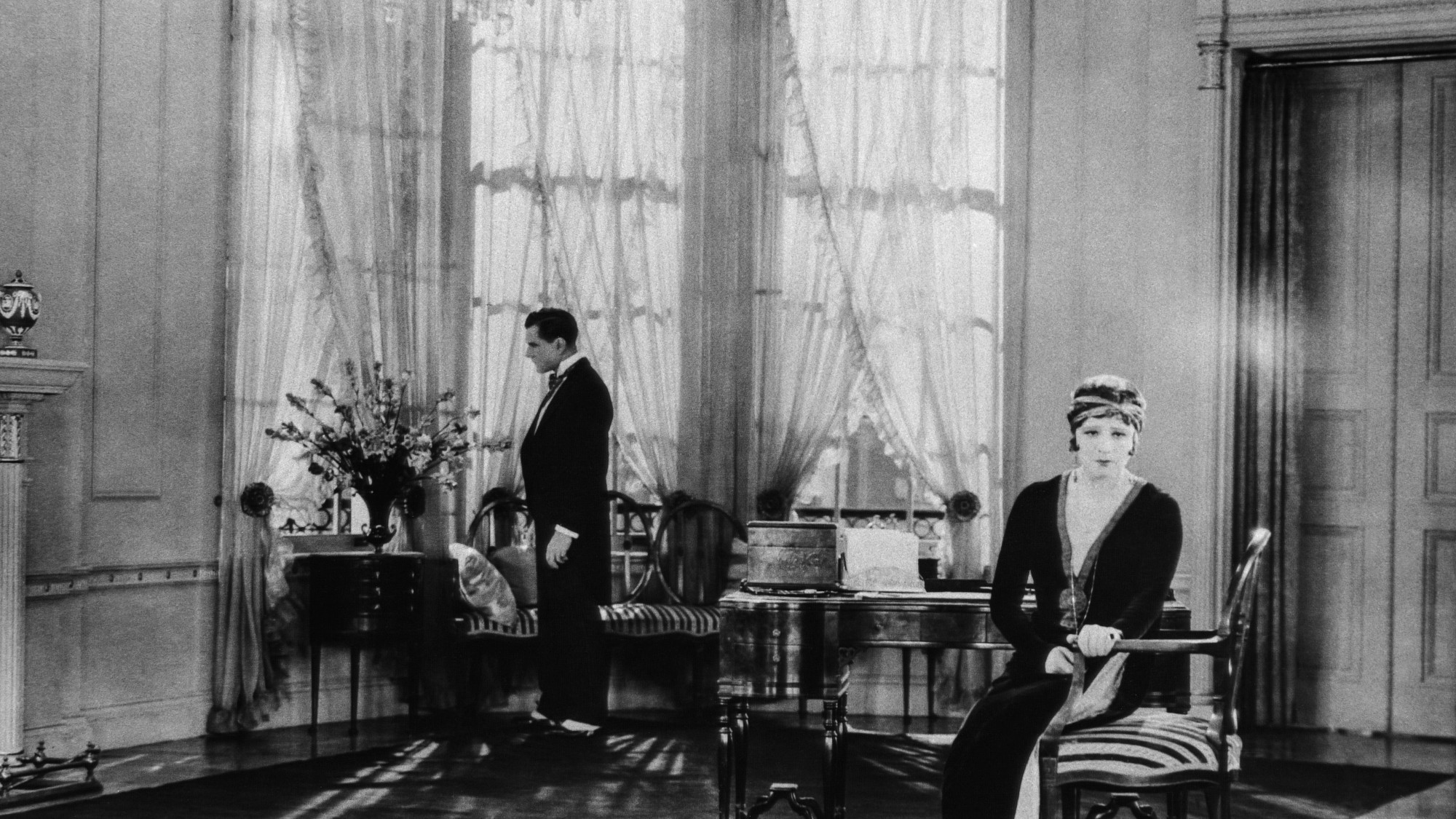
By 1925, Lady Windermere’s Fan, which was first staged in 1892, had become a pièce de résistance on both the European and American stage. Lubitsch made the play his own through a process of unfaithful adaptation. This, not only because none of the many aphorisms which spring out of the original text flow in the (as usual, few) intertitles; nor because the coup de théatre which Wilde reserves for the end of the second act (the scandalous Mrs Erlynne is Lady Windermere’s mother, rather than her rival as we had believed) is here revealed in the very first sequence, changing surprise for suspense (we know what the characters do not, and take pleasure in the spectacle, waiting for the bomb to go off). Lubitsch’s infidelity towards Wilde is the challenge between two kindred spirits, both of whom know the depth of appearances and the imperative of artifice. His daring substitution strategy means turning the wit of Wilde’s words into a visual texture: fleeting glances, searching binoculars, swift curtains, boxwood fences accurately fitted to conceal or reveal, a geometry of untrustworthy perceptions. It’s a matter of spatial disproportions: closeups vibrant with passion as well as fatuity (“I’ve a bit of news that may interest you / I love you”) cut briskly to long shots of huge art deco settings, where a girl’s eye may find itself at keyhole level. It’s a matter of time contractions: a seduced man tails his seducer in a single frame, against a pure pop art backdrop, on a horizontal perspective just like in early cinema, or in the Nouvelle Vague, or in Paul Thomas Anderson. Above all, the play on appearances conceals the fact that the greatest comedy of American silent cinema isn’t actually a comedy. Guido Fink wrote that “comedy is just a different way of looking at the same things”: So Lady Windermere’s Fan can be just a different way of looking at Stella Dallas (as the audiences at Cinema Ritrovato will have the opportunity to attest), if the narrative climax is still a mother’s Silent Sacrifice and Stifled Tears. Then, of course, this Mrs. Erlynne is someone who always lands on her feet, and on the very threshold of her self-sacrifice she will find a Lord Augustus waiting to be dragged away, in a whirlwind perfumed with ermine and Shalimar. Life, Oscar Wilde wrote, is far too serious a thing ever to talk seriously about it.
Paola Cristalli

Restored by MoMA with funding provided by Matthew and Natalie Bernstein
The film made by Ernst Lubitsch from Lady Windermere’s Fan is not easily recognizable as a version of Oscar Wilde’s comedy. For the plot is the only thing that Lubitsch has taken from Wilde, and the plot of Lady Windermere’s Fan is something to which no one has ever paid much attention. In itself, it’s old-fashioned, banal, and even rather cheap, and it is, therefore, ideal from the point of view of the Hollywood producer. Mr. Lubitsch has brushed off the sparkle of wit and cleared away the atmosphere of cynicism which formerly obscured and made tolerable this highly conventional comedy; but he has clothed it in such beautiful photography and directed it with so much resourcefulness that he has turned out a very attractive film. The silver and gray London streets, the white-gowned or black-morning-coated figures, standing in high-ceilinged rooms or looking out of long- curtained windows, are in his most distinguished manner, and his theatrical ingenuity, his great knack of shooting common- place incidents from inobvious and revelatory angles, though less amusing than in Kiss Me Again, is at least effective as ever. At one of the early showings of Lady Windermere’s Fan, one was given a demonstration of another phase of Lubitsch’s genius – his ability to induce his actors to embody his own ideas. The actress who played Mrs. Erlynne, Miss Irene Rich, appeared on the stage in person and made a little speech. In her role of the clever adventuress, Miss Rich had been notably successful – smart, slender, brunette, and lovely, with a charming air of sweetness and frankness which did not conceal, however, the exercise of a calculated tact, the product of much wordly experience. But in person, Miss Irene Rich turned out to be something quite different – a wholesome strapping girl from the Coast, as blonde as a Pacific Peach and as well-grown as a sequoia tree, who has nev- er, it appears, hitherto played anything other than rôles of betrayed and abandoned wives. That Lubitsch should have seen her possibilities as Oscar Wilde’s Mrs. Erlynne and enabled her to realize them succesfully is a proof of the cardinal difference that an intelligent director may make to the acting of the moving pictures. This is perhaps even more important in films than on the speaking stage, since, in the former, the actor has no audience but only the director to play to, and the relation between actor and director is closer and more direct. The effect of certain directors on their actors is, in fact, said to be almost hypnotic. Who knows but that a certain of the Hollywood pretty girls as well as of the Hollywood male popinjays might be turned into respectable performers taking part in attractive films if there were only enough German directors imported to mesmerize them?
Edmund Wilson, “A German Director in Hollywood” (24 March 1926), in The American Earthquake (Doubleday Anchor Books, 1958)
Print made in 1988 from nitrate source materials