[MOVIE]
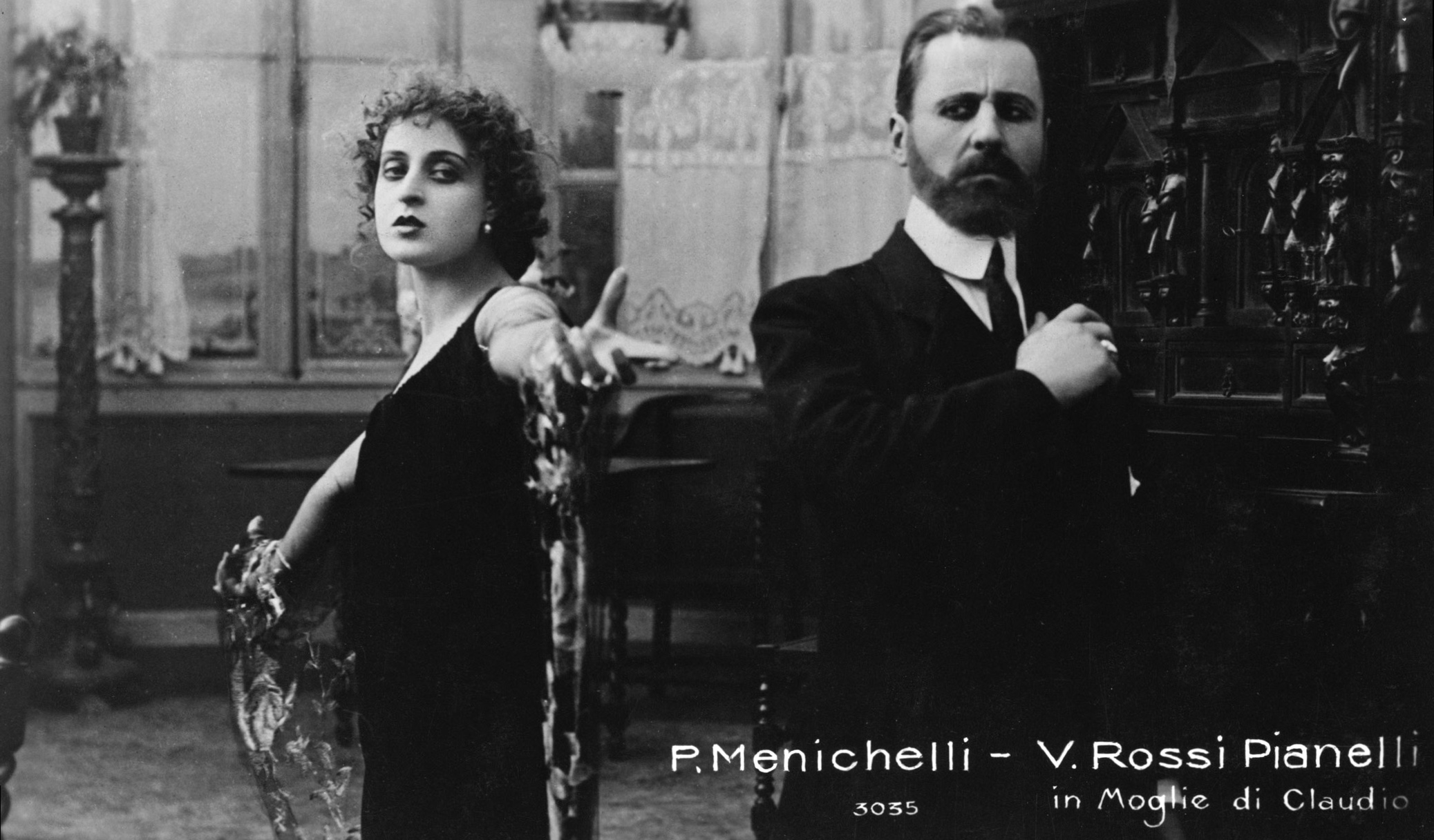
Supervisore alla regia: Piero Fosco [Giovanni Pastrone]. Sog.: dal dramma La Femme de Claude di Alexandre Dumas figlio. Scen.: Dante Signorini. F.: Antonio Cufaro [Segundo de Chomón]. Int.: Pina Menichelli (Cesarina Ruper), Vittorio Rossi-Pianelli (Claudio Ruper), Alberto Nepoti (Antonino), Arnaldo Arnaldi (Moncabré), Gabriel Moreau (Enea Cantagnac), Antonio Monti (Daniele), Gina Marangoni (Edmea). Prod.: Itala Film 35mm. L.: 1403 m (incompleto, l. orig.: 1798 m) D.: 68′ a 18 f/s. Desmetcolor
Edition History
Some of the most significant titles in the diva film genre derive from the encounter between Giovanni Pastrone and Pina Menichelli. After the actress became successful, she tried to distance herself from the role of the femme fatale, but she revisited it in La moglie di Claudio, her final collaboration with Pastrone.
At the end of World War I, Itala Film adapted Dumas’ story, keeping the patriotic theme in the background in order to create a stage for the actress’s dramatic, uninhibited ‘Menichelli’ mannerisms.
In the opening sequence, a splendidly dressed Cesarina (Pina Menichelli) provokes her suitors by voluptuously biting a rose in the middle of a salon. It is a gesture that the Countess Natka dared to make in Tigre reale (1916), but from inside a carriage and thus flirting only with the spectator. Claudio’s wife returns home after the failure of her escape with Moncabré and the murky episode of her convalescence (an euphemism for a pregnancy or maybe an abortion). We suddenly and unexpectedly see her through a window: this image of Cesarina, ready to grasp other victims, echoes Menichelli’s owl-woman in Il fuoco (1915).
The protagonist is a woman without feelings or morals – a shamelessly unfaithful wife – surrounded by intrigue, espionage, passion, dishonour, violence and, above all, death. Some sections of the narrative, such as the appearance of a secret society, are difficult to follow because of gaps in the only surviving print; others are obscured by prudent discretion of the intertitles, mentioning ‘the consequences’ of yet another relationship which almost cost Cesarina her life.
After attempting to reconquer her husband, seducing his favourite student and stealing secret documents, Cesarina is betrayed and unmasked by the light of a ‘damned moon’; then Claudio stops her with a gunshot. Menichelli rewards us with a textbook ending: mortally wounded, she grasps the curtains sensuously before falling to the floor enveloped in their folds, as if wrapped in a funeral shroud.
Claudia Gianetto

Restored in 2011 by Cineteca di Bologna and Museo Nazionale del Cinema, Torino at L‘Immagine Ritrovata laboratory from a positive nitrate print, tinted and toned, with French intertitles preserved at Lobster Films collection
Cesarina Rupert, a modern day Messalina, is Claudio’s wife, a patriot and a brilliant inventor of war vehicles for France. Between personal drama and spy intrigues, this mismatched couple is destined for a tragic end. Pina Menichelli demonstrates her impressive and expressive range in her role as Dumas’ dark heroine “the evil woman who undermines society, breaks up families, dismembers the mother country, challenges man, dishonors the woman she is impersonating, and destroys those who do not crush her”. The result is a performance that captures the excesses but also the hypnotic and erotic power of what Dalì defined as “hysterical cinema”. Even if local critics snubbed the film, not only because of the excesses of the female lead but also the un-original storyline, it is remarkable to see advanced social and political themes of the times addressed, such as abortion and the aspirations of the Jewish people for a national state.

Restored by Museo Nazionale del Cinema and Cineteca di Bologna at L’Immagine Ritrovata laboratory using a tinted and toned nitrate base with French intertitles from the Lobster Films Collection. The copy is a French re-release distributed by Vitagraph’s Parisian branch. The Italian intertitles were recovered thanks to the censor certificate and the lists of intertitles preserved by Museo Nazionale del Cinema. Some obvious editing errors have been corrected based on these documents, and missing frames have been replaced with black ones.