[MOVIE]
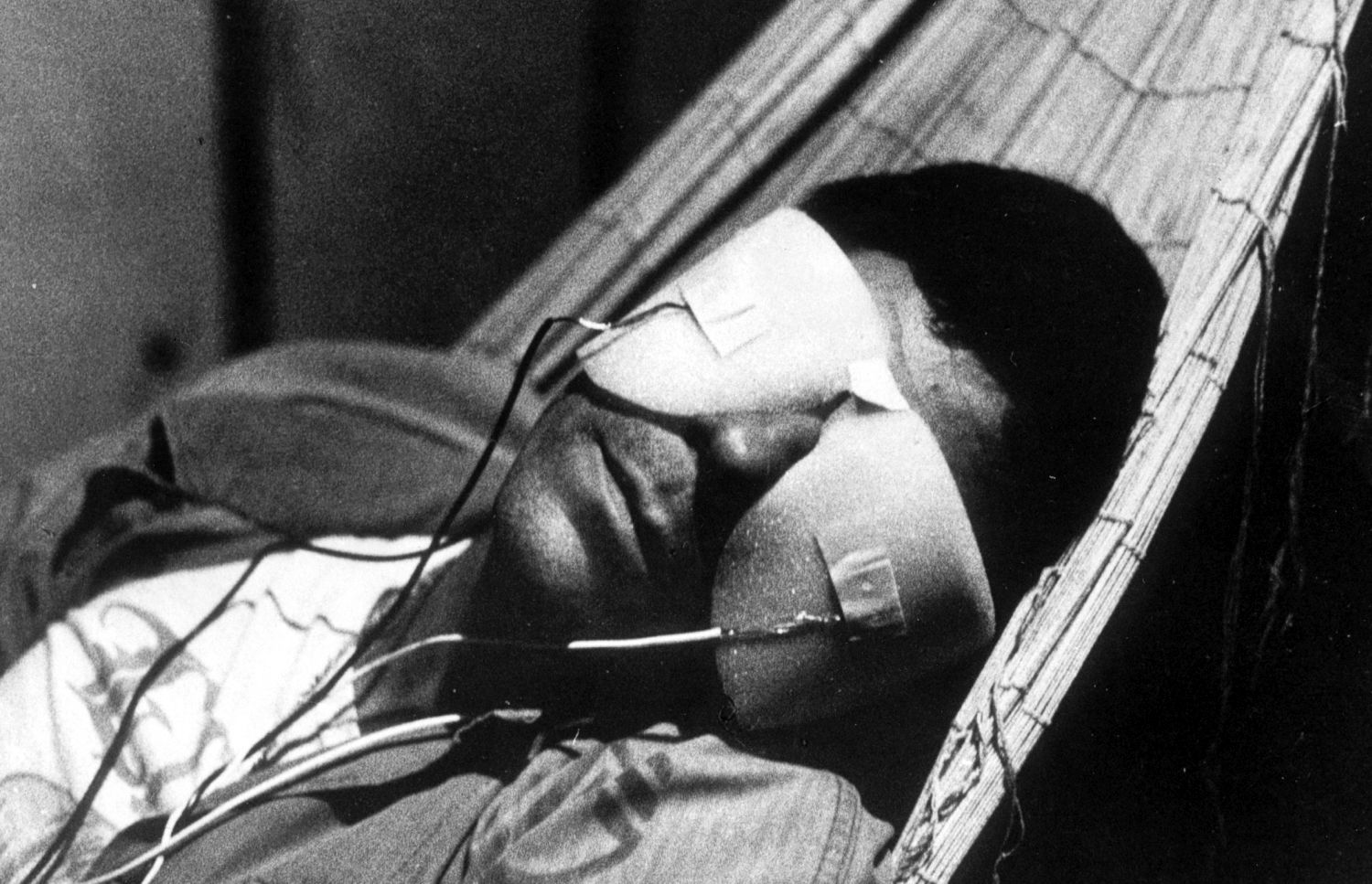
Scen.: Chris Marker. F.: Jean Chiabaut. M.: Jean Ravel. Mus.: Trevor Duncan. Int.: Hélène Chatelain (la donna), Davos Hanich (l’uomo), Jacques Ledoux (lo scienziato), Jean Négroni (voce narrante), André Heinrich, Jacques Branchu, Pierre Joffroy, Étienne Becker. Prod.: Anatole Dauman per Argos Films. DCP. D.: 27’. Bn.
Edition History
La Jetée is a cine-roman, a film-novel that operates within the strictest of economies. It is a film composed almost exclusively of still images, with the bare essentials of a story told in voice-over. It is an extraordinary film of ‘a man marked by an image from his childhood’, and it opens with a replay of this childhood moment. These are the ‘facts’, although facts benefit us little in this particular story. In the circular movement of the film, in which the end arrives at the beginning and so the beginning is also the ending, the concrete facts do not add up to much. A child witnesses his own death as a man, defying the premise of chronological time. […]
In less than half an hour, the film takes us into a projected present, a fabricated past and an imagined future. La Jetée is the story of a man who travels through time to secure the future of humanity in a post-apocalyptic context. […] It’s a story about going back. It tells of a man whose desire is to return to the past, and as such it is a film that echoes other stories, cultural myths that are full of warning. Orpheus loses his lover through a backward glance. Oedipus blinds himself after returning to his mother. In Alfred Hitchcock’s Vertigo, Scottie falls foul of a desire to re-stage his relationship with a woman, to consciously turn back the clocks. […]
The grip that La Jetée has on us is in imagining one thing through another. There is no immediate access to things, either the past through photographs or the future through science. Perception is always mediated, framed or set up, and with Marker, the frame is always an unexpected thing, like an old object found in the back of a cupboard. So in his idea of the future, Marker approaches it (frames it) through the skeleton of a leaf or the etching of tree bark. But this mediated way of seeing is not of the order of revelation. Its effect is not to disclose the secret qualities of things but, on the contrary, to spin a web of correspondences, to show us all of the connections and likenesses and differences of things. This is not a film disclosing something ‘about’ photography or its ontology, but a photo-roman that shows us photography through the frame of cinema. In so doing, we are exposed to qualities of movement and stillness that in belonging to each, belong differently.
Janet Harbord, La Jetée, Afterall Books, London 2009

La Jetée is first of all a meditation on the concept of Time. A coherent meditation. The duration of time is something we experience, but the concept of Time is something we think about, as more than one philosopher has tried to convince us. […] If Time is Thought and Thought is Reason, than Language is surely the best vehicle for Time travel. When he was making La Jetée, Chris Marker was still first and foremost a verbal filmmaker. Words, for him, were paramount. They provided the unifying commentary to his images, giving them continuity, drama and definitive meaning. In this film, it is language which provides this element which is at once fantastic and so banal as to be easily overlooked that allows us to blend fantasy and reality, the impossible with the possible, the moment of uttering with all the dizzy deliriousness of the thing uttered. […] The editing of the images and dialogues in La Jetée plays with grammar tenses to play with Time, in an attempt to locate the time of the spirit and the time of the world. It uses a strange future perfect tense, a past future tense, to express what is to come that has already happened (since someone is telling it); the ‘innocence’ and ‘naturalness’, the readiness with which the past is still happening and the future, we discover, is already here and already finished, which means that we, the spectators of the apocalypse, are its survivors. […] La Jetée is a film composed, not of shots of unmoving images, but of a series of stills. In 1963 this was not a novel idea. Resnais, and later Marker, were finding their place amidst a movement – dealing with films about art – born in 1940, whose major proponent was the Italian filmmaker Luciano Emmer […]. The challenge of La Jetée lay in having cinema contradict itself by its own means, forcing the medium to overcome its limitations esthetically, acting cleverly, using its own codes, forcing it to negate its own essence only to then suddenly be vindicated in that magical moment which has made the film famous: a frame in movement! While cinema, traditionally, affirms, “this is how it is and how is to be,” and photography says, “this is how it was”, or “this is how it still is, but frozen in the vacuum of Time”, Marker’s film, with its voice-over commentary and the provocative immobility of its images, states, “This is how it is, how it will be and how it was” all at once.
Barthélemy Amengual, Le Présent du futur. Sur La Jetée, “Positif”, n. 433, March 1997