[MOVIE]
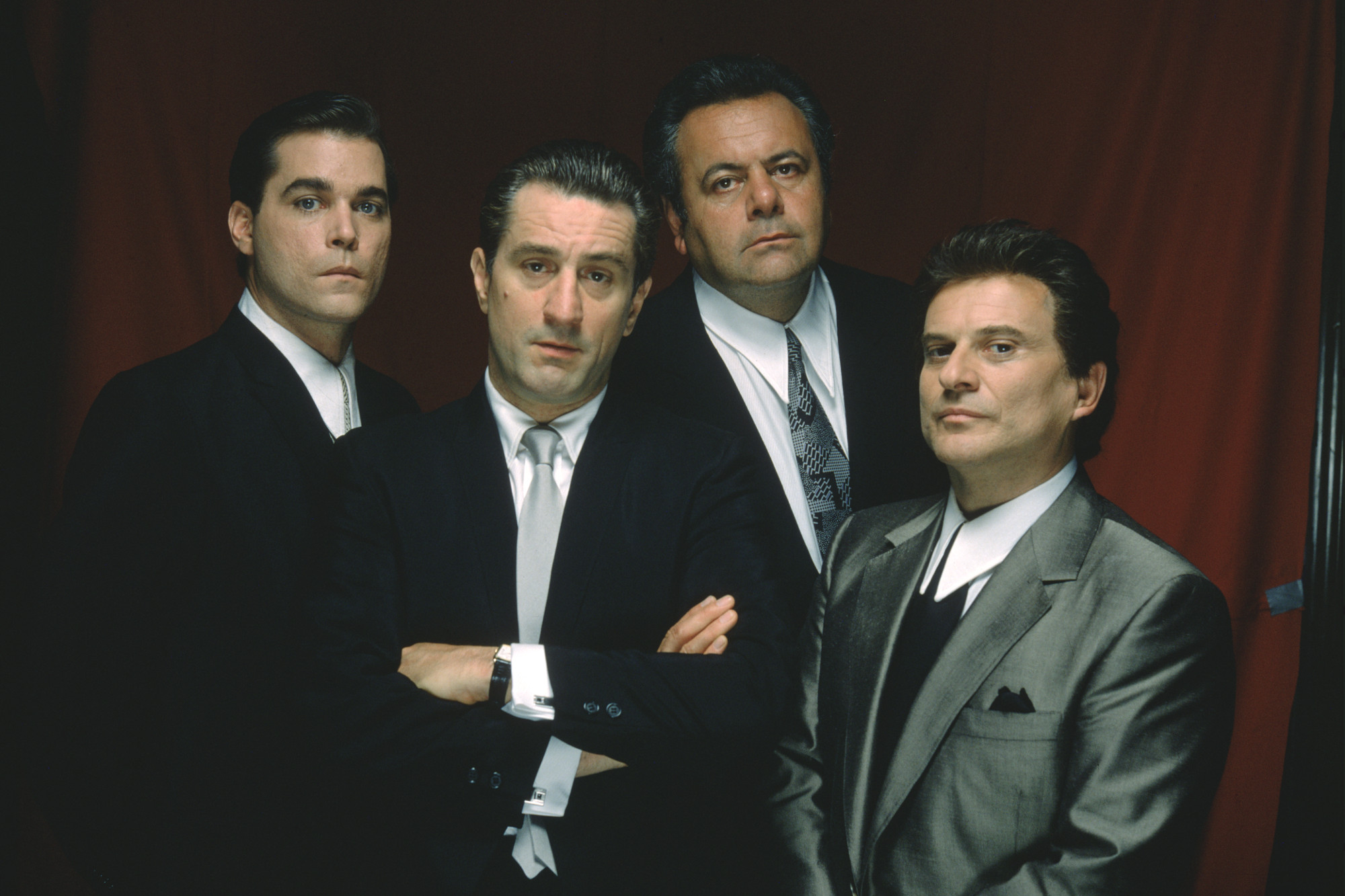
Sog.: from the novel Wiseguy (1986) by Nicholas Pileggi. Scen.: Nicholas Pileggi, Martin Scorsese. F.: Michael Ballhaus. M.: Thelma Schoonmaker. Scgf.: Kristi Zea. Int.: Ray Liotta (Henry Hill), Robert De Niro (James Conway), Joe Pesci (Tommy DeVito), Lorraine Bracco (Karen Hill), Paul Sorvino (Paul Cicero), Frank Sivero (Frankie Carbone), Tony Darrow (Sonny Bunz), Mike Starr (Frenchy), Catherine Scorsese (madre di Tommy), Charles Scorsese (Vinnie). Prod.: Irwin Winkler per Irwin Winkler Productions, Warner Bros. Pictures. DCP. Col.
Edition History
“As far back as I can remember, I always wanted to be a gangster”. That was the blunt, lucid and famous opening to Henry Hill’s account of his own life… Goodfellas is, first of all, a fascinating anthropological study of the mafia, which analyses the habits, behaviour, mentality and material life of a special ethnicity, the Italian-American criminal world of Manhattan… All of Hollywood gangster cinema is there, openly. After all, the underlying storyline is a classic one: the rise and fall, the power and the dust… More than the classics Little Caesar or Scar- face, what Scorsese has in mind are the small ‘neorealist’ gangster-movies of the 40s such as Hathaway’s Kiss of Death. Or, genre aside, Rossellini’s The Taking of Power by Louis XIV… Scorsese edits the rhythms of Goodfellas with the precision of clockwork and the freedom he loved in the nouvelle vague, the “first two minutes of Jules and Jim”… Scorsese does not use a line of original music, just a mosaic of songs, which reconstruct the musical ‘foundation’ of an era and a community. They also organise the story’s rhythm and settings, grounding its ethnic roots (Parlami d’amore Mariù), trivialities (songs by the Crystals or the Marvelettes), transgressions (Cream and the Rolling Stones) and ultimately eternity and mutability (the final My Way, but performed by Sid Vicious). A great montage of the sounds of a time that is not the ‘heroic’, fake and stereotyped era of Prohibition and jazz, but the modern era of records and TV. Even with Public Enemy in its backdrop, Goodfellas is a story of today, a story of small, modern gangsters without any halo of myth.
Alberto Farassino, Martin Scorsese, Dino Audino Editore, Rome, 1995
I had gotten hold of a proof copy of Nick Pileggi’s book after reading what sounded a promising summary. I devoured it in one sitting, it was the most authentic account of that way of life I had ever read. I immediately liked its unrestrained, freewheeling quality, along with [protagonist] Henry Hill’s amazing arrogance. The very free structure of the story, with several narrators, appealed to me a lot. You could see how the organization works, on every level. The accent is on the daily grind, not on shoot outs. This isn’t The Godfather. It’s about ordinary individuals who happen to be gangsters. […] For the first time since Mean Streets, I insisted on being credited [as co-writer] for the script. The challenge was to find a slightly different angle from which to observe that world; to be innovative in term of style; to be specific. Why not treat it like a documentary, one that would be as elaborately choreographed as a fiction film as if we had followed these guys around with a 16mm camera for twenty or twenty-five years? We’d have the freedom of documentary, where everything have not to be explicit, where you can fragment the story, jump from one period to another by using a voice-over. So there are lots of characters? Names you can’t memorize? You get a bit lost? Doesn’t matter. What matters is our exploration of a lifestyle.
Martin Scorsese in Michael Henry Wilson, Scorsese on Scorsese, Cahiers du Cinéma/Phaidon Press, London 2011
Restored in 2014 by Warner Bros. Entertainment at Warner Bros. Motion Picture Imaging laboratory
With Goodfellas, you were returning to the world of Mean Streets. I had known for a long time that I would come back to it sooner or later. I had gotten hold of a proof copy of Nick Pileggi’s book [Wiseguys] after reading what sounded a promising summary. I devoured it in one sitting, it was the most authentic account of that way of life I had ever read. I immediately liked its unrestrained, freewheeling quality, along with [protagonist] Henry Hill’s amazing arrogance. The very free structure of the story, with several narrators, appealed to me a lot. You could see how the organization works, on every level. The accent is on the daily grind, not on shoot outs. This isn’t The Godfather. It’s about ordinary individuals who happen to be gangsters.
Nick Pileggi told me how impressed he was by your contribution to the screenplay. He said that you could see and hear the minutest details of the story when you were putting it down on paper.
For the first time since Mean Streets, I insisted on being credited [as co-writer] for the script. The challenge was to find a slightly different angle from which to observe that world; to be innovative in term of style; to be specific. Why not treat it like a documentary, one that would be as elaborately choreographed as a fiction film as if we had followed these guys around with a 16mm camera for twenty or twenty-five years? We’d have the freedom of documentary, where everything have not to be explicit, where you can fragment the story, jump from one period to another by using a voice-over. So there are lots of characters? Names you can’t memorize? You get a bit lost? Doesn’t matter. What matters is our exploration of a lifestyle.
Speed is the film’s defining feature. It’s a relentless ride.
I’d like to have gone even faster, and for the whole film to have moved like a trailer or the opening of Jules and Jim. For two hours, uninterrupted! The problem is that even if the sequence lasts for only a brief moment, it has to be choreographed with all the logistical problems it entails. Half a page of screenplay can involve two days’ shooting. On this film, I believe we had eighty-five different locations. Some directors focus on the way a scene is lit. In my case, it’s on movement. I love the way a camera can move. I love cutting from one movement to another. Inspiration is always closely connected with the lens of the camera.
Michael Henry Wilson, Scorsese on Scorsese, Cahiers du Cinéma/Phaidon Press,
London 2011
Mastering in 4K completed from the original camera negative under the supervision of Martin Scorsese and Thelma Schoonmaker. Mastering completed in 2015 at Warner Bros. Motion Picture Imaging in Burbank