[MOVIE]
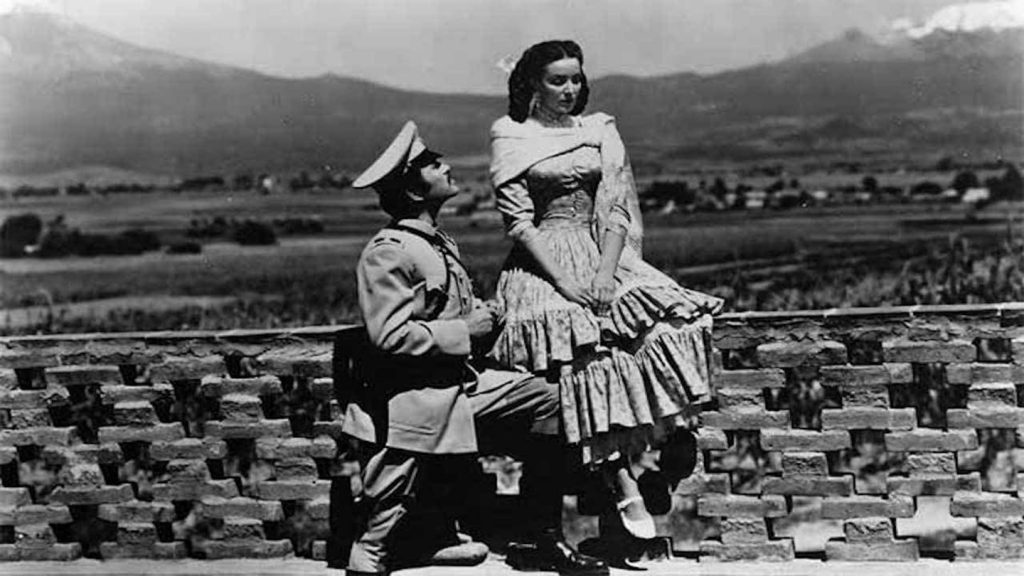
Scen.: Emilio Fernández, Íñigo de Martino. F.: Gabriel Figueroa. M.: Gloria Schoemann. Scgf.: Manuel Fontanals. Mus.: Eduardo Hernández Moncada. Int.: María Félix (Beatriz Peñafiel), Pedro Armendáriz (José Juan Reyes), Fernando Fernández (padre Rafael Sierra), Eduardo Arozamena (il sindaco Joaquin Gómez), Miguel Inclán (capitano Bocanegra), Manuel Dónde (Fidel Bernal), José Morcillo (Carlos Peñafiel), Eugenio Rossi (Eduardo Roberts), Norma Hill (Rosa de Bernal), Juan García (capitano Quiñones). Prod.: Benito Alazraki per Panamerican Films S.A.. DCP. D.: 99’. Bn.
Edition History
“I am Mexican cinema!” Emilio Fernández liked to tell people when they asked him about the state of filmmaking in his country. When one critic dared to dispute this grandiose claim, the director reputedly pulled a gun on him.
That story may be apocryphal but then Fernández tended to take a ‘print the legend’ approach to his own life, even if his life was already interesting enough to need no further embellishment. Having killed a man as a youth and fought in the quashed rebellion against President Obregón, Fernández ended up in jail in 1924, facing a 20-year prison sentence. He quickly escaped and fled to America, where he landed in Los Angeles and discovered the movies. […]
The template for Enamorada is Shakespeare’s The Taming of the Shrew, with the wealthy and anti-revolutionary Beatriz being particularly resistant to any taming. She is introduced wielding a gun and ready to defend herself against any man who dares to approach her.
[…] Figueroa’s mentoring by Toland and Fernández’s immersion in the home of American filmmaking during his formative years both seem to contribute to the aesthetic sheen of classical Hollywood cinema that is evident throughout Enamorada. The bickering relationship between the two leads has the ebb and flow of a screwball comedy (although Rosalind Russell never actually tried to blow up Cary Grant), while the more tender scenes are filmed with the intimacy and rapturous beauty of a Frank Borzage romance. […]
Through their very successful series of collaborations in the 1940s, Fernández and Figueroa are credited with playing a key role in putting Mexican cinema on the map, and Enamorada was seen as an important film by the authorities in helping to establish the country’s post-revolution identity. The narrative works to gradually bring together two fiercely independent and politically opposed people through the mediation of the Church, and the film’s climax proves to be genuinely stirring.
Philip Concannon, Enamorada, “Sight & Sound”, n. 11, November 2015

Restored in 4K in 2018 by UCLA Film & Television Archive and The Film Foundation’s World Cinema Project in collaboration with Fundacion Televisa AC and Filmoteca de la UNAM and with the support of the Material World Charitable Foundation at Roundabout Entertainment and Audio Mechanics laboratories from two elements, both provided by the Filmoteca de la UNAM: the original 35mm nitrate negatives stored by Televisa, and a 35mm nitrate print
“If Enamorada were a photograph album how we would love to turn its pages and thank its author, Gabriel Figueroa, who – as he did with Maria Candelaria – generously gives us the most beautiful images in the world. Black-and-white film has proven to work wonderfully in Mexican cinema, and in some of his productions (…). It’s been magnified in images rich in pictorial depth, in which both the shadows and the brightness of faces and scenery are captured by the unique light of that country. Yet Enamorada is not a photograph album – it is a film – and often this formal beauty and the story’s plot do not correspond. The many elements that make up the film coexist, but rarely reach a sense of unity. (…) In Enamorada it seems that the director, Emilio Fernandez, wanted to use that same inspiration and create another love story. The story is certainly passionate, and at times quite moving, but it is no longer the simple, banal (…) story of Maria. This time there is the addition of class conflict, and the author chooses some of the most conventional characters in this genre to enliven it: a coarse rebel leader (Pedro Armendariz) in love with a haughty (as could be expected) young aristocrat (Maria Felix), hostile towards the love that she has sparked. How will the story unfold? Maria Felix will be won over by the rebel’s love (thanks to the influence of an ecstatic priest), and she will follow him to his defeat, after he refuses to fight against the regular troops. If love is a winner, the revolution has been won. (…) Pedro Armendariz, who was in his element in Maria Candelaria, seems a bit lost in this role not tailored to him. He surprises us when his seemingly passive face turns quite violent, and while we imagine him to be a man of few words, he confesses his love in a manner reminiscent of The Song of Solomon. Yet it is his simple humanity, so constant through all of the throes of passion, to which we owe any emotions evoked. Maria Felix is beautiful. As for the images (…), I’d like to end with them, and especially with Pedro’s evening serenade under Maria’s window; a scene composed of a series of charming ‘pictures’ made more profound by the heartrendingly pure song”.
José Zendel, Amours mexicaines et révolution; d’admirables photos, mais…, “L’Écran frangais”, Paris, n. 151, 18 May 1948

Cortesy of Televisa
Print Restored On The Occasion Of Gabriel Figueroa’s Centenary