[MOVIE]
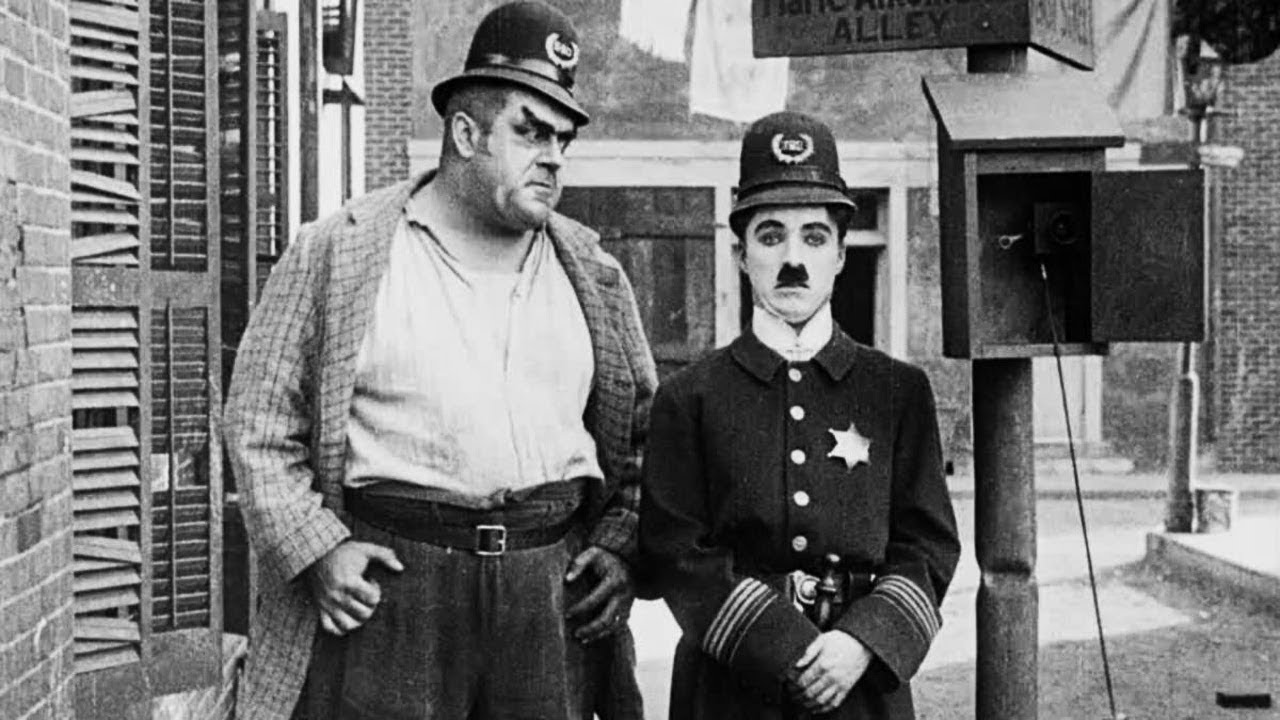
T. ted.: Charlie als Schutzmann. Scen.: Charles Chaplin. F.: Roland Totheroh. Int.: Charles Chaplin (un vagabondo), Edna Purviance (ragazza dell’Esercito della Salvezza), Eric Campbell (il terrore del quartiere), Albert Austin (pastore/ poliziotto), Henry Bergman (l’anarchico), Loyal Underwood (padre prolifico/ secondo poliziotto), Janet Miller Sully (moglie dell’uomo prolifico/visitatrice alla Missione), Charlotte Mineau (la donna ingrata), Tom Wood (capo della polizia). Prod.: Charles Chaplin per Lone Star Mutual. Pathé n. SB651. Publication 9.5mm: 7-8/1927. 9.5mm. L.: 100 m. D.: 14’ a 16 f/s. Bn.
Edition History

For Easy Street Chaplin decided to have – at the exorbitant price of $10,000 – his first large ‘T’ shaped set built, reminiscent, as David Robinson pointed out, of Methley Street, in London, where Hannah Chaplin lived with her two children. A few years later Chaplin will replicate the ‘T’ configuration at Chaplin Studios, where it become the standard model for much of Chaplin’s comedy, from A Dog’s Life to Monsieur Verdoux. As Francis Bordat observed, its use would change from film to film: “more naturalistic in A Dog’s Life, more poetic in The Kid, more functional in City Lights, more lyrical in Modern Times, more theatrical in The Great Dictator, and more gloomy in Monsieur Verdoux“. Thanks to this set, as well as to a more elaborate story than in his previous films, Easy Street manages to convincingly represent, with powerful realism, the violent life of an urban neighborhood. This violence was something new for Chaplin, as was the leading role he plays, in the shoes of a figure of authority. The most hilarious comic moments arise from this unexpected and contradictory set up.”The sublime irony comes in the epilogue”, writes Jean Mitry. “The institutions, the laws, the moral principles, and the church had never been so virulently satirized. Those who believe they can keep people on the straight and narrow with verses from the Bible and fear of the police are scorned with utter delight. Even ‘good intentions’ blossoming suddenly in the rose garden are victims of a laugh or a blessing”.

Restored in 2012 by Fondazione Cineteca di Bologna at L’Immagine Ritrovata laboratory, in collaboration with Lobster Films and Film Preservation Associates
Easy Street, together with The Pawnshop, is the masterpiece of the Mutual series. It is an absolute masterpiece. This film is a ballet, a poem, a parody, with a corrosive and farcical energy. And it is through this film that Chaplin’s social satire asserts itself and gains momentum. It is by far the most violent satire produced as a caricature by Chaplin prior to The Great Dictator. The characters descend in a maddeningly downward spiral that isolates them from the real world and plunges them into a symbolic and transparent representation of life. […] The conclusion is pure sublime irony. Institutions, laws, moral principles, and catechists had never been made fun of with such sarcastic virulence. Those who think they are keeping humanity on the straight path using snippets from the Bible and fear of the police are mocked with gusto. The same fate is reserved for ‘good intentions’ which suddenly blossom as a result of a smile or a blessing. Furthermore, Easy Street integrates farcical and comedic elements: when the Tramp robs the grocer’s cash box he was supposed to protect, the contradiction between his act and his duty is farcical. But this contradiction is only meant to underline his behavior and delineate his character, a character that is comical to the extent that it is revealed through such contradiction.
Jean Mitry, Tout Chaplin, Seghers, Paris 1972
Restored by Cineteca di Bologna at L’Immagine Ritrovata laboratory, in collaboration with Lobster Films and David Shepard. Other elements from: Academy of Motion Picture Arts and Sciences, CNC – Archives françaises du film, British Film Institute
New musical score composed by Neil Brand and performed live by Orchestra del Teatro Comunale di Bologna