[MOVIE]
Edition History
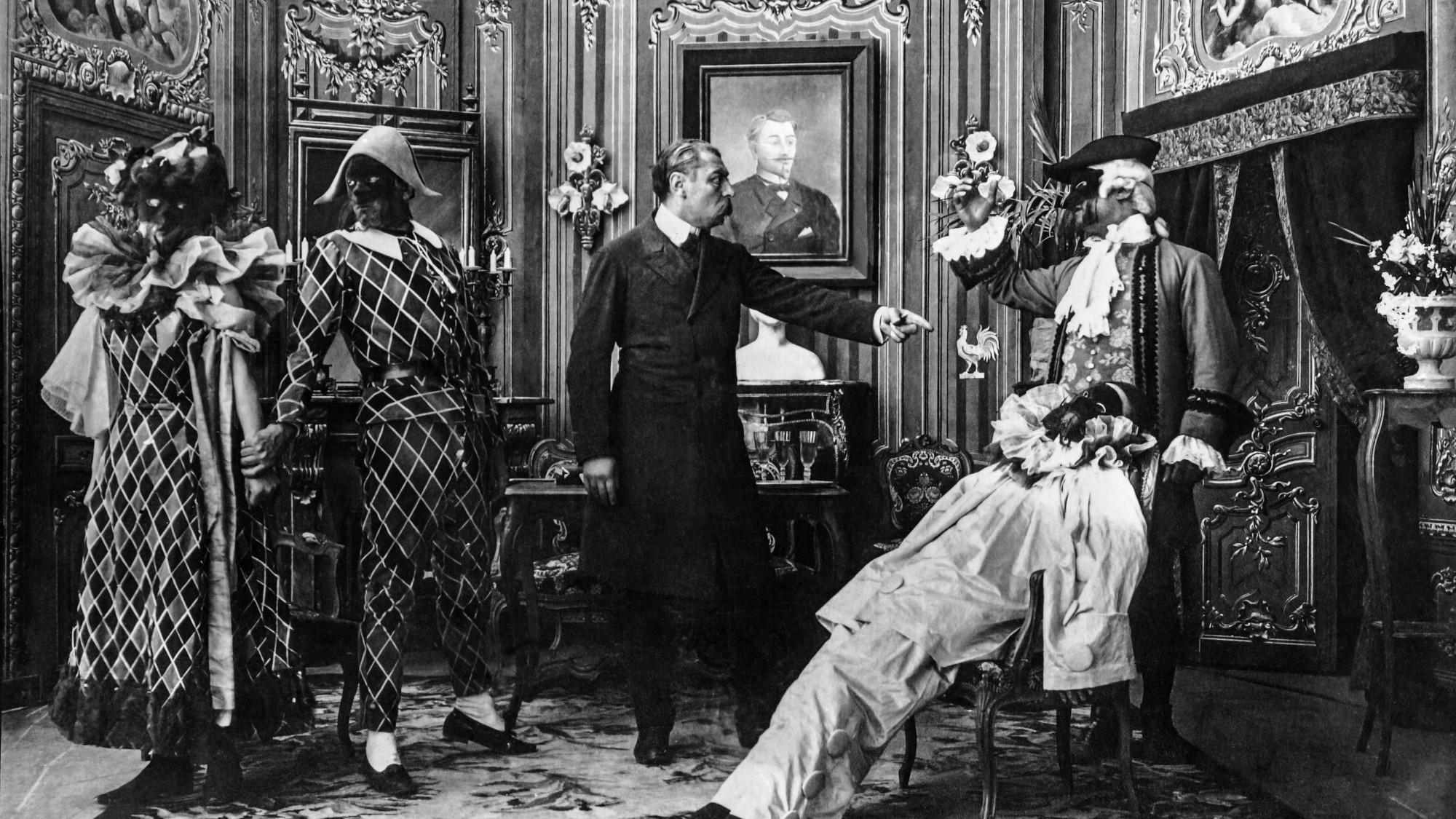
Corso tragique marked a turning point in Albert Capellani’s filmography after directing fables, fairy tales, trick scenes and biblical scenes such as Don Juan, Le Pied de mouton, Cendrillon, Peau d’Âne or Jeanne d’Arc, produced by Pathé from 1906. In 1908, the statutes of the SCAGL (Société cinématographique des auteurs et gens de lettres) were filed and Capellani became the artistic director of the company whose aim was to bring French literary heritage to the screen. He then turned to more dramatic and social films. Corso tragique was shot entirely (except for the last scene) on location in Nice, where Pathé had been filming seasonally since 1905, before creating its own Comica and Nizza brands in the early 1910s. In the summer of 1908, Capellani moved south, leaving the Vincennes studios, first to Nice, and then to Arles where he shot L’Arlésienne, his first production for the SCAGL.
In the style of regional costume films, Corso tragique opens in the port of Nice. An oyster seller, played by Renée Doux – the wife of Ferdinand Zecca – sells shellfish from her stall before going to meet the man who is to become her fiancé. When her hand in marriage is rejected, she complains to her brothers and, as in a vendetta, they avenge her honour during the carnival. Capellani uses the Nice carnival as an opportunity to integrate the event into his fiction film, which thereby becomes a testament of regional culture.
Manon Billaut

Restored in 4K in 2023 by Fondation Jérôme Seydoux-Pathé with funding provided by CNC – Centre national du cinéma et de l’image animée at L’Image Retrouvée laboratory, from a negative nitrate
The films of these years are anonymous and serial, and we generally do not know the names of the participants on screen or behind the camera. Nor do we need to know them, for in 1905 or 1908, it is the production company and the production series (the genre) that define a film. When organising the 1907 programme, however, in the light of Amour d’esclave, a gorgeous mise-en-scène of classical antiquity, I asked myself for the first time, ‘Who made this sophisticated film?’ It is Bousquet who provided the name of Albert Capellani, and further on in his catalogue I discovered that two other outstanding films from the 1907 programme also owed their existence to Capellani, the atmospheric and realistic women’s drama Les deux soeurs and the delightful féerie Pied de mouton, an affectionate celebration of the cardboard set shortly before its demise.
Has anyone ever tried to figure out why film history before 1920 was reduced for decades to Lumière-Méliès-Griffith and not Lumière- Méliès-Capellani-Griffith? Was it perhaps the influence of Surrealist anti-highbrow propaganda? From his very first film on – the memorable Le chemineau of 1905, based on an episode from Victor Hugo’s Les Misérables – Albert Capellani transports the contents and qualities of bourgeois culture to the cinema. He films Zola, Hugo and Daudet – his Arlesienne of 1908 has unfortunately been lost. His many fairy tale films (scène des contes), biblical and historical scenes reveal him as a great art director, who also adopted the latest developments in modern dance and worked with its stars Stacia Napierkowska and Mistinguette. Highly versatile, he had an unerring sense of the best approach to a given genre. In the outdoor sequences of his scènes dramatiques such as Les deux soeurs and Mortelle idylle (1906), he uses for moments the realistic effects of the photographic medium in a manner unparalleled at the time. Yet such was his cinematic power that he did not even need this; he could film big cotton wool snowflakes dropping in Le chemineau and make them look bitterly cold.
When Albert Capellani (1870-1931) joined Pathé in 1905, he had already enjoyed success as an actor (for André Antoine and at the Odéon), director (at Firmin Gémier) and administrative director (of the music hall L’Alhambra). In 1908, Charles Pathé appointed him director of the new company S.C.A.G.L., which was founded that summer to compete with Film d’Art. By the end of that year, Capellani had made the following films for S.C.A.G.L.: L’Arlesienne (now lost), L’homme aux gants blancs (fragment of 130m out of 310m survives) and L’Assomoir (not on the programme), which at 740 m (some forty minutes long at 16 f/s) is considered the first full-length French film. (It premiered, according to Bousquet p. 177, on 21.12.08 at the Cirque d’Hiver).
Mariann Lewinsky

Print restored in 2008