[MOVIE]
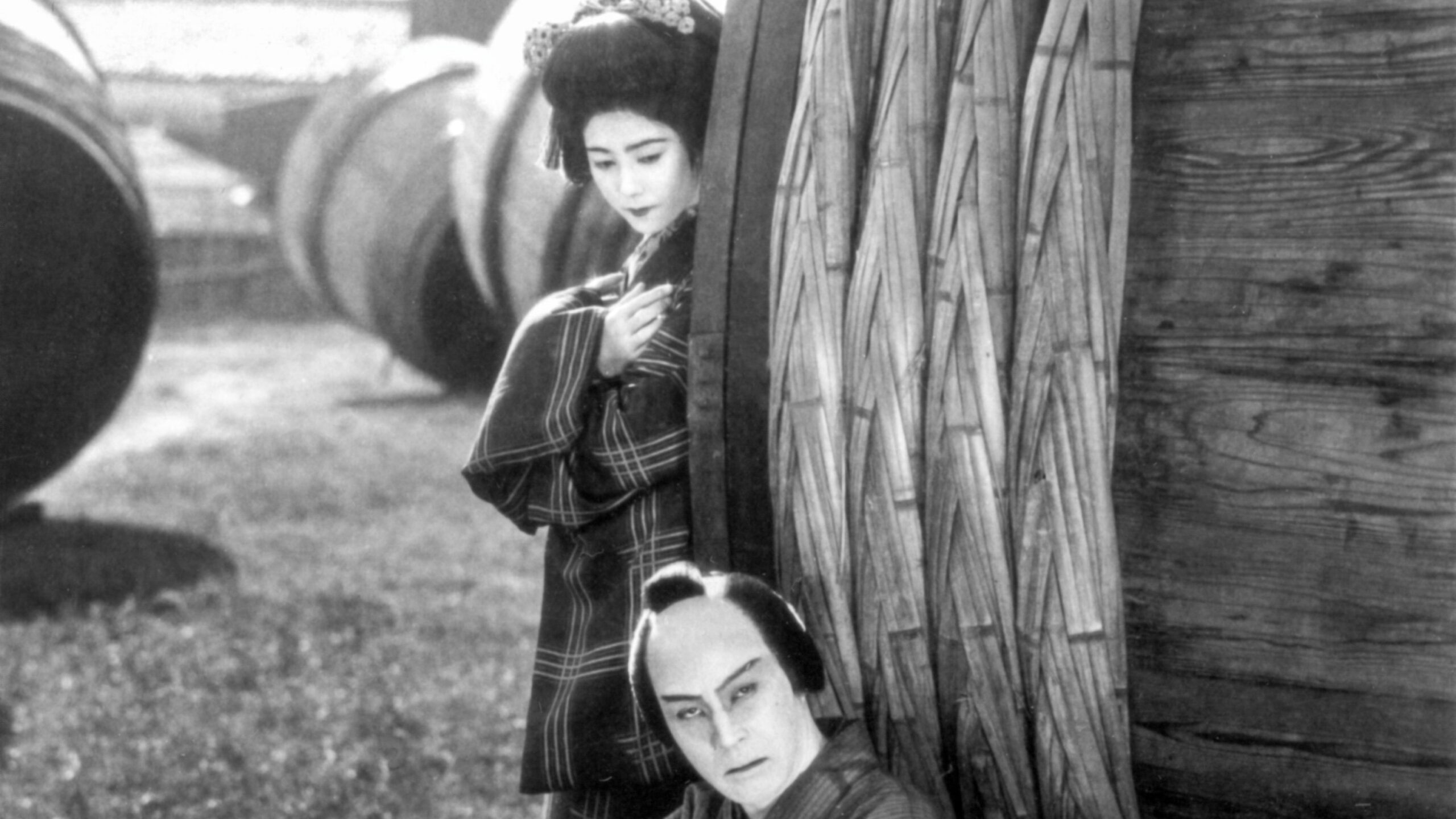
Scen.: Daisuke Ito. F.: Rokuzo Watarai, Hiromitsu Karasawa. Int.: Denjiro Okochi (Chuji Kunisada), Hideo Nakamura (Kantaro), Kichiji Nakamura (Yasuzaemon Kabe), Seinosuke Sakamoto (Bunzo), Naoe Fushimi (Oshina), Ranko Sawa (Okume), Motoharu Isokawa (Kihei), Kajo Onoe (Otozo). Prod.: Nikkatsu. 35mm
Edition History
Described by S.A. Thornton as “a deeply pessimistic story of resistance and betrayal”, this is Ito’s most famous film and among the most famous of Japanese silent films. It was exemplary of the so-called shin-jidai-geki, (“new period film”), an innovative mode of socially conscious period film, which took for its protagonist a disgruntled, lonely, nihilistic drifter, pitted against society or the rigid sociopolitical structure of feudal times. Released only a year after the death of pioneering jidai-geki star Matsunosuke Onoe (1875-1926), who had himself played a more conventionally heroic interpretation of Chuji Kunisada in 1925, the film controversially replaced a “righteous Chuji” with a “ruffian Chuji”. The change heralded a fundamental shift in the tone of the period genre. The downbeat mood of Ito’s film owes much to the brooding performance of Denjiro Okochi, a leading light of the jidai-geki.
A three-part epic, Ito’s early masterpiece was for many decades known only by reputation, since no copy was believed to have survived. “Kinema Junpo”’s Kizuo Uchida remarked, prophetically, that the work “will long remain in memory as a classic of the period film”; when, in 1959, the magazine selected the Best Ten films of the Japanese cinema’s first sixty years, it topped the poll. For Junichiro Tanaka, it was “a work of unprecedented artistry”; for Akira Iwasaki, Ito had created a protagonist who gradually “becomes a tragic figure reminiscent of Greek drama”. These critics must have relied on memories of the film’s first release.
In 1991, however, a considerable part of Chuji tabi nikki resurfaced when eight reels of battered nitrate film were rediscovered in Hiroshima. The extant footage includes a section of the second episode and more than half of the concluding episode, including its climax. Although it is a pity that Ito’s epic is still incomplete, the surviving footage preserves, in Mariann Lewinsky’s words, tantalising hints of the original triptych’s “mood modulation in microcosm” and “some remnants of the network of recurring motifs”, which “demonstrate the director’s visual sense and creative power”.
Alexander Jacoby e Johan Nordström

“It must be remembered that the historical or period films (jidaigeki) are really about the present and not the past, and at that time were far more distinctly political than the films with a contemporary setting (gendaigeki). In Japan’s repressive political systems – centuries of military dictatorship soon followed by militarist fascism – historical or geographical disguise blossomed into the camouflaged expression of political opinion, and producers and audiences easily understood each other in the fictional transpositions of historical plays and films. (The main weakness of censorship is that it does not understand anything about fiction and its protean nature.) When in 1927 the noble folk hero of Chuji tabi nikki was hunted by the state through a series of three films and finally arrested, a betrayed, ill and silenced man, the Japanese public of the period not only saw a thrilling genre film, but also read it directly as a portrait of contemporary politics. The’“Laws for Maintaining the Peace’, introduced in 1925 as the basis for criminalizing the left, were already taking effect, resulting in waves of arrests, the banning of political parties, trials and political murders and, finally, the military coup in Manchuria. And that is what the jidaigeki of those years – the pessimistic ones by Ito Daisuke, Makino Masahiro and Yamanaka Sadao, and the satirical ones by Itami Mansaku – were about. […]
Of the trilogy one scene of part two and about haif of part three have been recovered. The overall structure of the trilogy – described by critics of the period as a succession of dominant moods, from the ‘freshness’ of the opening installment to the intense ‘sentiment’ of the second part and the ‘gloomy nihilism’ of the finale – has certainly been lost. But the surviving material contains, in microcosm, a comparable modulation of mood and, along with it, Chuji’s utter decline from an invincible athletic hero (cf the comedically-structured scene with the local yakuza boss) to a mute, paralysed body on a stretcher. The overall weave of graphic and thematic motifs has been lost, but remaining traces (such as the circle motif of the giant brewery tubs and the children’s ring games) testify to the filmmaker’s visual sense and creative power. Also lost are most of the formally extravagant passages (the critics mention accelerated montage sequences or virtuoso camera movements, and Ito Daisuke was nicknamed ‘Ido Daisuki’, or ‘big fan of camera movement’) but the surviving material contains many instances of perfect filmmaking flair.
(Mariann Lewinsky, On the Fragment of Chuji Tabi Nikki, Cinegrafie, 12, 1999)

Preserved in 1992 from nitrate positive materie