[MOVIE]
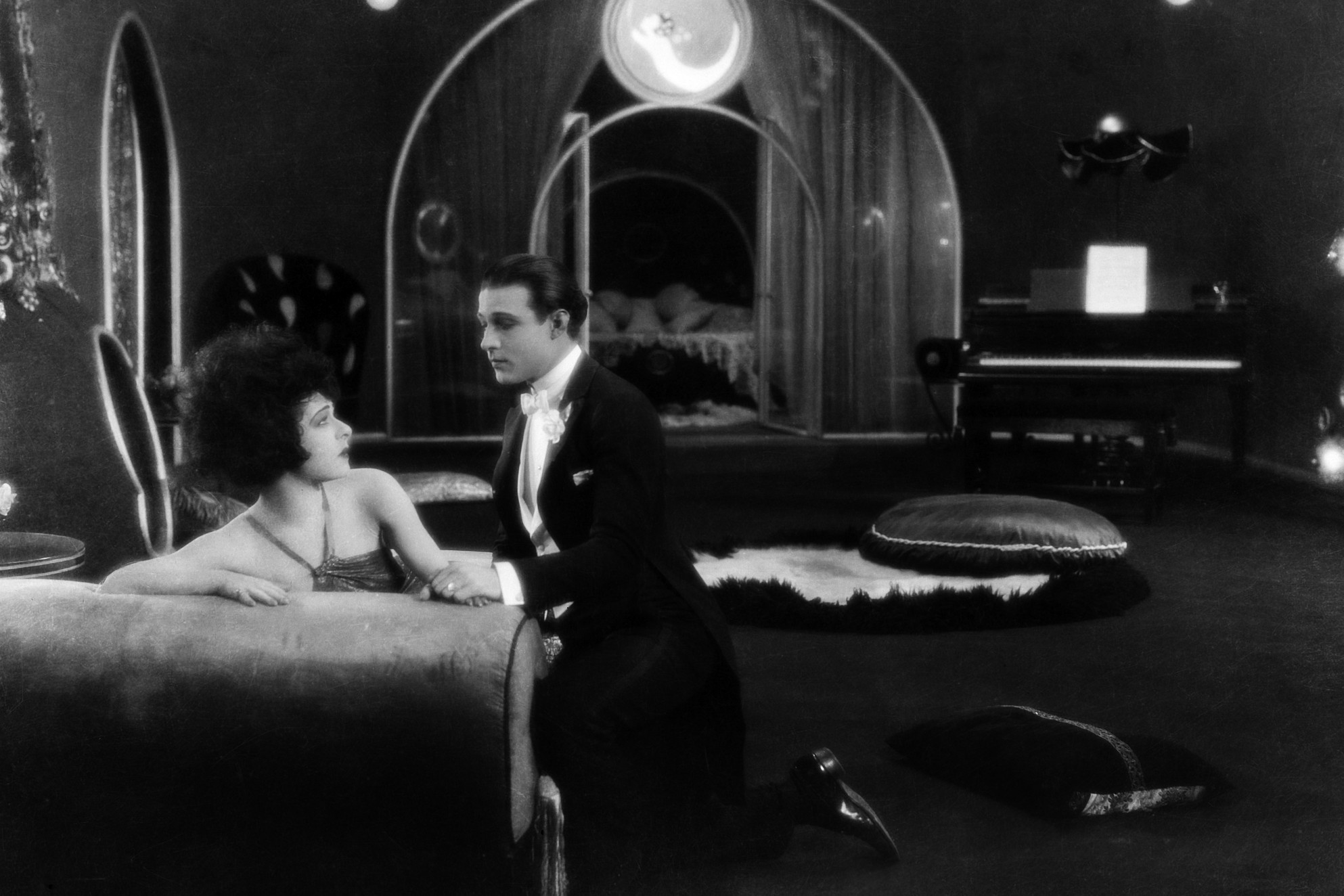
T. it.: La signora delle camelie. Sog.: dal romanzo La signora delle camelie (1848) di Alexandre Dumas figlio. Scen.: June Mathis. F.: Rudolph J. Bergquist. Scgf.: Natacha Rambova. Int.: Alla Nazimova (Marguerite Gautier), Rodolfo Valentino (Armand Duval), Arthur Hoyt (conte di Varville), Zeffie Tilbury (Prudence), Rex Cherryman (Gaston), William Orlamond (Duval padre), Edward Connelly (il duca), Patsy Ruth Miller (Nichette), Consuelo Flowerton (Olimpe), Elinor Oliver (Manine). Prod.: Nazimova productions. 35mm. L.: 1736 m. 18 f/s. Bn.
Edition History
As a film star, Valentino resembles Elvis Presley: their film achievements were thoroughly scorned by the critics, while audiences, especially female audiences, guaranteed them enormous success. Quite apart from the fact that their films were criticised as trivial, both men were seen as having been destroyed by their film work: Elvis suffered the decline of a rock’n’roll artist, while in the case of Valentino, it was thought that feminine influence prevented him from having a masculine acting career.
Today, when we recognise Valentino’s ‘queerness avant la lettre’, we are sharing in the delight of the women viewers of his time. But we are also taking up the work of the women who gave Valentino so much scope in films. In Camille we have June Mathis, the screenwriter who discovered Valentino and chose him for The Four Horsemen of the Apocalypse; Alla Nazimova, the actress and producer who wanted him as her partner in Camille; and finally Natacha Rambova, the set designer, whose influence on the career of her husband during their brief marriage was condemned as unmanly dependence. Together they developed filmic strategies aimed at portraying the reality of women and of female love in their films.
Bourgeois culture pinned man down to the mind, the subject who decides and acts, and pinned woman down to nature: passivity, immaturity. Men are the ones who know, who are reality-savvy; women are the ones who don’t know, are naïve, inexperienced. A radical reversal of these ascriptions takes place in Camille. This is very clear in the middle section of the film, when Armand’s father intrudes into the lovers’ domesticity. Despite the shock, and at the price of her happiness, Marguerite/Nazimova is capable of reaching an agreement with him because she, the courtesan whose profession is to amuse men, has a knowledge of the repressive, misogynistic social conditions. Marguerite’s knowledge of this in the film equates to Nazimova’s knowledge of it in the film business.
Armand is presented from beginning to end as unknowing, incapable in the face of reality, completely absorbed in his loving perception. Valentino’s portrayal of Armand understands just one sense of reality: the sense of a possible women’s reality, where the sexes live together in a human, social relationship. Valentino seduces through his beauty as a man, through a physical aura that transports something female. This is what made him a utopian man for the women who got him into films, and for the female viewers he lured into the cinema: he discovered their life.
Heide Schlüpmann

“Natacha Rambova (born Winifred Shaughnessy) enters the life of Rudy as a dominatrix and ,to start, turns him into the Armand Duval of Camille. ‘I will be your servant – your slave – your dog’, swears Valentino’s Armand, embracing the knees of the thin and sinuous Alla Nazimova. It is not by chance that this lady of the camellias in déco clothes pretends a masochistic accentuation, a declaration of erotic vassalage from her young lover: Camille, a free adaptation in modern costume of a literary classic like La Dame aux camélias by Dumas, is the film in which the Valentino’s still fragile celebrity totally abandons itself to the talents and desires of powerful women capable of exercising a firm hold on him. This game of consenting passivity, this fabrication of the erotic object seems to play between the set and Dumas’ exemplary story, which here Mathis re-writes with a more seductive star and a more seduced Armand. It must have been, without a doubt, an interesting set: Nazimova still, perhaps, in love with Rambova, the most brilliant and independent of her protégés who frequented or gathered around her lesbian circle, Rambova suddenly attracted by Valentino who, for his part, falls at the feet of the fascination of the fake Russian, and in the background June Mathis, with her great power and brain, who, it isn’t difficult to believe nurtured a private passion for the Italian boy, hers by discovery and thus in some way by right. The result of so much erotic circulation is a cold, hysterical, extreme film most notable in the network of correspondences which it squeezes between geometries of desire and constructions of screenplay.
Paola Cristalli,Rodolfo Valentino: lo schermo della passione, Ancona, Transeuropa, 1996