[MOVIE]
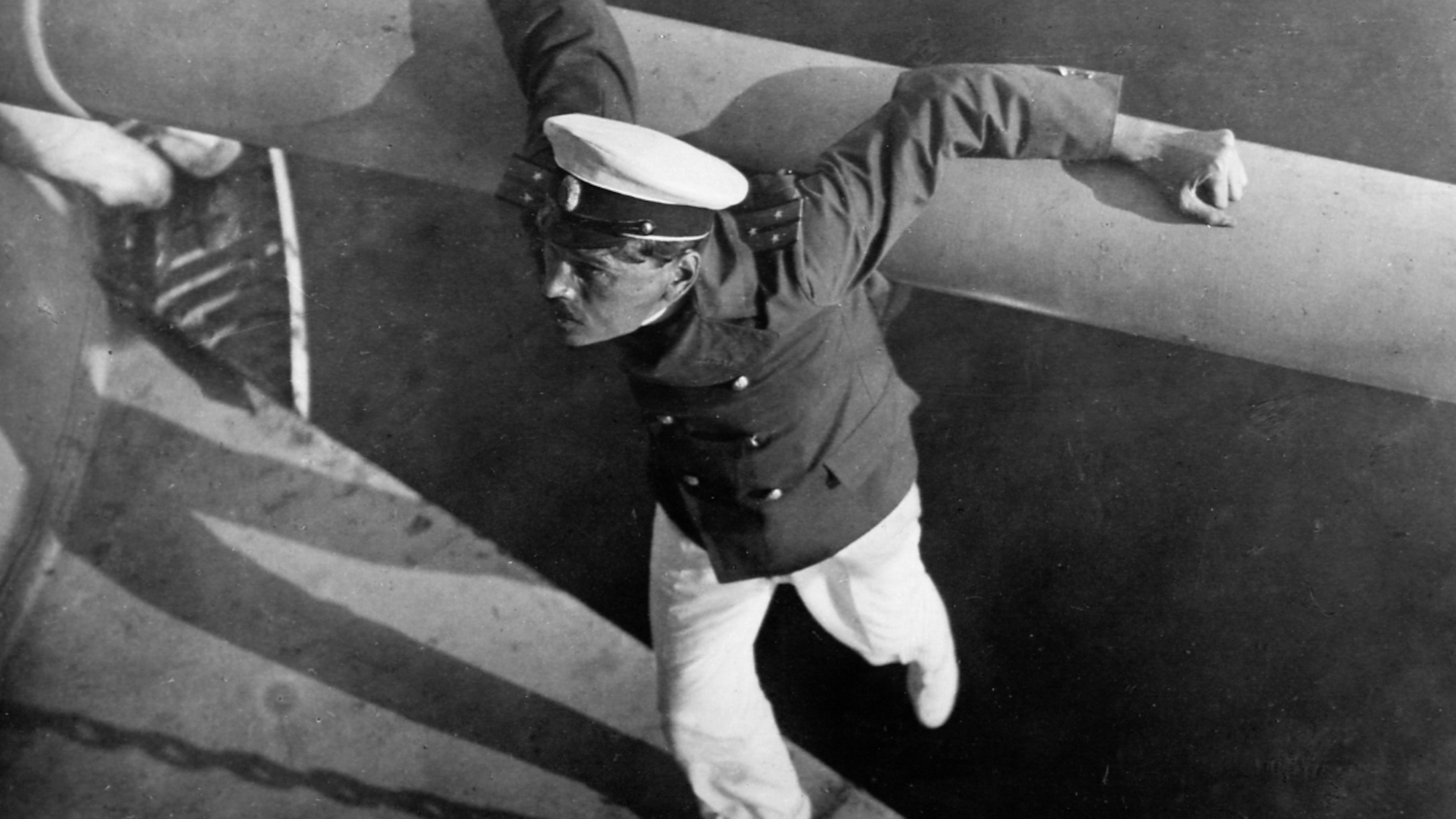
Scen.: Nina Agadžanova-Šutko, Sergej Ėjzenštejn. F.: Ėduard Tissė. Scgf.: Vasilij Rachal’s. Mus.: Edmund Meisel. Int.: Aleksandr Antonov (marinaio Vakulinčuk), Vladimir Barskij (comandante Golikov), Grigorij Aleksandrov (ufficiale Giljarovskij), Aleksandr Levšin, Andrej Fajt, Marusov (ufficiali), Zavitok (medico di bordo Smirnov), Michail Gomorov (marinaio nel comizio), Ivan Bobrov (marinaio recluta). Prod.: Goskino. 35mm. L.: 1401 m. D.: 68’ a 18 f/s. Bn
Edition History
In 1925, the Soviet Union celebrated the 20th anniversary of its first revolution. It was the first commemoration of the noble prologue to the October Revolution. In March, an ambitious film project titled 1905 was launched, and the 27-year-old Sergei Eisenstein was called on to direct it. The idea was to create a broad and complex narrative featuring various episodes related to the events of 1905; however, the time available was extremely limited – only nine months in total: the film was scheduled for release on the last day of the year … Hans Richter recalled an interesting memory of how Eisenstein created his film, condensing the year 1905 into a few vivid, dramatic elements: “The sea, the city of Odesa, the battleship, the monumental staircase, the townspeople, the Cossacks. ‘I unleashed the conflict between these elements,’ Eisenstein told me. ‘And so, starting from these places and these objects, I built the story – simply by standing at the top of the staircase.’” Films are not only what they appear to be. There are hidden layers – cinema is intrinsically also the art of the invisible. Eisenstein had witnessed the violence of 1905 with his own eyes, at the age of seven: he wanted to convey that physical sensation. The child’s perspective is one of the keys to accessing the deeper emotional landscape of Potyomkin – a landscape governed by threat, irrational terror, and an immense curiosity about the human condition. Twenty years later, standing atop the staircase, Eisenstein could experience a sudden, electric identification with what the people of Odesa might have felt in the decisive moments of 1905 – on that very staircase – if they had truly been there … As in the texts of the best writers who described Odesa – Babel and Paustovsky – Bronenosets Potyomnkin shines with the magical ability to make us feel the air, the warmth and the world filtered through human senses. Perhaps here lies a real contradiction between Eisenstein’s later theoretical reflections and the vivid, passionate vitality the film communicates.
Peter von Bagh, In cima alla scalinata, in La corazzata Potëmkin,Edizioni Cineteca di Bologna, Bologna 2017

In spring of 1925 young Sergej Ejzenštejn, who had recently debuted as a director with Strike!, was hired to direct a film celebrating the twentieth anniversary of the 1905 Russian Revolution. The film was titled Bronenosec Potëmkin and was shot and edited in four months. Although formally limited to the 1905 episode – the mutiny of the crew of a military ship in the Black Sea – the film reflected the main themes of the Revolution: the cruelty of the autocratic regime and social unrest for freedom.
The first screening was held on December 21 at the Bolshoi Theatre during the jubilee festivities. Despite its triumphant success, the film commission decided to screen Potëmkin only in workers’ clubs after conferences and meetings: no one thought that film audiences would be interested in a movie without stars and without the usual adventure or love story. Legend has it that Futurist poet Vladimir Majakovskij threatened to use his heavy cane if the film was not distributed at large. When it was first screened in theaters, this movie ‘without individual heroes’ and ‘without a story of intrigue’ could compete with biggest Hollywood commercial success of that year, Robin Hood with Douglas Fairbanks.
In the spring of 1925 German censors tried to stop Potëmkin’s release, fearing that the film on the 1905 Revolution in Russia could provoke revolutionary sentiment in Germany with its emotional power. Social democrat deputies in the Reichstag won the battle against censorship demonstrating that the film was not ‘subversive’ in any way. Indeed, it was actually grounded in the democratic slogan of “fight against despotism and social inequality” but also the humanistic message of “stop reciprocal violence”. That said, the film was cut for censorship purposes, and in some areas of Germany the magnificent soundtrack composed by Edmund Meisel was banned.
In most of Europe, Asia and South America censors were no less short-sighted and fearful than their German colleagues, and Bronenosec Potëmkin was banned for a long time. It began to be redistributed only after World War II: with its soundtrack in theaters and without it at film archives and festivals. At the Brussels World Fair in 1958 it was at the top of the list of the twelve best films of all time, and ever since it has been considered an undisputed international masterpiece.
Thanks to the efforts of archives in Russia, Germany, Great Britain and the United States and the work of film historians, composers and directors, the original versions of Ejzenštejn’s film and Meisel’s score have been restored. Today Bronenosec Potëmkin appears just as alive and riveting as it did ninety years ago. And the film’s main theme hasn’t aged: that a sense of brotherhood, abandoning violence and recognizing the bond connecting all of us on earth are necessary for freedom and human equality.
Naum Klejman
Die Freunde der Deutschen Kinemathek, Berlin
Restored in 35mm in 2005 by Deutsche Kinemathek with the support of Bundesarchiv-Filmarchiv, BFI – National Archive and Russian State Archive of Literature and Arts (RGALI). For the reconstructed version of the film, Edmund Meisel’s music, composed for the film’s German premiere in 1926, was revised by Helmut Imig with advice from Lothar Prox. Original music by Edmund Meisel performed by Filarmonica del Teatro Comunale di Bologna diretta da Helmut Imig