[MOVIE]
Edition History
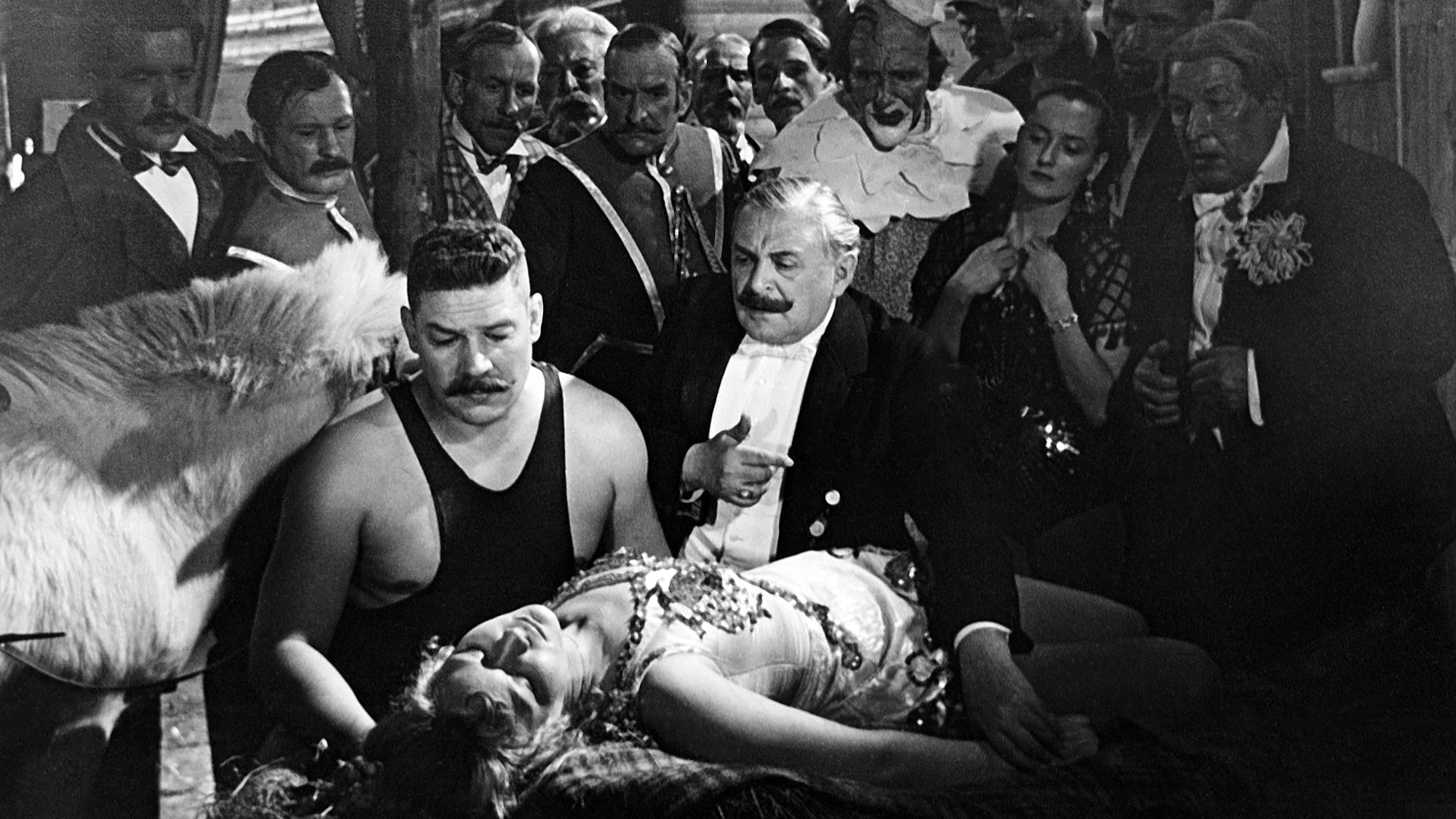
Borets i kloun’s heroes are two historical figures: Ivan Poddubny, the most illustrious Russian wrestling champion, and Anatoli Durov, founder of a circus dynasty. Konstantin Yudin, a talented genre film director, had prepared this tribute to the “old circus” for years. He died suddenly after a few weeks of shooting, and Boris Barnet was asked to step in – which he did in his own way, changing the casting and improvising as much as he was allowed to. The film bears the name of both directors. Barnet told Georges Sadoul that it had become one of his favourites.
Indeed, he made this picture-book of times gone by into one of his most spirited films in the shooting and editing process, playing on the qualities and shortcomings of the Sovcolor process, and remembering his own short-lived career in the boxing ring.
The story unfolds over many years, with no concern for symmetry or clarity: Esterina, the circus owner’s daughter, who runs off with her lover, reappears later sans fiancé, now a mischievous Parisienne, against all logic: clearly two roles have been merged to favour Kiunna Ignatova, who had been Barnet’s heroine in Lyana (1955). The more subtle of the two heroes is not the young lead, but the colossal Poddubny (Stanislav Chekan, Yudin’s inspired casting), in the same reversal as in By the Bluest of Seas (Barnet was to give Chekan a short, impressive scene in Annushka).
Passions and friendships are sudden and lasting. Deaths occur unannounced: the trapeze artist Mimi, Poddubny’s love, who wanted to be lighter than air, is defeated by gravity. Here Barnet remembers D.W. Griffith, whom he studied under Kuleshov’s teaching. Godard couldn’t know how right he was when he wrote in 1959 that “the famous Triangle style, more than in Allan Dwan or Raoul Walsh, is to be found in Boris Barnet’s work today”.
Adapted from Bernard Eisenschitz, Boris Vassilievitch Barnet, Editions de l’Œil, Paris 2024

unique print in Sovcolor (Soviet Technicolor) preserved by La Cinémathèque française.
It’s no mystery that the 1950s were a difficult time for Barnet, struggling with doubts, with the fear of being left on the outskirts of production and with films destined to little success. Nevertheless, Borec i kloun is a high moment of this period. The film was begun by Konstantin Judin and, according to his own wishes, completed by Barnet after Judin’s death. The screenplay V starom cirke [In the Old Circus], written in ’53, told the story of a friendship between the famous wrestler Ivan Poddubnyj and the clown Anatolij Durov, known for his satirical performances. Barnet remained faithful to the linear narrative style of his colleague and friend, leaving unchanged the original idea of an adaptation capturing the atmosphere of the circus at the end of the 1800s and beginning of the 1900s and the inner development of the protagonists observed behind the scenes. As proof of the human sensitivity and mutual esteem that bound the two filmmakers, the film’s tone maintains its consistency, perfectly balancing comedy and melancholic lyricism, while the conflict between athletes of different nationalities is unfettered by Stalinist rhetoric due to the new political trend and reacquires its competitive spirit.
The sophisticated style of Borec i kloun charmed Godard, who defined it “a very entertaining comic work” and observed its strong connections with classic Hollywood films.