[MOVIE]
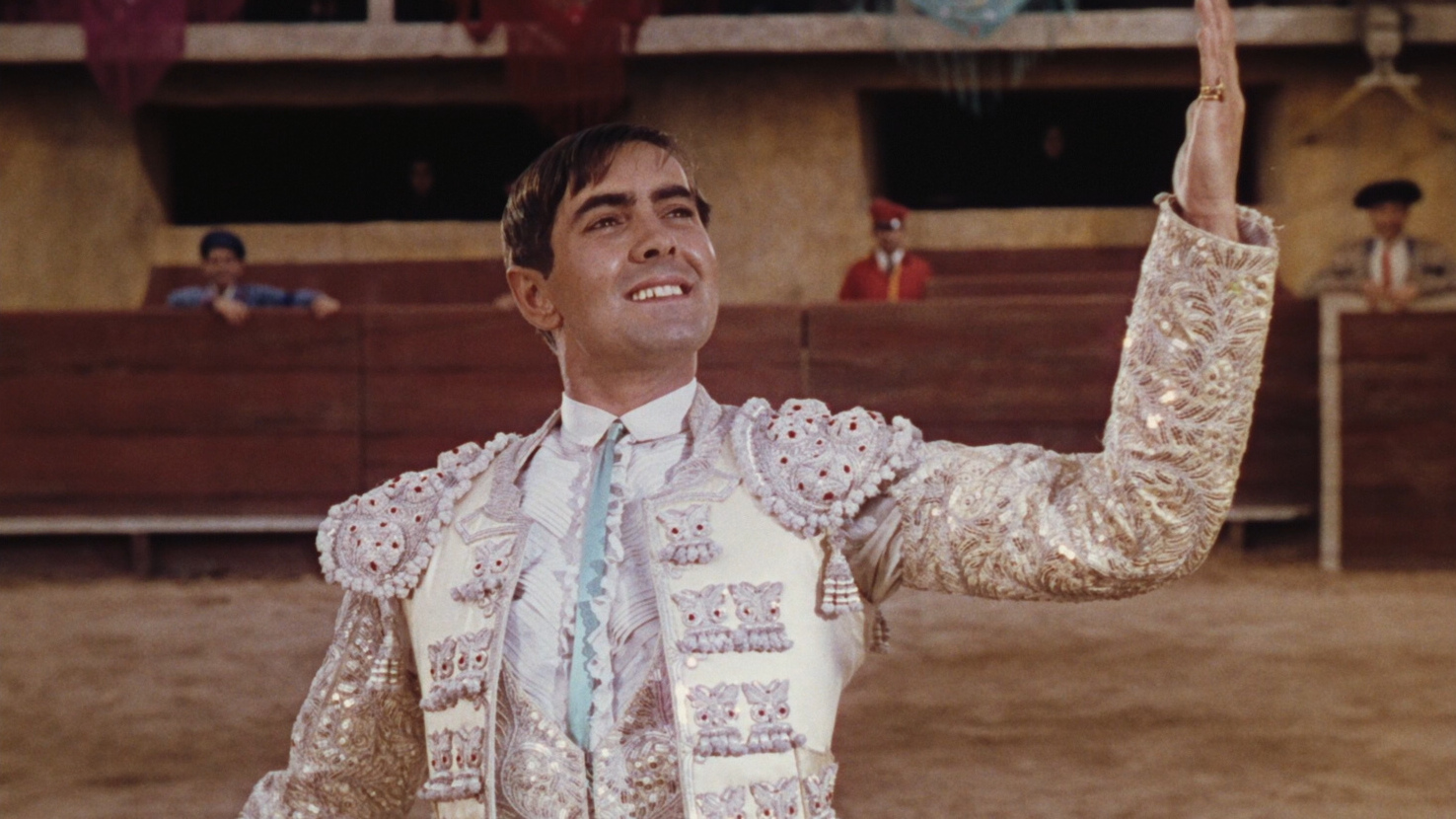
Sog.: from the novel Sangre y arena (1908) by Vicente Blasco Ibáñez. Scen.: Jo Swerling. F.: Ernest Palmer, Ray Rennahan. M.: Robert Bischoff. Scgf.: Richard Day, Joseph C. Wright. Mus.: Alfred Newman. Consulente tecnico: Budd Boetticher. Int.: Tyrone Power (Juan), Linda Darnell (Carmen Espinosa), Rita Hayworth (Doña Sol), Alla Nazimova (Señora Augustias), Anthony Quinn (Manolo de Palma), J. Carrol Naish (Garabato), John Carradine (Nacional), Lynn Bari (Encarnacion), Laird Cregar (Natalio Curro), William Montague [Monty Banks] (Antonio Lopez). Prod.: Darryl F. Zanuck per Twentieth Century-Fox. 35mm. D.: 125’. Col.
A masterpiece about dream and downfall, Blood and Sand is a tragedy told in light and colour. This is Mamoulian’s ultimate “painting film”, the result of laborious study into the work of Spanish masters such as Goya, Velázquez and El Greco, translated into tableaux of desire, seduction and death with the help of cinematographers Ernest Palmer and Ray Rennahan who won an Oscar for their Technicolor work. Colours abound, yet it is still the darkness of the corridors, contrasted against the sun-drenched and sweltering Seville, and shadows that loom larger than the figures who cast them, that dominate.
A half-starving and illiterate yet ambitious Juan (played as an adult by Tyrone Power) dreams of becoming a matador. Driven by his obsession, he grows up fast and rough, making the big time, only to lose everything he has gained – including his wife – after being seduced by a vamp named Doña Sol (Rita Hayworth). The 1908 book by Vicente Blasco Ibáñez, upon which this and the famous silent version starring Rudolph Valentino were based, is an anti-bullfighting statement. Mamoulian retains that critique but mainly depicts bullfighting as a violent type of job in much the same way he treated prize fighting two years earlier in Golden Boy. Even the hysterical shots of blood-hungry spectators are transposed directly from the previous film. Hunger is the main motif, hunger as in needing to eat and hunger as the destructive urge to become somebody.
Bullfighting scenes (the most impressive of them in a ranch when a young Juan runs bare-chested in front of the bull) are nearly silent and impressively authentic. Yet, Mamoulian largely refuses to show the fights and captures snippets of them only for dramatic purposes. Mexico City’s Plaza de Toros stood in for Spain and Budd Boetticher served as the technical advisor. No slaughter of bulls is shown. Instead an overexcited spectator’s dark red wine pours down the edge of the ring stand. The strange serenity of the film’s depiction of violence is accompanied by religious iconography, which foretells death in the afternoon.
Ehsan Khoshbakht
Colour cinematography tends to brighten and cheapen natural colour. The problem was to counteract that. I realised that colour in films is nearer to painting than to the stage. Now if you look, for instance, at a crimson cloak painted by El Greco, you’ll find that what first appears as a mass of colour is in fact a subtle blending of all sorts of shades, with patches of pink and blue and purple and green. So I treated the colour the way a painter would. I devised what came to be known as the Mamoulian Palette. Beside me on the set I had a huge box of scraps of material – scarves and handkerchiefs and so on, in all colours – so that if a costume or a set needed a bit more of a particular colour – a colour accent, as it were – I could put it in myself. And I had a collection of spray guns beside me, so that I could spray colour on a costume or set or even an actor. The art director had made me a beautiful chapel; and he was very upset when I sprayed everything with green and grey paint. Then again, there’s a banquet, which was done entirely in black and white. There were flowers on the table and (naturally) the leaves were green. I think when they saw me painting them black, they went and told Mr Zanuck I’d gone out of my mind.
Rouben Mamoulian, interview by David Robinson, “Sight & Sound”, no. 3, Summer 1961

courtesy of Park Circus.