[MOVIE]
Edition History
Director Josef von Sternberg once again shows Marlene Dietrich as a femme fatale in the nightclub milieu, but also as a wife and caring mother. German cabaret singer Helen Faraday returns to her old profession in order to finance treatment for her sick American husband (Herbert Marshall). The millionaire and playboy Nick Townsend (Cary Grant) sees her perform and falls in love with her. Helen begins an affair with him and is thus able to secure her husband’s medical care. But this only seems to solve all her problems.
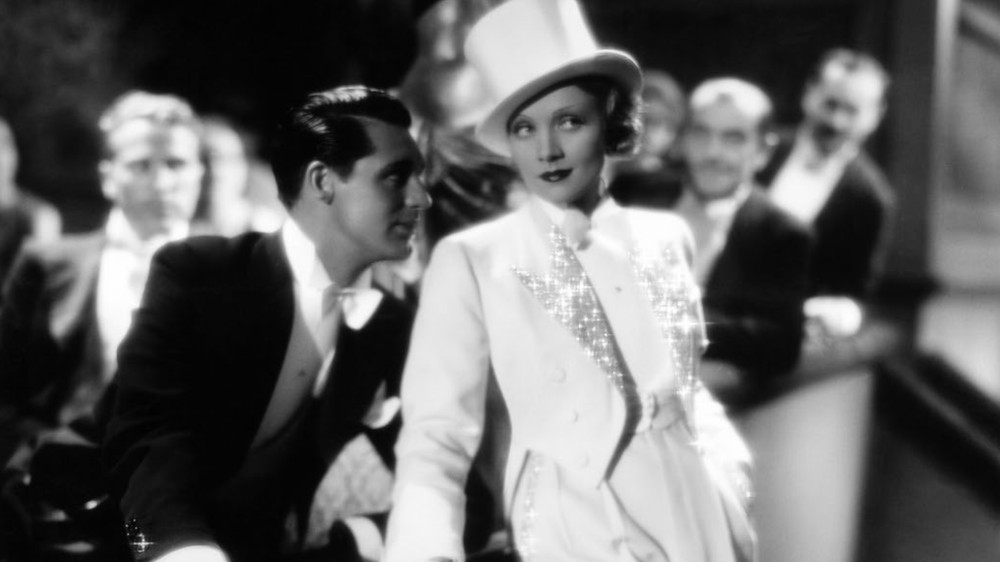
The film features cross-dressing with Dietrich in a white tuxedo and top hat, and spectacular song-and dance interludes – some of which are racist, such as the number Hot Voodoo in which Dietrich, surrounded by stereotypical African dancers, frees herself from a gorilla costume and transforms into a white beauty. Because it contained allusions to the desperate economic situation of many families during the Depression, the script was changed several times during filming, causing a conflict between director von Sternberg and Paramount. In America, the film received a lot of criticism, while it was celebrated abroad. Manfred Georg wrote on 19 November 1932 in the newspaper “Tempo” about Dietrich’s performance: “She goes through this film as mother, lover, wife, prostitute and yet these are not stations, but always just the one woman who holds all possibilities within herself; only that life shines on her sometimes like this, sometimes like that. The great truth of the eternal changeability of women has become a wonderful, visible example in Marlene Dietrich – that is the secret of her great attraction, confirmed once again this evening.”
Peter Mänz

Courtesy of Park Circus
Sternberg combines brilliant visual and sound design, orchestrating his actors through extreme changes in milieu. This cinematic design sense helps deflect attention from the morality-defying story of a woman who saves the husband she loves by selling herself to a man she falls in love with too, never denying that she loves both of them. At once a “fallen woman” story of mother- love-on-the-run, because Dietrich has to flee to keep her child from being taken away from her by her vindictive husband, it is also a quintessentially rags-to-riches story, Helen Faraday’s rise out of pure willpower from ashes to international stardom – her name lights up the paris skies – and a reason to find Dietrich in magnificent costumes as she performs for us again. No one could forget her politically incorrect hot voodoo number. How many ways could Sternberg switch types of story, zigzag back and forth between Europe and America, even moving into the deep south, and portray a sex symbol whose most important love, and heartbreak, is a little boy?