[MOVIE]
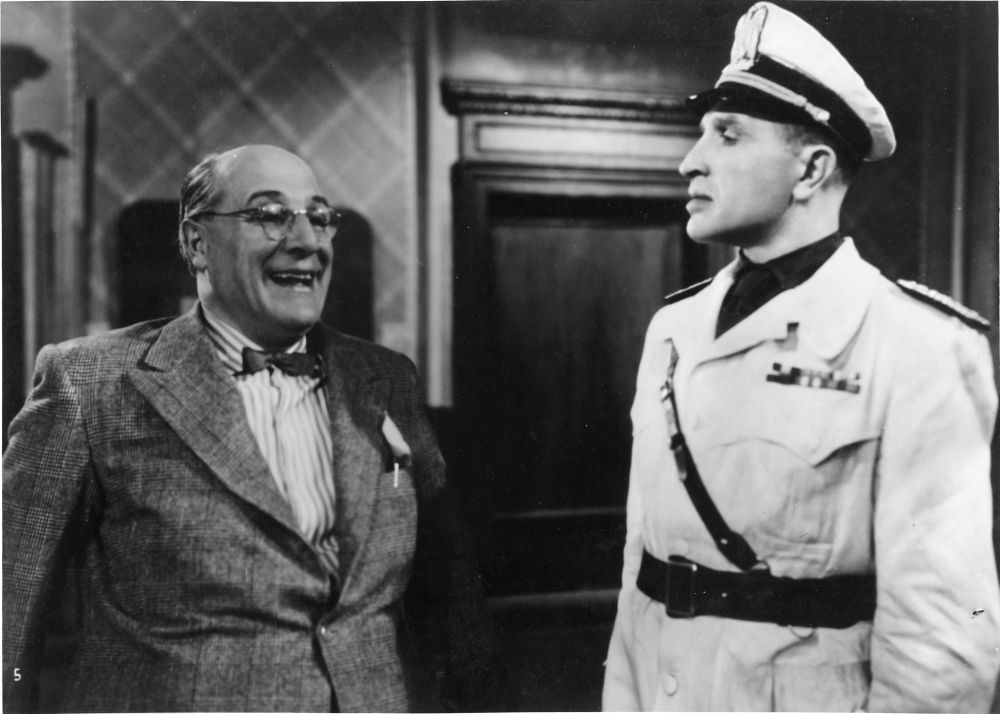
Sog.: da Il vecchio con gli stivali di Vitaliano Brancati; Scen.: Vitaliano Brancati, Luigi Zampa, Sergio Amidei, Enrico Fulchignoni, Franco Evangelisti; F.: Carlo Montuori; Mo.: Eraldo da Roma; Mu.: Franco Casavola, Nino Rota; Scgf.: Ivo Battelli; Co.: Giuliana Bagno; Int.: Umberto Spadaro (Aldo Piscitello), Massimo Girotti (Giovanni), Ave Ninchi (Rosina), Enzo Biliotti (il barone), Giovanni Grasso, Aldo Silvani (il farmacista), Odette Bedogni [Delia Scala] (Elena), Olinto Cristina, Loris Gizzi (il ministro fascista), Ernesto Almirante (nonno), Carletto Esposito (Riccardo), Milly Vitale (Maria), Raniero De Cenzo, Ermanno Randi, Bruno e Vittorio Di Stefano, Gabriele Tinti, Natale Cirino, Giuseppe Nicolosi, Agostino Salvietti; Prod.: Domenico Farzari per la Briguglio Film; Pri. pro.: 9 settembre 1948 35mm. D.: 113’. Bn.
Edition History
“Being able to laugh at one’s own faults is the greatest virtue of a civilized people” says the opening sign. But in 1948 not everyone was willing to laugh with civility. At the first meeting between Zampa and Brancati, they adapted a story by the Sicilian writer that told the paradoxical parable of an unlucky man (Spadaro) forced at first to join the fascist party and later hounded by who had really been a fascist but stayed in power under the Italian republic.
It was the first time in the post-war period that there were discussions about “trasformismo, rampant immorality at every level of society, impossibility for a common man to live and be honest” (Brunetta). Zampa and Brancati have a secular, disenchanted, bitterly ironic point of view. Perhaps this was the birth of Italian-style comedy.
At first the censorship board did not claim any responsibility (“Since the content of the film seemed offensive to the Italian people, the Commission made no decision regarding it”). The film was released by Andreotti as undersecretary to the President of the Council of Ministers with special powers regarding performing arts (Brancati would speak negatively about the reasons of such a generous gesture). There were later parliamentary interpellations for the destruction of a film that was “considered a national shame” (Zampa). And on the left, things didn’t go much better: Ugo Casiraghi in “l’Unità” wrote that Zampa equated fascism with antifascism. Italo Calvino tried to defend it in the Milan edition of L’Unità: the article was never published. Today, thanks to scholars like Tatti Sanguineti and Goffredo Fo , the film has finally received the respect and status it deserves.

Restored in 2008 by L’Immagine Ritrovata Laboratory from an original nitrate positive print preserved by Fondazione Cineteca Italiana and from dupe safety preserved by the British Film Institute.
Il vecchio con gli stivali appeared in 1944 in the magazine “Aretusa” while the North was still under the Germans and the new fascist leaders, who would encounter death in the summer of 1945, were still alive. The screenplay enriched the story with characters and episodes; with the son who is sent to fight in various battles and dies in ’43 in view of his own house, there is an almost tragic element. Piscitello’s daughter is a Dannuzian based on a female character of another story of mine, Singolare avventura di Francesco Maria. At the same time, the comedy of manners, which is basically what the history of the last twenty years consists in, at least in my opinion, is more picturesque.
In adapting it to film, I worked assiduously with the extraordinary screenwriter Sergio Amidei. Zampa was quite lucky, if we can call luck the occasions obtained by one’s own genius: a powerful leading actor, Umberto Spadaro, whose better qualities were unknown until then, and a beautiful city, Modica, in addition to an infinite number of other actors, including Girotti, Ninchi, Giovanni Grasso, and many private citizens brilliantly transformed into provincial party secretaries, inspectors, spies, etc. But again his main fortune is what has always been with him: his own ingeniousness. I hope the comedy of manners is not viewed as an indictment against Italians, rather as a shared confession, because I too played a part in that comedy… Laughing at one’s own faults is the finest virtue of a civilized people; and that is not all: the clearest sign of the civilization of a people is the fact that they do not leave the priority of exposing their own defects to others. No one laughs at a person or a people who know how to laugh about themselves. When fascism wanted to point the finger at England, it found nothing better than quoting the allegations of English writers: and they did not realize that, by quoting those writers, they drew more attention to the frankness and courage of self-criticism than to the faults criticized. And so the weapon, used by a foreigner, turns against the person who uses it.
Vitaliano Brancati, Almanacco del cinema italiano, 1948
Restored in 2008 by L’Immagine Ritrovata Laboratory from an original nitrate positive print preserved by Fondazione Cineteca Italiana and from dupe safety preserved by the British Film Institute. For the sound restoration, safety print from Cinémathèque Suisse was used together with the print from Milan.