[MOVIE]
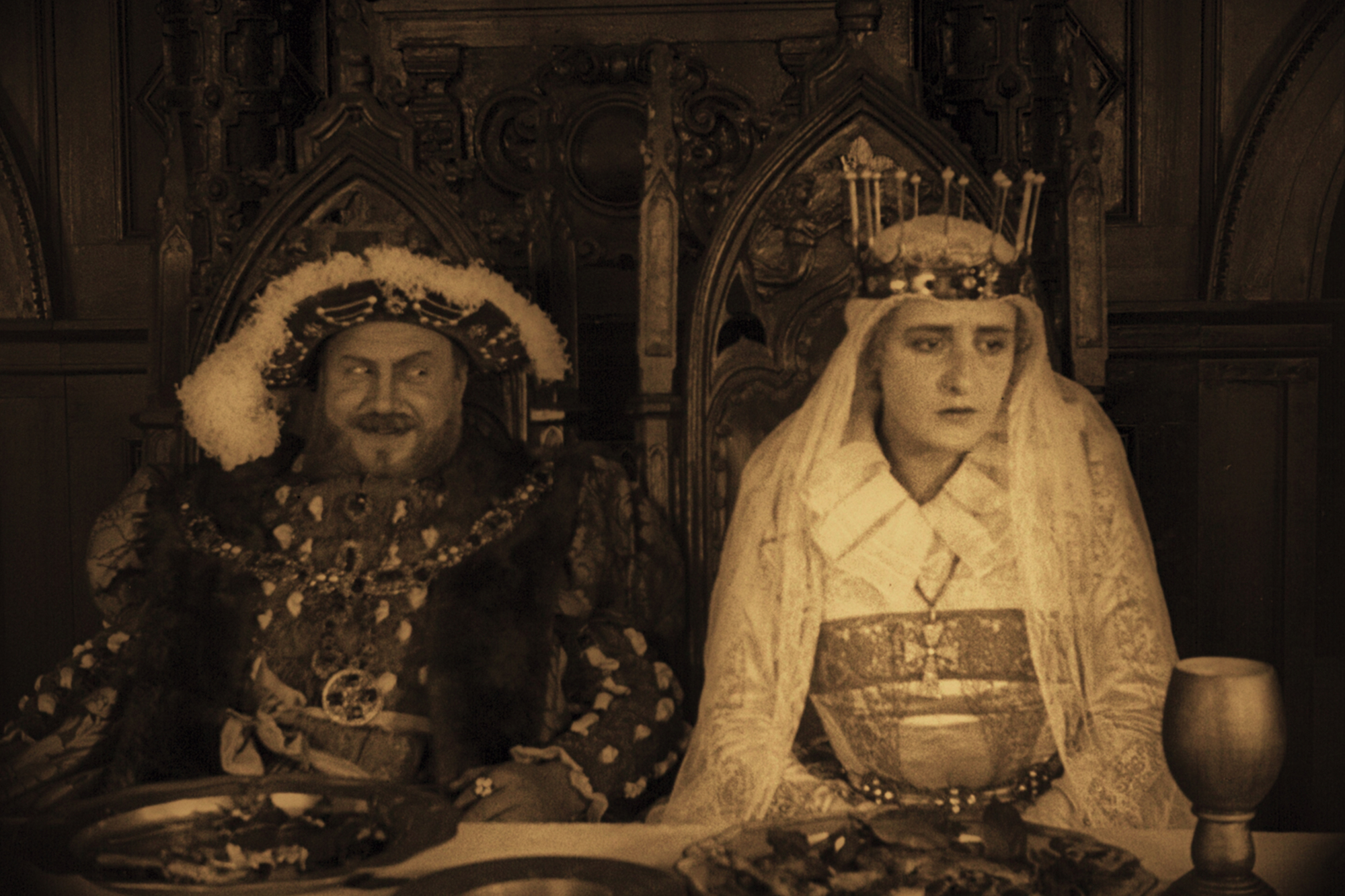
Scen.: Hans Kraly, Fred Orbing [Norbert Falk]. Scgf.: Kurt Richter. F.: Theodor Sparkuhl. Int.: Henny Porten (Anna Bolena), Emil Jannings (Enrico VIII), Hedwig Pauly (regina Caterina), Hilde Muller (principessa Maria), Ludwig Hartau (conte di Norfolk), Aud Egede-Nissen (Jane Seymour), Ferdinand von Alten (Marc Smeton), Paul Hartmann (cavaliere Heinrich Norris), Maria Reisenhofer (lady Rochford), Adolf Klein (cardinale Wolsey). Prod.: Messter-Film GmbH, Projektions-AG Union. 35mm. L.: 2690 m. D.: 118’ a 20 f/s. Col. (a partire da una copia nitrato imbibita e virata).
Edition History
Around 1920 Lubitsch reached the first highpoint of his career. He tried his hand at several different genres turning each work into a unique achievement, and a success. He made a series of delightful comedies, and great costume dramas. Nobody in the German cinema could hold a candle to him. Like many costume dramas, Anna Boleyn was the product of huge effort and expense, which was detailed and used in the film’s publicity. According to the magazine “Lichtbild-Buhne”, 500 horses and 4,000 extras were used for the tournament scene, 380 sculptures were modelled for the set of Westminster Abbey and a host of seamstresses were working on the costumes. The reviewer of “Das Tage-Buch” was so impressed by this monumental expenditure that he stated: “I always have the feeling, with Reinhardt as with Lubitsch, that now in theatre and cinema we are reaping the fruits of the old militaristic era. Such mass scenes can only be carried out so well with a people trained in drills”. In addition to this abstruse theory, however, the critic also noted that Lubitsch’s talent lay not only in directing masses of extras like a general, but also in directing the actors in individual scenes. Indeed, the acting in the individual scenes is brilliant throughout. An outstanding cast was put together for this work, allegedly the most expensive German feature film to date at the time. First and foremost, of course, Henny Porten as Anna Boleyn, a woman who tries to assert herself in a man’s world determined by power strategies and egoism. She is doomed to become a victim to male narcissism and injured pride. The plot of the initially cheerful film darkens as the action inexorably progresses with an intensity that is still shocking today. Despite their clear functionality in a dramatic plot, the characters in Anna Boleyn are drawn with a humanity and complexity that only exceptional actors can achieve, under the guidance of an extraordinary director such as Lubitsch. For example, when Henry VIII (Emil Jannings), a man of blind violence, sheds tears of pain and grief because he is not given a male heir to the throne, one can feel how Lubitsch succeeds in conveying humanity in all its tragic forms.
Karl Wratschko

The reconstruction happened in 1998 in cooperation between Deutsches Filminstitut – DIF, Bundesarchive-Filmarchive and Friedrich-Wilhelm-Murnau-Stiftung and at last with Fondazione Cineteca Italiana Milano, who provided the tinted and toned nitrate print.
The reconstruction had been made from an original nitrate negative of Bundesarchive-Filmarchive, which seemed to be a second choice re-rut negative, produced using original camera negative and dupe negatives of the time. Unfortunately reel 6 was missing, so that a later produced dupe negative/acetate needed to be used.
After we finished the reconstruction of the film, what means producing a b&w dupe negative, we had provided with the tinted and toned nitrate print of Fondazione Cineteca Italiana in order to produce tinted and toned prints by using Desmetcolor System. All laboratory work had been done by L’Immagine Ritrovata, Bologna. Work on intertitles had been done by Optronic Potsdam.
Paul Eipper visited the set of Anna Boleyn with painter Lovis Corinth. We cite his impressions from Ateliergespräche mit Liebermann und Corinth (München 1971):
“The knight is Paul Hartmann, the woman beside him Henny Porten. In front of the couple Ernst Lubitsch, seated on a crude stool in shirt sleeves, directs the scene. That is he shouts, screaming at the actors in such a way that they, intimidated, follow exactly his orders. As if the laments of the violin was not enough. ‘Stop!’ orders the director. The cameraman halts, the assistant cameraman of the second unit does the same, the lighting technician extinguishes the reflectors, the violin stops playing, from the piano a final note arrives and the harmonium falls silent. But already, without lowering his voice, Lubitsch orders: ‘Let’s take it from the top!’. Above Henny Porten’s head, three or four Jupiter reflectors light up, there are two of them on either side of the actress, and two more at the height of her eyeline. The bluish light, crackling, suffuses the unnaturally made-up faces of the actors, the music starts agian, Lubitsch orders ‘Silence!’, and again he begins to shout: ‘Hartmann, clutch her arm higher up, tighter, Porten, turn away! Hartmann seize her! Convince her! Insist with words! Hold her tight! Porten, back with your head! He tells you something, it pleases you, you push him away, Hartmann, hold her tight, tighter! You love her, you tremble, your mouth whispers, Porten, you are frightened! Now Hartmann, kneel! – Good! Lights off!’. The music stops and the director opens another button of his shirt”. (Enno Patalas, Hans Helmut Prinzler, Ernst Lubitsch, 1984)