[MOVIE]
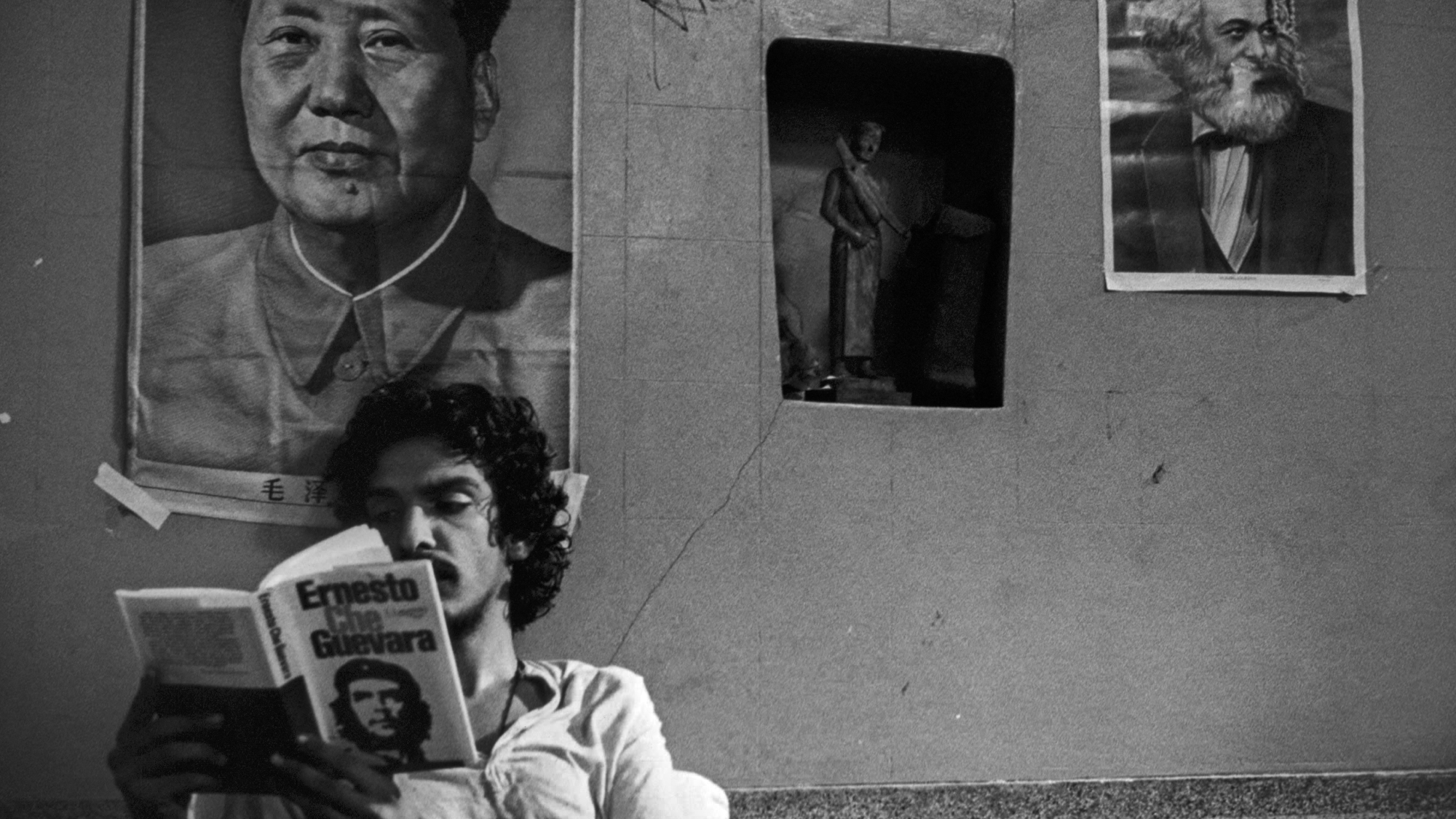
Scen.: John Abraham F.: Venu. M.: Bina Paul. Mus.: Sunitha. Scgf.: Ramesh. Int.: Joy Mathew (Purushan), Kunhilakshmi Amma (la madre di Purushan), Harinarayanan (Hari), Maji Venkatesh (Paru), Nilambur Balan, Itingal Narayani, Nazim, Ramachandran Mokeri, Naseem, Venu K. Menon. Prod.: Odessa Movies.
Edition History
Amma Ariyan was filmmaker John Abraham’s final work before his untimely death in 1987. It is a film that details the history of revolutionary politics in Kerala through the prism of the road movie, adopting an iconoclastic structure in which flashbacks, ellipses and inserts punctuate the narrative with personal and historical reports on social resistance and political disillusionment, including the militant labour riots of Cochin in 1953. Indian Parallel Cinema was in many ways the first true de-colonial filmmaking practice to emerge out of India after independence and a political work such as Amma Ariyan was very much part of a broader collective revisionism taking place at the time. John Abraham captures a time of crisis and upheaval where resistance seems to be everywhere and comes most readily from a Keralan youth galvanised by the impact of the Naxalite Movement in the late 1960s, a peasant insurgency that had widespread political implications for the establishment and Leftist political thought in India. Abraham’s critique of orthodox structures in Indian society – including caste, religion, and the arts – was shaped by the cinema of Ritwik Ghatak, his teacher and perhaps his greatest influence. While many Parallel Cinema filmmakers have been compared to Ghatak, and directors such as Mani Kaul and Kumar Shahani drew on his fractured, melodramatic style, it is Abraham’s films that most clearly distil a sense of political revolt and critique of a corrupt system that persisted after independence. Another way to understand the film is through the persistence of trauma, which Abraham presents as a multilateral rather than singular phenomenon. He situates the Marxist political histories of Kerala within an ongoing historical trauma that has shaped working-class lives in violent and debilitating ways, while also reflecting on the aftermath of revolution and state repression. What emerges from the narrative’s reports is an open wound – an irreparable rupture that remains in contest.
Omar Ahmed

Restored by Film Heritage Foundation at L’Immagine Ritrovata laboratory in association with Odessa Collective. The 4K restoration used one of the only two surviving prints, a first-generation 35mm release print preserved at NFDC – National Film Archive of India. Funding provided by Film Heritage Foundation.
In Malayalam cinema, the growth of film cooperatives, notably Chitralekha in Kerala, led to a new generation of filmmakers who opted for low budgets and location shooting. Amma Ariyan is situated among the second wave of Malayalam cinema and is undoubtedly one of the most accomplished and complex political films to have come out of Parallel Cinema. The story of Amma Ariyan is set against the backdrop of Kerala, in which the legacy of the Naxalite movement looms large, and unfolds at a time when the cost of political extremism was being reassessed by the youth from a critical perspective. One such youth is Purushan (Joy Mathew), a bearded, introspective cipher. Purushan is on his way to Delhi when he sees the dead body of Hari, a tabla player and Naxalite activist. Thus begins Purushan’s journey to inform Hari’s mother of her son’s death. The loose narrative is structured as a series of reports delivered from the perspective of characters that Purushan encounters along his journey.
Director John Abraham only made four films before he died in 1987. Hailing from a middle-class orthodox family, Abraham started watching films at the age of 15. Joining the Pune Film Institute in 1965, Abraham would later assist Mani Kaul on Uski Roti (1969), a seminal experience. Perhaps Abraham’s major achievement was not his films but the Odessa Movies collective, which he helped to form in 1984 as a way of working in parallel to the mainstream. In fact, the budget for Amma Ariyan was raised through the 16mm films that Odessa distributed, collecting ten rupees a time from viewers. The international influences on the film, expressly Third Cinema, are markedly evident in the astounding handheld, reportage camerawork that recalls Kalatozov’s Soy Cuba (I’m Cuba, 1964). Ultimately, Amma Ariyan comes together as an unofficial historical record of resistance, injustice and dissent, while the potent Jungian symbolism of the mother provides a link to Ritwik Ghatak’s iconoclastic work.
Omar Ahmed