[MOVIE]
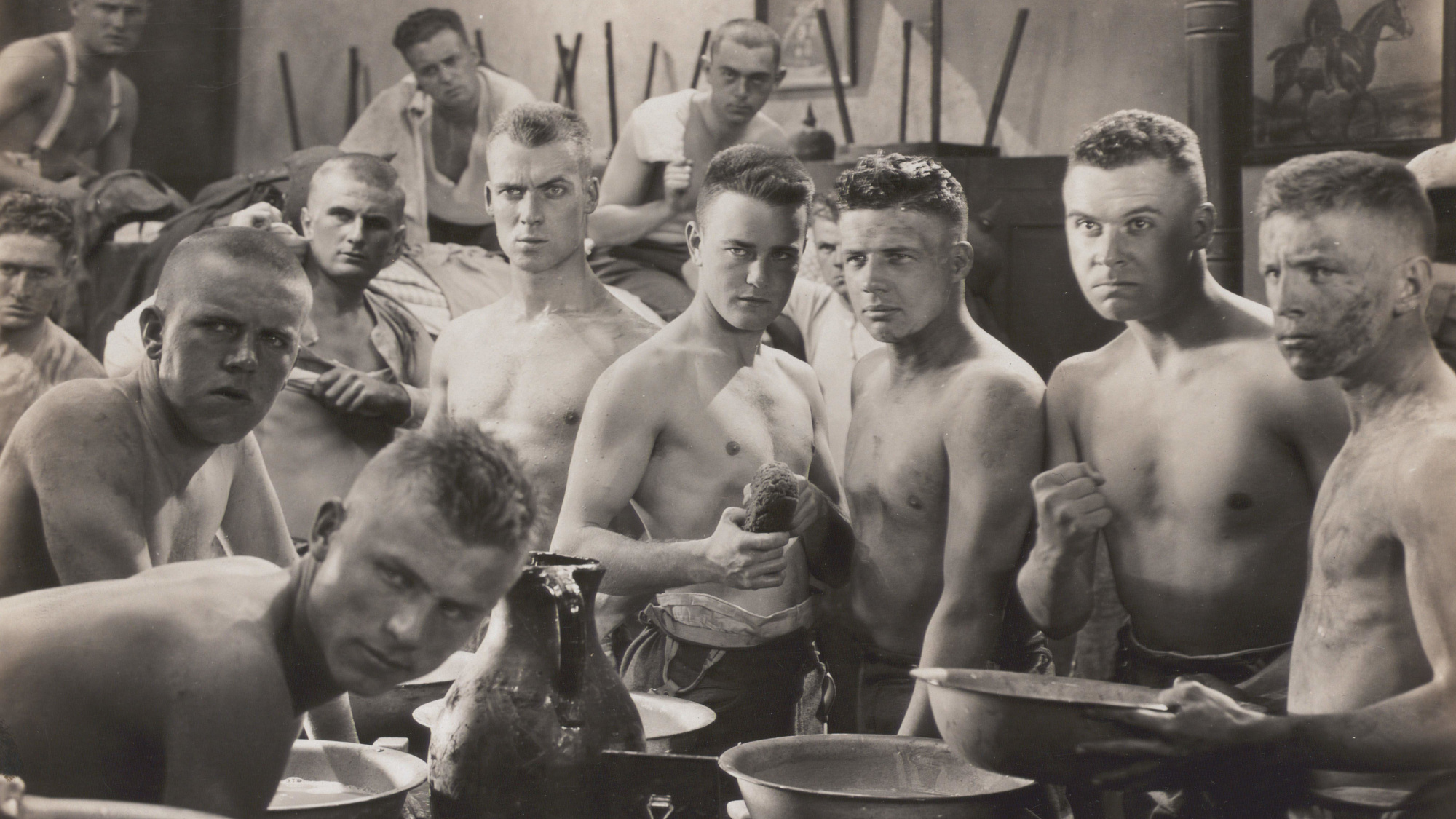
Sog.: from the novel of the same name (1929) by Erich Maria Remarque. Scen.: George Abbott. F.: Arthur Edeson, Karl Freund. M.: Edgar Adams, Milton Carruth. Scgf.: Charles D. Hall, W. R. Schmitt. Mus.: David Broekman. Int.: Louis Wolheim (corporal Stanislaus ‘Kat’ Katczinsky), Lew Ayres (Paul Bäumer), John Wray (Himmelstoss), Arnold Lucy (professor Kantorek), Ben Alexander (Franz Kemmerich), Scott Kolk (Leer), Owen Davis, Jr. (Peter), Walter Browne Rogers (Behn), William Bakewell (Albert Kropp). Prod.: Carl Laemmle per Universal Studios.
Silent version, 35mm. D.: 133’. Bn.
Edition History
Like Orson Welles a decade later, Milestone, from very early on, landed himself in the most precarious position: he made a film instantly dubbed “seminal,” “classic,” and the film to end, if not all wars, then all films. As is often the case with retrospective viewing of such works, one tends to seek faults to counter those historic claims. Yet, 95 years on, there are very few weak links in All Quiet on the Western Front. For clarity, it is indeed a “masterpiece,” but more importantly, it is a guidebook to Milestone’s mise-en-scène.
Based on German author Erich Maria Remarque’s best-selling novel about a group of credulous German boys recruited as soldiers during World War I, the film is a descent into a hellscape of mud and barbed wire where whimpering boys are harvested by machine guns, flying debris reaches the lens and silences prove deadlier than the ruckus of barrage. Shot by Arthur Edeson and Karl Freund, the combat scenes feel like documentary footage. Indeed, I’ve lost count of how many documentary and fiction works have used them as stock footage. Milestone slices the screen with lines of marching soldiers and tracking shots over trenches. His window-frame shots are like Bruegel paintings reinterpreted by the Soviet formalist filmmakers of the 1920s.
Visual elements condense the novel into objects, shots, and carefully lit scenes. The ending, involving a butterfly and a reaching hand (Milestone’s own), is improvised and does not belong to the novel. The butterfly, equivalent to the “all quiet” moment in the book, has since become a symbol of the film.
The film was a huge success in many countries except in Germany, where the Berlin screening of an already censored and German-dubbed version was interrupted by the goons of a then little-known Joseph Goebbels. They released mice into the cinema and detonated stink bombs, unwittingly convincing attendees that the horrors of the trenches were all too real. That violence spread across other parts of Germany, and the film was banned until 1952. In the meantime, World War II happened.
Ehsan Khoshbakht

By courtesy of Universal Pictures and Park Circus.
Restored by Library of Congress.
Andrew Kelly, in his article All Quiet on the Western Front: “brutal cutting, stupid censors and bigoted politicos”(1930-1984) (Historical Journal of Film, Radio and Television, n. 2, 1999), examines good part of the troubled history of Milestone’s film. Despite being mutilated by the censors of different countries, in certain cases banned for many years, re-edited to different lengths in 1939 and in 1950 and finally recomposed in 1984 for ZDF Television, All Quiet on the Western Front remains one of the most famous films about the First World War. Little is said of the silent version that Milestone shot at the same time as the sound version. The version that Milestone had delivered to Universal consisted of 17 reels. Universal cut them down to 14 for the sound version. Milton Carruth, Milestone’s assistant, was given the job of editing the silent version. This version was truer to Milestone’s original idea, with more fluid camera movements and the inclusion of many shots that were discarded from the sound version. Andrew Kelly continues: “This version was also known as the European Version as it was released in Spain and France prior to the arrival of the sound version. A copy of the silent film still exists apparently; Universal in California is reputed to have a print and there is a private collector in Amsterdam who possesses a copy but it is unlikely it will ever be seen publicly”.
Fortunately Kelly’s prophecy was not fulfilled.
Print restored in 2003 from a nitrate lavander. Silent version with synchronised music